Beyond My Ken, CC BY-SA 4.0, via Wikimedia Commons
Imagine checking into a hotel in Upstate New York and discovering that your room is inside a building where National Guard soldiers once trained. Or finding out that the restaurant where you are eating dinner used to be an elementary school gymnasium. There is even a hotel in Cooperstown where local farmers once went to buy feed and other agricultural supplies.
Some of the most interesting hotels in New York State were never designed to accommodate tourists. They were factories, schools, religious institutions, banks, private homes and other buildings that served the communities around them. When their original occupants moved on, the buildings themselves proved too interesting or too useful to abandon.
What makes these places especially fascinating is that you can still see evidence of their former lives. A bank vault has become a hotel reception area, an old factory overlooks the waterfall that once helped power its machinery, and a former girls’ school dormitory welcomes an entirely different generation of overnight guests. The architecture is often only the beginning of the story.
Here are 25 hotels, inns and resorts across Upstate New York that occupy buildings originally used for something other than public lodging. In several cases, the hotel also includes newer guest rooms, so travelers who want to experience the historic building itself should pay attention to which accommodations they reserve. These properties are not ranked.
1. Amsterdam Castle – Amsterdam
County: Montgomery
Former life: New York National Guard armory
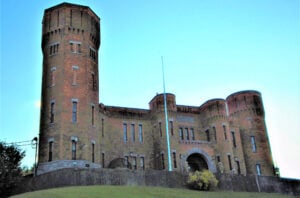
The imposing brick castle overlooking Amsterdam’s South Side was not built for royalty. It was constructed in 1895 for the 46th Separate Company of the New York National Guard. Its architect, Isaac G. Perry, designed numerous armories across the state and gave this one the towers, battlements and fortress-like entrance associated with late Victorian military architecture. Behind the decorative exterior was a substantial drill hall where soldiers could assemble and train.
The building housed military units for roughly a century before the state retired it in the 1990s. After passing into private ownership, it underwent renovations that ultimately produced Amsterdam Castle, a boutique hotel. The enormous interior hall, brick towers and original military architecture give visitors an idea of the scale of the former armory. What looks from a distance like a medieval castle is actually a surviving piece of New York’s military history.
2. The Richardson Hotel – Buffalo
County: Erie
Former life: State psychiatric hospital
Few hotels in America occupy a building with an architectural pedigree quite like this one. Henry Hobson Richardson designed the Buffalo State Asylum for the Insane, as it was historically called, while Frederick Law Olmsted and Calvert Vaux planned its grounds. The hospital began receiving patients in 1880. Its layout reflected the ideas of physician Thomas Story Kirkbride, who advocated generous light, ventilation and access to landscaped surroundings as part of psychiatric care.
As treatment practices changed, the historic wards were gradually vacated, with the last patients leaving those buildings by 1974. The complex deteriorated before a major preservation campaign made rehabilitation possible. Hotel Henry opened in the restored central buildings in 2017 but closed in 2021. The Richardson Hotel reopened there in 2023. Guests occupy part of a much larger historic campus, whose broad corridors, towering stone exterior and grounds still reflect the hospital’s original design. The transformation saved an extraordinary work of American architecture without erasing its difficult and important medical history.
3. Hotel Skyler – Syracuse
County: Onondaga
Former life: Synagogue and performing arts center
Anyone approaching Hotel Skyler at 601 South Crouse Avenue might reasonably wonder why a hotel has such a magnificent classical entrance. The building was completed in 1921 for Temple Adath Yeshurun, a Syracuse Jewish congregation. Its prominent columns and symmetrical facade were designed by architect Gordon A. Wright. For decades, families gathered here for religious services and community occasions.
After the congregation moved to a new home, the building became associated with the Salt City Center for the Performing Arts, where local actors and musicians entertained audiences for many years. The hotel conversion opened in 2011, creating guest rooms within the former religious and theatrical space. Syracuse University purchased the property in 2024 while retaining its hotel operations. The next time someone checks into Hotel Skyler, they will be entering a building that has already played two entirely different roles in Syracuse’s cultural history.
4. Tailwater Lodge – Altmar
County: Oswego
Former life: Elementary school
For local children, the building on Pulaski Street once meant spelling lessons, school lunches and gym class. Altmar Elementary School closed in 2012 following a reorganization of the school district. Its proximity to the Salmon River, however, made the property unusually attractive to developers interested in the area’s fishing economy. Anglers travel to this part of Oswego County for salmon and steelhead fishing.
Tailwater Lodge opened in 2014, initially offering 42 rooms in the converted school. The developers retained elements of the building rather than starting over. The former gymnasium became the restaurant, with the school’s old athletic floor incorporated into the space. Subsequent expansion added more lodging and recreational facilities. Children who once played basketball inside the school would probably be astonished to see people enjoying dinner in the same room before heading back to their hotel accommodations.
5. The Wick – Hudson
County: Columbia
Former life: Soap, candle and textile factory
The name of The Wick is a clue to the building’s industrial past. Constructed in the 1860s, the former South Bay Mill on Cross Street housed the soap and candle manufacturing operations of Gale & Hover. These were essential household products in an era when electric lighting was still decades away from widespread use. Later in the nineteenth century, the property was adapted for textile manufacturing.
A redevelopment costing approximately $10 million transformed the building into a 55-room hotel, with a formal opening in 2018. The former factory’s timber floors and sections of exposed brick survived the conversion. Hudson’s industrial history is sometimes overshadowed by its better-known antique stores and restaurants, but The Wick preserves a piece of the city where generations of people earned their living making ordinary goods for American households.
6. Hotel Kinsley – Kingston
County: Ulster
Former life: Bank building and historic private residences
Hotel Kinsley is spread among four buildings in Kingston’s historic Stockade District. Its flagship property at 301 Wall Street was once a nineteenth-century bank. Rather than conceal the evidence of its former financial business, the developers incorporated one of its most distinctive features into the hotel: guests check in at a reception desk located inside the former bank vault.
The hotel opened its first building in 2019 and expanded into three nearby properties, including a stone house with origins in the seventeenth century and a cottage dating from before the American Revolution. Together they tell a broader story about the evolution of Kingston’s commercial and residential streets. The hotel conversion made it possible for overnight visitors to experience several different periods of the city’s architecture, all within a short walk of one another.
7. School 31 Lofts – Rochester
County: Monroe
Former life: Public school and later educational and production facilities
Rochester’s former Alexander Hamilton School was constructed in 1919. Located in what is now known as the Neighborhood of the Arts, the building accommodated generations of students before its public school days came to an end. It was acquired in 1980 for a different educational mission, later housing theological instruction and developing space for television production.
School 31 Lofts occupies part of the old building today, offering boutique overnight accommodations. The generously sized rooms, tall ceilings and broad windows reflect the design of the original school rather than that of a conventional hotel. The building’s history makes it an unusual example of adaptive reuse: instead of making a single jump from schoolhouse to lodging, it found new life through several different educational and creative activities before welcoming travelers.
8. The Roundhouse – Beacon
County: Dutchess
Former life: Water-powered manufacturing complex
The industrial buildings that house The Roundhouse stand beside Fishkill Creek, where falling water made manufacturing practical long before electricity became widely available. The property was part of the Matteawan Manufacturing Company’s early nineteenth-century factory complex. Over the years, businesses on the site produced textiles, dyes and equipment, including lawnmowers. The curved walls of the Roundhouse building were part of its industrial design.
After the factories ceased operating and the complex deteriorated, a redevelopment brought lodging, dining and event spaces into the old buildings. Many of their large factory windows and timber structural elements were preserved. The waterfall that once supplied power to local industry is now one of the property’s greatest attractions. It is a remarkable example of a hotel deriving much of its appeal from the very landscape that originally attracted industrial manufacturers.
9. James Newbury Hotel – Coxsackie
County: Greene
Former life: Ironworks and wire and cable manufacturing facilities
Long before visitors arrived to enjoy the Hudson River waterfront, workers at this site were employed in heavy industry. The buildings originated in the early twentieth century as part of the J. G. Newbury Ironworks and later became associated with State Wire and Cable. Their location beside the river reflected the importance of waterfront industry to communities along the Hudson.
After the buildings sat vacant for at least two decades, a redevelopment valued at nearly $11 million transformed the complex into a 47-room hotel and a neighboring event venue called The Wire. The project formally opened in October 2023 with support from New York State. Even the names of the two businesses acknowledge the industrial occupants that preceded them. The old manufacturing site has become part of a new chapter in the economic history of downtown Coxsackie.
10. The Railroad Inn – Cooperstown
County: Otsego
Former life: Agricultural supply and feed store
Cooperstown may be famous for baseball today, but Railroad Avenue developed around businesses that supplied the region’s farmers and transported their products. The building now occupied by The Railroad Inn dates to 1890 and eventually housed an Agway feed store. Farmers came to the area for essential supplies rather than souvenirs from the Baseball Hall of Fame.
In 2016, the former agricultural supply property was acquired for a redevelopment that cost approximately $3 million and created a 22-room boutique hotel. Its railroad-themed accommodations acknowledge the neighborhood’s earlier commercial identity. The transformation is particularly interesting because Agway was once a familiar name in rural communities throughout New York. A building associated with the everyday work of local farmers now welcomes visitors who travel to Cooperstown to celebrate America’s national pastime.
11. The Inn at Stone Mill – Little Falls
County: Herkimer
Former life: Textile mill
The Stone Mill was constructed in 1839 and enlarged in 1845 in what is now Little Falls’ Canal Place historic district. Originally associated with Stitt & Underhill, the building became part of the industrial landscape shaped by the power of the Mohawk River and the transportation advantages of the Erie Canal. According to the inn’s historical account, textile production at the mill supplied cloth during several American wars, from the Mexican-American War through World War II.
Today the nine-room inn occupies the third floor of the historic building. Its guest rooms are named in recognition of the mills and manufacturers that once employed substantial numbers of Little Falls residents. A stay in this building offers an unusually direct connection to the area’s industrial past. The old mill survives beside the waterways that helped make the city a manufacturing center, even though its machinery and workers are long gone.
12. Wallcourt Hall – Aurora
County: Cayuga
Former life: Girls’ school and college dormitory
Wallcourt Hall was built in 1909 to house students of Miss Goldsmith’s School for Girls, a preparatory school run by Wells College graduate Anna Goldsmith Taylor. The name reflected the brick-walled vineyard that previously occupied the site. The school was part of the educational community that developed around Wells College in this small village on Cayuga Lake.
When the school closed in 1928, the building was given to Wells College, which continued using it as student housing until 1974. It also briefly accommodated creative work for MacKenzie-Childs, the distinctive home furnishings business. After years of vacancy, a restoration associated with entrepreneur and Wells graduate Pleasant Rowland brought it back to life in 2016 as one of the Inns of Aurora. The former dormitory is now a boutique hotel, preserving the building that once housed young women pursuing an education.
13. Historic Hotel Broadalbin – Broadalbin
County: Fulton
Former life: Glove and mitten store; later an alcohol treatment institution
The oldest portion of the Historic Hotel Broadalbin was built in 1854 by glove manufacturers James Louis Northrup and J. N. Richards as a store for their products. The distinction matters: the original brick section was a retail outlet, rather than simply the factory sometimes described in accounts of the hotel. An addition constructed in 1881 helped establish the property as an important local lodging and gathering place.
In the 1890s the building experienced a particularly unexpected change of occupation when it became associated with a treatment program for people struggling with alcohol dependence. Such institutions were part of a nationwide movement promoting remedies that were poorly understood and often medically unsound. The hotel subsequently returned to hospitality use. Restored by the Thompson family after their purchase in 2007, it offers lodging and dining in a building that connects Fulton County’s glove-making heritage with a curious episode in American medical history.
14. Curtiss Hotel – Buffalo
County: Erie
Former life: Commercial office building
The ornate Harlow C. Curtiss Building was constructed in 1912–13 at Franklin and West Huron streets. Designed by architect Paul F. Mann, its steel structure and elaborate glazed terra-cotta exterior reflected the prosperity of downtown Buffalo in the early twentieth century. Its tenants included attorneys, commercial businesses and the Kittinger Furniture Company. It was a place to conduct business rather than spend the night.
Like many downtown properties, the building lost tenants as commercial activity shifted elsewhere. It stood vacant before undergoing a substantial restoration that produced the Curtiss Hotel in 2017. The transformation created 68 guest rooms while retaining the distinctive historic facade. Its decorative urns, scrollwork and light-colored terra cotta still distinguish it from surrounding buildings, recalling an era when even an ordinary office building might receive extraordinary architectural attention.
15. The Inn on Broadway – Rochester
County: Monroe
Former life: Private university club
The Georgian Revival building at 26 Broadway was constructed in 1929 for the University Club of Rochester. Architect Leon Stern designed it as a private meeting place for the city’s college-educated professional community. Members enjoyed dining rooms, sitting rooms and other club facilities, with overnight rooms available upstairs for their own use. It was not originally a hotel open to the traveling public.
After financial difficulties led to the club’s demise, the building was converted into the Inn on Broadway in 2000. Its woodwork, fireplaces and other details recall the atmosphere of the old club. A later renovation even uncovered forgotten recreational spaces connected to the property’s former athletic facilities, including an old racquetball court and pool. The building’s history gives it an identity quite different from that of a hotel originally constructed for tourists or business travelers.
16. The Mansion on Delaware Avenue – Buffalo
County: Erie
Former life: Industrialist’s private mansion
Charles F. Sternberg, a wealthy grain elevator proprietor, commissioned this Second Empire mansion in 1869. Its architect, George M. Allison, designed a conspicuous residence with extensive windows, high ceilings and a mansard roof. It was one of the extravagant homes that reflected the fortunes being accumulated in Buffalo through its position as a major center of grain shipping and commerce.
The building subsequently became a hotel under Samuel Curtis Trubee, welcoming visitors around the time of Buffalo’s 1901 Pan-American Exposition. It later housed a restaurant before falling into disuse in the 1970s. A restoration brought it back into hotel service in 2001. Its return to hospitality was actually a revival of one of its earlier occupations, but the great house was originally built to demonstrate the wealth of one private family.
17. InnBuffalo off Elmwood – Buffalo
County: Erie
Former life: Industrialist’s residence and boarding house
Herbert Hills Hewitt, an inventor and industrial executive, commissioned this mansion on Lafayette Avenue in 1898. The architectural firm Lansing & Beierl designed the home with an eclectic combination of woodwork, stained glass and other ornamental features. Its technical innovations were particularly interesting for the period: lighting fixtures could use both electricity and gas, while a sophisticated heating system provided unusual control over the temperature of individual areas.
After the Hewitt family era, the mansion was converted into a boarding house in the 1940s. It remained in that use for decades before being acquired and restored for InnBuffalo, which opened in 2015. Its survival makes it possible to experience a private residence built during Buffalo’s industrial heyday. The elaborate architectural finishes and early household technologies reveal as much about that period’s ambitions as the grand exterior does.
18. Batcheller Mansion Inn – Saratoga Springs
County: Saratoga
Former life: Diplomat’s residence, later a rooming house and business offices
The extraordinary mansion at 20 Circular Street was commissioned in 1873 by George Sherman Batcheller, a lawyer, military officer and politician who subsequently served as an international judge in Egypt and as American minister to Portugal. Designed by Nichols & Halcott, the house combined several Victorian architectural styles, with its tower, mansard roof and elaborate interiors making it unlike almost any other residence in Saratoga Springs.
Batcheller’s diplomatic career kept him abroad for much of his later life. After his daughter sold the house in 1916, the mansion eventually declined into a rooming house and stood in need of major restoration. Later owners repaired it, and for a time it served as both a residence and corporate offices. By the 1990s it had become the Batcheller Mansion Inn. Particularly surprising are the tall windows in its renovated kitchen, salvaged from a Boston bank and installed during an earlier restoration of the house.
19. Hotel Lilien – Tannersville
County: Greene
Former life: Private Catskill Mountains summer estate
In the 1890s, the Manhattan-based Lilienthal family established a country retreat in Tannersville. They called their home Villa Meta after their daughter, who later became a writer and recalled the world of her childhood in the memoir Dear Remembered World. The mansion reflected the growing popularity of the Catskills among prosperous city families seeking an escape from New York’s crowded summer streets.
The estate eventually became an inn, operating in later years under the name Washington Irving Inn. A new ownership group restored and reopened the property as Hotel Lilien in 2022, adopting a name that pays tribute to the original family. The surviving staircase, wood paneling and colorful stained glass remain important parts of the building’s character. Unlike the enormous Catskill resorts built for the vacation trade, this hotel began as one family’s private mountain home.
20. The Maker – Hudson
County: Columbia
Former life: Historic residential and commercial buildings, including a carriage house
The Maker occupies three historic structures on Warren Street: a Georgian mansion, a Greek Revival building and a nineteenth-century carriage house. They were built for a Hudson very different from the present city, when horses and carriages were part of everyday transportation and the streets were lined with homes and businesses tied to the river city’s commercial economy.
Lev Glazman and Alina Roytberg, the founders of the beauty company Fresh, collaborated with Damien Janowicz to turn the properties into an eleven-room hotel that opened in 2020. The renovation joined the buildings while retaining selected fireplaces, wood floors, stained glass and other historic details. The former carriage house now contains a lounge. A space once intended for the practical requirements of horse-drawn travel has become part of a hotel built around design, art and craftsmanship.
21. The Inn at Taughannock Falls – Trumansburg
County: Tompkins
Former life: Private summer estate
John and Amelia Jones of Philadelphia established a country estate overlooking Cayuga Lake, completing their Victorian summer home in 1873. Jones made his fortune in wallpaper manufacturing and had a passion for racehorses. The estate once encompassed approximately 800 acres, including the spectacular Taughannock Falls itself. Imagine owning one of the most celebrated waterfalls in the Finger Lakes as part of your private property.
Much of the estate was sold to New York State in 1925, helping create the state park. The mansion remained in private hands until the 1940s, when Merritt and Maude Agard acquired it and opened Taughannock Farms Inn in 1946. The present inn incorporates the historic home along with other accommodations. Some of the original furnishings and chandeliers remain, while the old estate grounds provide a reminder of the era when a private residence occupied land now enjoyed by the public.
22. Geneva On The Lake – Geneva
County: Ontario
Former life: Private Italian-style villa and Franciscan monastery
Completed in 1914, the villa overlooking Seneca Lake was commissioned by Byron Nester and designed by Lewis Colt Albro and Harrie T. Lindeberg. It drew inspiration from Villa Lancellotti in Frascati, Italy. The formal gardens, marble fireplaces and classical architecture give the building a distinctly European appearance despite its location in the Finger Lakes.
In 1949, Capuchin Franciscan friars acquired the estate and adapted it for religious and educational purposes, adding a chapel, classrooms and dormitory facilities. The friars departed in 1974, leaving the property vacant. A subsequent restoration brought it back into use as a resort in 1981. Guests today occupy a building whose rooms and gardens have served a wealthy private family, a religious community and finally the traveling public. The monastery chapter makes this one of the most unusual hotel conversions in the region.
23. Belhurst Castle – Geneva
County: Ontario
Former life: Private mansion, later dining and gambling establishment
The stone mansion known as Belhurst Castle was built in the late 1880s for Carrie Collins on a property overlooking Seneca Lake. Its imposing towers and intricate interiors reflected the ambitions of a wealthy owner rather than those of a hotel developer. The estate had already seen several earlier residences and owners, but the surviving castle represents the elaborate late nineteenth-century construction project that gave the property its distinctive appearance.
In the twentieth century, Cornelius “Red” Dwyer turned the castle into an entertainment and dining establishment. The property developed a reputation for gambling and illicit liquor during Prohibition, and its gambling operations ended in the early 1950s. After Robert and Nancy Golden acquired Belhurst in 1975, the upper floors eventually became overnight accommodations. The resort later expanded beyond the original building. Travelers who reserve rooms inside the historic castle can experience the mansion that preceded its restaurant, gambling and hotel years.
24. The Point – Upper Saranac Lake
County: Franklin
Former life: Rockefeller family Adirondack Great Camp
One of the most extravagant forms of American wilderness living developed in the Adirondacks, where industrialists and financiers built private summer estates known as Great Camps. The Point was built in the early 1930s for William Avery Rockefeller II on a peninsula extending into Upper Saranac Lake. Originally called Camp Wonundra, the retreat combined substantial log buildings with fine furnishings, creating the appearance of rustic living without sacrificing the comforts of an affluent household.
In 1980, the property began operating as a resort, opening a setting previously reserved for its private owners to paying guests. Its eleven guest rooms occupy several camp buildings, rather than a single conventional hotel block. The native timber, stone fireplaces and lakeside setting preserve the architectural character of the Great Camp tradition. It is one of the few opportunities to spend the night in a former Rockefeller retreat rather than simply tour one.
25. Glen Iris Inn – Letchworth State Park
County: Wyoming
Former life: Private country estate
William Pryor Letchworth, a successful Buffalo businessman, acquired land overlooking the Genesee River gorge in 1859 and established his country home at Glen Iris. He devoted considerable effort to preserving the landscape, collecting historical material and improving the estate. One of his customs was to have visitors plant trees in remembrance of their stays. The property eventually became part of his extraordinary gift to the people of New York State.
The gift of the estate in 1906 helped establish Letchworth State Park. After Letchworth died in 1910, work was undertaken to adapt his former residence for guests, and it opened as a country inn in 1914. Some of the new rooms were named after trees associated with the estate’s visiting tradition. The historic inn still overlooks Middle Falls and operates seasonally. The opportunity to spend the night in the former home of the man whose conservation efforts helped preserve one of New York’s most spectacular landscapes is especially fitting.
More Discoveries in Upstate New York
These buildings tell a history of Upstate New York that extends far beyond the hospitality industry. They reflect the rise and decline of manufacturing, the development of public education, the fortunes of industrial families and the changing needs of local communities. What once was useful for teaching children, making candles or training soldiers has become useful in a completely different way. Perhaps the most fascinating aspect of these hotels is that visitors can experience the history from the inside.
For more stories about New York’s hospitality and architectural heritage, explore our articles on 25 Historic Hotels in Upstate New York Still Welcoming Guests, 10 Lost Catskills & Adirondacks Hotels and Resorts, 25 Abandoned Places in Upstate New York and What Happened to Them, and the history of the Erie Canal.