New York City is a city of bridges, but not every bridge is open to people on foot. Some of the city’s most famous spans have dedicated pedestrian promenades, while others allow walkers on shared-use paths or sidewalks alongside bicycle and vehicle traffic. A few major bridges remain closed to everyday pedestrians entirely.
For visitors and New Yorkers alike, walking across a bridge is one of the best free ways to see the city. The Brooklyn Bridge offers the classic skyline experience, the Manhattan Bridge gives you one of the best views of the Brooklyn Bridge itself, the High Bridge provides a quiet car-free crossing between Manhattan and the Bronx, and several lesser-known spans open up neighborhoods that many visitors never see on foot.
This guide focuses on the major New York City bridge crossings that are practical for pedestrians, along with additional Harlem River crossings and the major bridges that do not normally allow public foot traffic.
1. Brooklyn Bridge: Manhattan to Brooklyn
Best for: First-time visitors, skyline views, architecture, Lower Manhattan and DUMBO
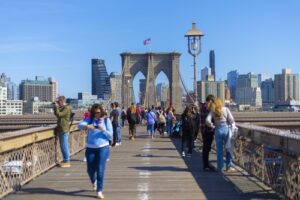
The Brooklyn Bridge is the most famous bridge walk in New York City. Opened in 1883, it crosses the East River between Lower Manhattan and Brooklyn and remains one of the city’s defining landmarks.
The elevated promenade is now reserved for pedestrians. In 2021, NYC DOT moved bicycle traffic to a protected two-way bicycle lane on the roadway below, ending the long-standing conflict between cyclists and walkers on the historic promenade.
From Manhattan, the traditional pedestrian entrance is near Centre Street and City Hall Park. On the Brooklyn side, walkers can continue toward Downtown Brooklyn or descend toward DUMBO and Brooklyn Bridge Park.
The bridge can be crowded during the middle of the day. Early morning remains the best time for a quieter crossing and unobstructed photographs.
2. Manhattan Bridge: Manhattan to Brooklyn
Best for: Brooklyn Bridge views, photographers, Chinatown and DUMBO
The Manhattan Bridge opened in 1909 just north of the Brooklyn Bridge. Its pedestrian walkway offers something the Brooklyn Bridge cannot: a direct side view of the Brooklyn Bridge with Lower Manhattan behind it.
The pedestrian walkway is separated from the bicycle route, although subway trains use the bridge and can create considerable noise and vibration as they pass. The Manhattan approach begins near Canal Street and the Bowery, while the Brooklyn side reaches the area around Jay and Sands Streets near DUMBO and Downtown Brooklyn.
This is one of the best bridge walks in the city for photography because the view looks directly toward the Brooklyn Bridge rather than from it.
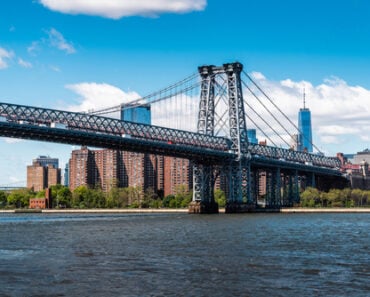
3. Williamsburg Bridge: Lower East Side to Williamsburg
Best for: Lower East Side and Williamsburg walks, neighborhood views, a more local bridge experience
The Williamsburg Bridge connects Delancey Street on Manhattan’s Lower East Side with Williamsburg, Brooklyn. When it opened in 1903, it surpassed the Brooklyn Bridge as the world’s longest suspension-bridge span.
The bridge provides separate elevated space for pedestrians and cyclists. The walk has a very different character from the Brooklyn Bridge. Steel trusses dominate the view, and the path feels more connected to the neighborhoods at both ends than to the tourist traffic of Lower Manhattan.
From the bridge, walkers can see portions of Midtown, the East River, and the dense neighborhoods of the Lower East Side and North Brooklyn.
4. Ed Koch Queensboro Bridge: Manhattan to Queens
Best for: Midtown views, Long Island City, Roosevelt Island Tram views
The Ed Koch Queensboro Bridge, still called the 59th Street Bridge by generations of New Yorkers, connects Midtown East with Long Island City and passes over Roosevelt Island.
The bridge has a signed public pedestrian and bicycle crossing on its outer-roadway system. Because NYC DOT has been changing the way pedestrians and cyclists are separated on the bridge, walkers should follow the current signs at the approaches rather than rely on an old north-side or south-side description.
The Manhattan approach is near East 60th Street and Second Avenue. The Queens approach is in Long Island City near Queens Plaza and Crescent Street. The walk provides dramatic views of Midtown Manhattan, Roosevelt Island, the East River, and the Roosevelt Island Tramway.
5. High Bridge: Manhattan to the Bronx
Best for: History, a peaceful car-free crossing, Highbridge Park
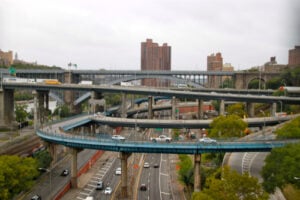
The High Bridge opened in 1848 as part of the Old Croton Aqueduct and is the oldest surviving bridge in New York City. It crosses the Harlem River between Highbridge Park in Manhattan and the Highbridge neighborhood of the Bronx.
Unlike most major New York bridges, the High Bridge is a park walkway rather than an active vehicle crossing. It is reserved for pedestrians and cyclists and provides a much quieter experience than the East River bridges.
The short crossing is especially rewarding when combined with a walk through Highbridge Park and the surrounding northern Manhattan and Bronx neighborhoods.
6. George Washington Bridge: Manhattan to Fort Lee
Best for: Hudson River views, the Palisades, long-distance walking and cycling
The George Washington Bridge crosses the Hudson River between Washington Heights and Fort Lee, New Jersey. Opened in 1931, it is one of the world’s great suspension bridges and offers one of the longest and most dramatic pedestrian crossings in the New York area.
The bridge has public pedestrian and bicycle access on its signed shared-use walkway system. The Port Authority periodically changes which side is in use during major maintenance projects, so walkers should follow the current approach signs before beginning the crossing.
The views include the Hudson River, the New Jersey Palisades, Upper Manhattan, and the Little Red Lighthouse below the Manhattan tower.
7. Ward’s Island Bridge: East Harlem to Randall’s and Wards Islands
Best for: Parks, running, cycling, East Harlem waterfront access
The Ward’s Island Bridge, often called the 103rd Street Footbridge, crosses the Harlem River from East Harlem to Randall’s and Wards Islands. It was designed specifically for pedestrians and cyclists rather than ordinary motor traffic.
The bridge provides direct access to the island park system, sports fields, waterfront greenways, and paths that continue toward other parts of the RFK Bridge complex.
It is one of the most useful bridge crossings for anyone building a longer walking or cycling route around upper Manhattan and the East River.
8. Robert F. Kennedy Bridge: Manhattan, Queens, and the Bronx
Best for: Experienced walkers, Randall’s Island, three-borough routes
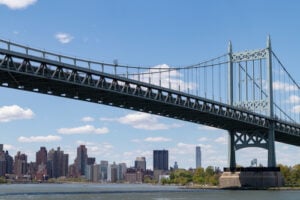
The Robert F. Kennedy Bridge, still commonly called the Triborough Bridge, should not be placed on a list of bridges pedestrians cannot cross. Public pedestrian paths exist within the bridge complex and connect Manhattan, Queens, the Bronx, and Randall’s and Wards Islands.
That does not mean it is the easiest recreational bridge walk in the city. The route is more complicated than the Brooklyn or Manhattan bridges, portions are narrow, and stairs at some approaches make it less convenient for bicycles and people with limited mobility.
For walkers interested in exploring Randall’s Island or creating a longer interborough route, however, the Triborough remains a legitimate pedestrian crossing.
9. Pulaski Bridge: Greenpoint to Long Island City
Best for: Brooklyn-Queens walks, Midtown skyline views, Newtown Creek
The Pulaski Bridge crosses Newtown Creek between Greenpoint, Brooklyn, and Long Island City, Queens. It carries vehicle traffic but also provides protected space for people walking and cycling.
The crossing is not as monumental as the East River suspension bridges, but it is extremely useful. It links two highly walkable neighborhoods and offers excellent views toward Midtown Manhattan.
The Pulaski Bridge is also part of several popular running and cycling routes between Brooklyn and Queens.
10. Kosciuszko Bridge: Brooklyn to Queens
Best for: Modern bridge engineering, Newtown Creek, long urban walks
The modern Kosciuszko Bridge replaced the old truss bridge that had become one of New York’s most notorious traffic bottlenecks. The new cable-stayed crossing carries the Brooklyn-Queens Expressway over Newtown Creek.
One of the biggest changes from the old bridge is a wide shared-use path for pedestrians and cyclists. The path offers an unusual elevated view across the industrial landscape of Newtown Creek, with the Manhattan skyline visible in the distance.
Because the approaches are longer and less tourist-oriented than those of the Brooklyn Bridge, the Kosciuszko is best suited to walkers who are deliberately exploring Brooklyn and Queens rather than looking for a quick sightseeing stop.
11. Bayonne Bridge: Staten Island to New Jersey
Best for: Staten Island walkers, Kill Van Kull views, major engineering
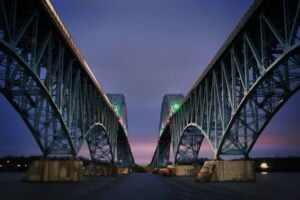
The Bayonne Bridge connects Staten Island with Bayonne, New Jersey, across the Kill Van Kull. The great steel arch opened in 1931 and later underwent an extraordinary reconstruction that raised its roadway to allow larger container ships to pass beneath it.
The rebuilt bridge includes a public shared-use path for pedestrians and cyclists. For Staten Island residents, it is one of the few major bridge routes that can be crossed legally on foot.
12. Goethals Bridge: Staten Island to Elizabeth, New Jersey
Best for: Staten Island-New Jersey walking and cycling connections
The modern Goethals Bridge connects Staten Island with Elizabeth, New Jersey, across the Arthur Kill. The replacement cable-stayed bridge includes a shared-use path for pedestrians and cyclists, something the old Goethals Bridge did not provide.
The path is more functional than scenic compared with the Brooklyn or George Washington bridges, but it is an important connection because it gives pedestrians and cyclists another legal route between Staten Island and New Jersey.
Other Harlem River Bridges You Can Walk Across
The High Bridge and Ward’s Island Bridge are the most distinctive pedestrian crossings in upper Manhattan, but they are not the only Harlem River bridges with public walking access. Sidewalks or pedestrian paths are also available on several vehicle bridges connecting Manhattan and the Bronx, including the Broadway Bridge, University Heights Bridge, Washington Bridge, Macombs Dam Bridge, 145th Street Bridge, Madison Avenue Bridge, Third Avenue Bridge, Willis Avenue Bridge, and Henry Hudson Bridge.
These crossings are generally more useful as transportation links than sightseeing destinations, but they make it possible to create long walking routes between Manhattan and the Bronx without using the subway.
Major NYC Bridges You Cannot Normally Walk Across
Verrazzano-Narrows Bridge: The Verrazzano-Narrows Bridge has no everyday public pedestrian walkway. Pedestrian access is permitted only during authorized events such as the New York City Marathon.
Bronx-Whitestone Bridge: There is no public pedestrian walkway.
Throgs Neck Bridge: There is no public pedestrian walkway.
Outerbridge Crossing: There is no public pedestrian walkway.
Hell Gate Bridge: The Hell Gate Bridge is a railroad bridge and has no public pedestrian crossing.
Tips for Walking New York City Bridges
- Stay in the pedestrian lane. On bridges where bicycle routes run nearby, remain on the signed pedestrian side and expect fast-moving commuter cyclists.
- Expect stronger wind over the water. Conditions on a bridge deck can feel much colder or windier than the streets below.
- Wear comfortable shoes. Bridge approaches can be longer and steeper than the river span itself.
- Bring water. Most bridge walkways have no vendors, restrooms, or other services once you are on the crossing.
- Check for construction before a special trip. Maintenance can temporarily change entrances, walkway sides, or access hours, especially on major transportation bridges.
- Build a neighborhood walk around the crossing. The best bridge walks continue into places such as DUMBO, Brooklyn Heights, Williamsburg, Long Island City, Washington Heights, Highbridge, and Randall’s Island.
More New York Bridge History
For the deeper stories behind these crossings, continue with our histories of the Brooklyn Bridge, Manhattan Bridge, Williamsburg Bridge, 59th Street Bridge, George Washington Bridge, and Triborough Bridge. You can also compare the engineering and history of the city’s great spans in our guide to the 10 Most Iconic Bridges in New York.
Walkable NYC Bridges at a Glance
| Bridge | Connection | Pedestrian Access | Best Known For |
|---|---|---|---|
| Brooklyn Bridge | Manhattan-Brooklyn | Pedestrian-only elevated promenade | Classic skyline and stone-tower views |
| Manhattan Bridge | Manhattan-Brooklyn | Dedicated pedestrian walkway | Best side view of the Brooklyn Bridge |
| Williamsburg Bridge | Manhattan-Brooklyn | Elevated pedestrian route | Lower East Side and Williamsburg connection |
| Ed Koch Queensboro Bridge | Manhattan-Queens | Signed public outer-roadway path | Midtown, Roosevelt Island, and tram views |
| High Bridge | Manhattan-Bronx | Car-free pedestrian and bicycle bridge | Oldest surviving NYC bridge |
| George Washington Bridge | Manhattan-Fort Lee, NJ | Public shared-use walkway system | Hudson River and Palisades views |
| Ward’s Island Bridge | Manhattan-Wards Island | Pedestrian and bicycle bridge | Park and greenway access |
| RFK/Triborough Bridge | Manhattan-Queens-Bronx | Pedestrian paths through bridge complex | Three-borough connection |
| Pulaski Bridge | Brooklyn-Queens | Protected pedestrian space | Greenpoint-LIC connection |
| Kosciuszko Bridge | Brooklyn-Queens | Wide shared-use path | Modern cable-stayed bridge views |
| Bayonne Bridge | Staten Island-Bayonne, NJ | Shared-use path | Kill Van Kull and steel arch |
| Goethals Bridge | Staten Island-Elizabeth, NJ | Shared-use path | Staten Island-New Jersey connection |
Published August 10, 2026.
Which Bridges Can You Walk Across in NYC? Pedestrian Bridge Guide article published on ClassicNewYorkHistory.com © 2026