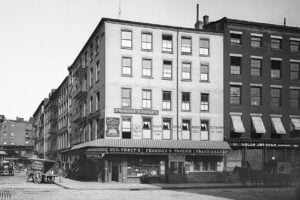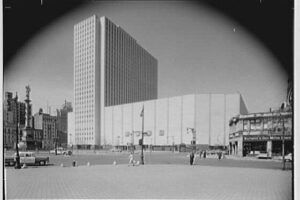
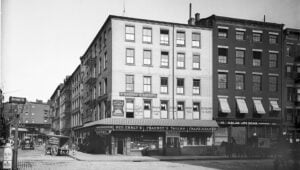
Fraunces Tavern at Broad and Pearl Streets in Lower Manhattan around the turn of the 20th century. The historic complex was the site of the still-unresolved 1975 Fraunces Tavern bombing. Detroit Publishing Co. / Library of Congress. Public domain.
New York City has always generated legends, rumors, scandals, and mysteries almost as quickly as it has built skyscrapers. Some of those stories were solved. Others ended with an acquittal, a missing body, an unidentified killer, or an investigation that simply ran out of answers.
The cases below span more than two centuries of New York history. They include disappearances, assassinations, bombings, and murders that became national sensations. In several of them, investigators developed strong theories or identified likely suspects. But suspicion is not the same thing as proof, and each of these mysteries still contains a central question that was never definitively answered.
1. The Disappearance of Justice Joseph Force Crater
Date: August 6, 1930
Location: West 45th Street, Midtown Manhattan
The Case: Joseph Force Crater was a recently appointed justice of the New York Supreme Court when he disappeared on a hot August night in 1930. After spending part of the day dealing with personal and professional matters, Crater had dinner with lawyer William Klein and showgirl Sally Lou Ritz at Billy Haas’s chophouse on West 45th Street. He was last reliably seen leaving the area that evening. He never returned to his apartment or to his wife, and no confirmed trace of him was ever found.
The Lingering Mystery: The disappearance became tangled in the political world of Tammany Hall and the corruption investigations surrounding New York government at the time. Crater’s finances, political relationships, personal life, and activities immediately before he vanished produced theories ranging from murder to voluntary disappearance. A grand jury heard dozens of witnesses without determining what happened. Crater was declared legally dead on June 6, 1939, and the NYPD eventually closed the case unresolved.
2. The Disappearance of Dorothy Arnold
Date: December 12, 1910
Location: Fifth Avenue near West 27th Street, Manhattan
The Case: Dorothy Arnold was a 25-year-old member of a wealthy Manhattan family who left her home at 108 East 79th Street to shop for a dress. She bought chocolates and later a book at Brentano’s on Fifth Avenue near 27th Street. Shortly before 2 p.m., she encountered her friend Gladys King. After the two separated, Arnold disappeared.
The Lingering Mystery: Arnold’s family initially tried to keep the disappearance private and relied on lawyers and private investigators before the police and press became fully involved. By the time the case became public, valuable weeks had passed. Reported sightings, ransom demands, rumors of secret relationships, and theories involving an accidental death or voluntary disappearance led nowhere. No verified later sighting of Dorothy Arnold was ever established, and her fate remains unknown.
3. The Murder of Arnold Rothstein
Date: November 4, 1928
Location: Park Central Hotel, Seventh Avenue near West 55th Street, Manhattan
The Case: Arnold Rothstein was one of the most notorious gamblers and underworld figures in New York during the 1920s. On the night of November 4, 1928, he went to the Park Central Hotel after receiving a telephone call. He was shot inside the hotel and later found badly wounded near a service entrance. Rothstein died at New York Polyclinic Hospital two days later.
The Lingering Mystery: Rothstein refused to identify the person who shot him. The killing was widely linked to disputes surrounding a high-stakes poker game and large gambling debts, but the financial details varied among witnesses and later accounts. George “Hump” McManus was prosecuted for the murder and acquitted. The identity of Rothstein’s killer was never established in court, leaving one of the most famous murders in New York underworld history officially unresolved.
4. The Wall Street Bombing
Date: September 16, 1920
Location: Wall Street near Broad Street, Lower Manhattan
The Case: Shortly before noon, a horse-drawn wagon stopped near the U.S. Assay Office, across from the J. P. Morgan building. The driver disappeared into the crowd. Minutes later, explosives hidden in the wagon detonated, sending metal fragments through one of the busiest financial districts in the world. More than 30 people were killed immediately, the death toll later increased, and hundreds were injured.
The Lingering Mystery: New York police, the Bureau of Investigation, the Secret Service, and other agencies pursued the case. Investigators reconstructed parts of the bomb and examined anarchist groups after threatening leaflets were discovered nearby. Federal investigators came to believe that followers of Italian anarchist Luigi Galleani were likely responsible, but the evidence never produced a prosecution. The FBI still describes the Wall Street bombing as an unsolved case.
5. The Assassination of Carlo Tresca
Date: January 11, 1943
Location: Fifth Avenue and West 15th Street, Manhattan
The Case: Carlo Tresca was an Italian-American newspaper editor, labor organizer, anarchist, and outspoken opponent of fascism. On the night of January 11, 1943, he was shot and killed near Fifth Avenue and 15th Street. His murder immediately drew attention because Tresca had accumulated powerful enemies through decades of political and labor activism.
The Lingering Mystery: Investigators examined possible connections to organized crime, Italian fascists, and political enemies on the left. Carmine Galante, who later became a major organized-crime figure, was among those investigated, but no one was convicted of Tresca’s murder. The New York County District Attorney’s investigative files remained active for years, and the identity of the person or people who ordered and carried out the assassination was never established in court.
6. The Bond Street Murder of Dr. Harvey Burdell
Date: January 31, 1857
Location: 31 Bond Street, Manhattan
The Case: Dentist Harvey Burdell was found brutally murdered inside his Bond Street townhouse, stabbed repeatedly and strangled. The killing became one of the great newspaper sensations of 19th-century New York. Suspicion quickly centered on Emma Cunningham, a widow who lived in the house and claimed that she and Burdell had secretly married.
The Lingering Mystery: Cunningham was indicted and tried for murder, but a jury found her not guilty in May 1857. The case grew even stranger afterward when her claims to Burdell’s estate produced another public scandal. No one else was ultimately convicted of murdering Burdell. The acquittal left New York with a famous homicide, a house full of suspects and conflicting testimony, but no legally established killer.
7. The Fraunces Tavern Bombing
Date: January 24, 1975
Location: Fraunces Tavern complex, Broad and Pearl Streets, Lower Manhattan
The Case: A bomb exploded during the lunchtime rush inside the Fraunces Tavern complex in Lower Manhattan. Four people were killed and dozens were injured. The attack struck one of the city’s most historically significant sites, a building complex associated with the tavern where George Washington famously said farewell to his officers after the Revolutionary War.
The Lingering Mystery: The Fuerzas Armadas de Liberación Nacional, better known as the FALN, claimed responsibility for the bombing. Federal investigations later connected the organization to a broader campaign of bombings, and members of the group were prosecuted for other crimes. But responsibility at the organizational level did not answer the central question of who actually built, transported, and planted the Fraunces Tavern bomb. Government records continued to describe the specific perpetrators as unidentified.
8. The Manhattan Well Murder
Date: December 1799
Location: Lispenard Meadows, near present-day Spring and Greene Streets in SoHo
The Case: Gulielma “Elma” Sands disappeared on the night of December 22, 1799, after leaving the boarding house where she lived. Days later, her body was discovered in the Manhattan Well. Suspicion fell on Levi Weeks, a young carpenter who had been courting her.
The Lingering Mystery: Weeks was prosecuted in one of the most famous early criminal trials in New York history. His defense team included Alexander Hamilton and Aaron Burr. Witnesses described hearing a woman cry out near the well, and prosecutors presented evidence tying Weeks to Sands, but the jury acquitted him. With Weeks legally cleared and no later defendant convicted, the identity of Elma Sands’s killer was never established. The well itself survives beneath 129 Spring Street, giving the mystery a physical connection to modern New York more than two centuries later.
9. The Murder of Helen Jewett
Date: April 10, 1836
Location: 41 Thomas Street, Manhattan
The Case: Helen Jewett, a young woman working in a Manhattan brothel, was found murdered in her bed after being struck with a hatchet. A fire had also been started in the room. Suspicion centered on 19-year-old Richard P. Robinson, a customer who had visited Jewett that night. The case became a sensation as New York newspapers competed for readers with increasingly detailed coverage of the murder and trial.
The Lingering Mystery: Robinson was tried for Jewett’s murder and acquitted after a highly publicized proceeding. Historians have continued to debate the strength of the evidence and the influence of class, gender, and contemporary attitudes toward prostitution on the case. Robinson could not be tried again after his acquittal, and no other person was convicted. The legal record therefore left Helen Jewett’s murder without an established killer.
10. The New York City Bicycle Bombings
Date: 2005–2008
Location: British Consulate, Mexican Consulate, and Times Square, Manhattan
The Case: In the early morning hours of March 6, 2008, an explosive device detonated outside the United States Armed Forces Recruiting Station in Times Square. Surveillance footage showed a suspect riding a blue bicycle through Midtown before leaving the device near the recruiting station and fleeing. No one was injured.
The Lingering Mystery: The FBI determined that the 2008 bombing resembled two earlier unsolved New York attacks: a bombing at the British Consulate in May 2005 and another at the Mexican Consulate in October 2007. In all three cases, an individual used a bicycle and the devices exploded in the early morning hours. The FBI has said the incidents may be connected and continues to seek information identifying the person or people responsible. Despite surveillance footage, recovered physical evidence, and years of investigation, the bomber has never been publicly identified or convicted.
Readers interested in more of New York City’s unsettling and hidden history can continue with our history of the Manhattan Well Murder and the ghost stories that followed, our history of Fraunces Tavern, and our look at 20 New York City secrets hiding in plain sight.
Sources
- Syracuse University Press / JSTOR — Finding Judge Crater: A Life and Phenomenal Disappearance in Jazz Age New York
- American Heritage — The disappearance of Dorothy Arnold
- TIME — Arnold Rothstein and the Park Central Hotel shooting
- Federal Bureau of Investigation — Wall Street Bombing 1920
- New York City Municipal Archives — Carlo Tresca assassination closed case files
- Smithsonian Magazine — Harvey Burdell murder and Emma Cunningham trial
- Fraunces Tavern Museum — History of the 1975 bombing
- United States District Court, Southern District of New York — Grand jury investigation of the Fraunces Tavern bombing
- Library of Congress — 1800 trial record of Levi Weeks for the murder of Gulielma Sands
- Smithsonian Libraries and Archives — Patricia Cline Cohen’s The Murder of Helen Jewett
- Federal Bureau of Investigation — Unsolved New York City bombings, 2005–2008