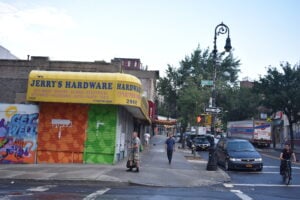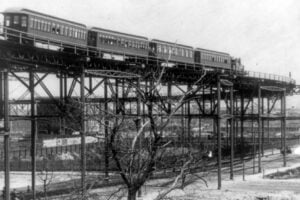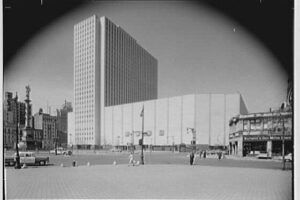
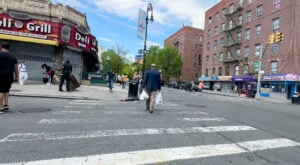
Bainbridge Avenue and East 206th Street in the Bronx, New York. Photo by Brian Kachejian © 2026
Every Bronx neighborhood carries a distinct historical footprint, from colonial-era settlements and estates to 19th-century industrial districts and planned residential communities.
This guide looks at the origins of 35 Bronx neighborhood names and the history behind the people, places, landmarks, and developments that gave them their identities.
1. Spuyten Duyvil
Origin: A 17th-century Dutch place-name whose exact meaning has been debated for centuries.
The Story: The Dutch name Spuyten Duyvil has been translated in several ways, often with references to a “spouting,” “spinning,” or otherwise devilish current. The rough waters around the old Spuyten Duyvil Creek clearly helped inspire the enduring interpretations. Washington Irving later popularized the famous story of trumpeter Antony Van Corlear attempting the crossing “in spite of the devil” in his 1809 satirical A History of New York. Irving’s tale is part of the name’s folklore rather than a literal account of its origin.
2. Mott Haven
Origin: Named after industrialist and inventor Jordan Lawrence Mott (1799–1866).
The Story: In 1828, Gouverneur Morris II sold a large tract in the southwest corner of Morrisania to Jordan L. Mott and several co-investors. Mott established the Mott Iron Works on the Harlem River and named his pocket of Morrisania Mott Haven. In 1850, he proceeded with plans for the Mott Haven Canal, which allowed boats to travel inland and encouraged the growth of heavy industry around the waterfront.
3. Morrisania
Origin: Named for the prominent Morris family, whose estate became the colonial Manor of Morrisania.
The Story: Richard and Sarah Morris acquired the former Bronck lands in the 17th century. Their son Lewis Morris (1671–1746) later took control of the estate, and in 1697 Governor Benjamin Fletcher granted a patent establishing the Manor of Morrisania. Morris went on to serve as chief justice of New York and governor of New Jersey. Later generations of the family included several major figures in American political history, including Gouverneur Morris.
4. Kingsbridge
Origin: Named after The King’s Bridge, New York City’s first bridge, constructed across Spuyten Duyvil Creek in 1693.
The Story: Merchant and landowner Frederick Philipse built the King’s Bridge in 1693 and collected tolls from travelers using the important northern route between Manhattan and the mainland. The crossing became strategically important during the American Revolution, and the village that grew nearby took the name Kingsbridge. New York City records state that the original bridge was demolished in 1917 after major changes to the surrounding waterways.
5. Throggs Neck
Origin: Named after English settler John Throckmorton, whose surname was shortened over time.
The Story: John Throckmorton settled in the area under Dutch rule in the early 1640s. The peninsula became associated with his name, which evolved through forms such as Throckmorton’s Neck, Throck’s Neck, Throggs Neck, and Throgs Neck. The modern neighborhood and the Throgs Neck Bridge preserve versions of that centuries-old place-name.
6. Fordham
Origin: A 17th-century place-name associated with John Archer’s Manor of Fordham; the deeper etymology is not completely settled.
The Story: In 1671, English Governor Francis Lovelace granted John Archer a large manor in this section of what is now the Bronx. A long-standing explanation interprets Fordham as a combination of “ford,” meaning a shallow river crossing, and “ham,” meaning a settlement or home. Other accounts have proposed a personal-name origin. What is certain is that Fordham was an established place-name long before St. John’s College opened in 1841 on the campus that later became Fordham University.
7. Riverdale
Origin: A mid-19th-century suburban name created for a planned villa community overlooking the Hudson River.
The Story: Interest in the northwest Bronx increased after the Hudson River Railroad improved access to the area. In 1852, a group of merchants headed by W. W. Woodworth purchased land adjoining the Ackerman property for a private villa development. A plan for the community, called Riverdale, was filed in 1853. A second nearby development, The Park–Riverdale, was organized in 1856. Although the original projects did not develop exactly as envisioned, the Riverdale name endured and eventually came to describe a much larger section of the northwest Bronx.
8. Fieldston
Origin: Named for the Fieldston estate of the Delafield family.
The Story: Major Joseph Delafield purchased 257 acres in the area in 1829. His son Maturin L. Delafield later built a larger house there in 1869 and named it Fieldston after a property in England that had been owned by his ancestors. In the early 20th century, the Delafield family developed a residential community that retained the name. Its winding street plan, natural rock outcroppings, and wooded landscape remain defining features of the Fieldston Historic District.
9. Pelham Bay & Pelham Parkway
Origin: Derived from the colonial manor name Pelham, established by English physician Thomas Pell.
The Story: In 1654, Thomas Pell acquired an enormous tract covering parts of what are now the Bronx and lower Westchester. Pell named his manor Pelham, traditionally said to honor his tutor, Pelham Burton. The name survived long after the colonial manor disappeared and is preserved today in the Town of Pelham, Pelham Bay, Pelham Bay Park, Pelham Parkway, Pelham Gardens, and other local place-names.
10. City Island
Origin: Named as part of an ambitious 18th-century plan to create a commercial center that could rival New York.
The Story: The island had been known by several names, including Great Minnefords Island, before Benjamin Palmer purchased it for a syndicate in 1761. Palmer and his partners hoped to transform the island into a major commercial center and renamed it New City Island, later shortened to City Island. The project was interrupted during the American Revolution and never developed as planned, but the name endured. City Island later became famous for shipbuilding, boating, fishing, and oyster culture.
11. Hunts Point
Origin: Named after 17th-century landowner Thomas Hunt Jr.
The Story: Englishmen Edward Jessup and John Richardson purchased a large tract east of Broncksland in 1663. After Jessup’s death, his widow transferred his share to her son-in-law Thomas Hunt Jr., who acquired the salt-meadow peninsula in 1668. The property became known as Hunt’s Point, eventually contracted to Hunts Point. The area remained rural for generations before becoming an estate district and later one of New York City’s most important industrial and food-distribution centers.
12. Clason Point
Origin: Named after Scottish-born merchant Isaac Clason (1747–1815).
The Story: In 1643, English colonist Thomas Cornell received a patent from the Dutch for this peninsula, establishing Cornell’s Neck. In 1793, Isaac Clason—a prominent Manhattan shipping merchant and early director of the Bank of New York—purchased 1,000 acres of the peninsula and built a grand neoclassical country estate. The spelling gradually shifted over 19th-century land deeds from Clason’s Point to Clason Point.
13. Soundview
Origin: A descriptive waterfront name associated with the area’s position near the East River and the waters leading toward Long Island Sound.
The Story: Much of the peninsula near the mouth of the Bronx River was once tidal marsh and open water. Beginning in the 1920s and continuing into the 1960s, portions were filled with landfill. New York City acquired the original 93 acres that became Soundview Park in 1937 and added more land over time. The Soundview name became attached to both the park and the surrounding neighborhood.
14. Highbridge
Origin: Named after The High Bridge, New York City’s oldest surviving bridge, completed in 1848.
The Story: Built by chief engineer John B. Jervis as a key component of the Old Croton Aqueduct, the monumental stone-arch structure was engineered to carry fresh water from Westchester County across the Harlem River valley into Manhattan at a height of 138 feet above the water. The surrounding Bronx bluffs grew into a residential community centered around the aqueduct’s water tower (Highbridge Water Tower, built in 1872) and the recreation parks along the river cliffs.
15. Port Morris
Origin: Named for the industrial port developed by Gouverneur Morris Jr. on the East River waterfront.
The Story: Gouverneur Morris Jr., son of Founding Father Gouverneur Morris, recognized the industrial potential of the waterfront and developed a deep-water port in the 1840s. Rail connections later linked the docks to inland freight routes, helping Port Morris become an important manufacturing and shipping district. The neighborhood’s name preserves both its maritime function and the Morris family legacy.
16. West Farms
Origin: A geographic name for the settlement west of the older Town of Westchester.
The Story: In 1663, English settlers Edward Jessup and John Richardson purchased a large tract east of Broncksland, and the Patent of West Farms was secured in 1666. The property was divided into twelve farms and became known first as the “Twelve Farms” and then as West Farms because of its location west of Westchester. West Farms later became a separate village before its annexation to New York City in 1874.
17. Eastchester
Origin: The Bronx neighborhood inherited its name from the historic Town of Eastchester in Westchester County.
The Story: In 1664, ten Puritan families from Fairfield, Connecticut, settled in what became Eastchester, and the following year they recorded the Eastchester Covenant, which set out rules for land division, farming, education, and town meetings. Eastchester was separated from Westchester in 1667. The southern portion of the old town was annexed to New York City in 1895, and the Bronx neighborhood preserves the earlier municipal name.
18. Wakefield
Origin: Named after Wakefield, the Virginia plantation associated with George Washington’s birthplace.
The Story: The northern Bronx neighborhood was named for the Virginia birthplace of George Washington, paralleling nearby Mount Vernon in Westchester County, which was named after Washington’s later home. The area remained largely wooded and agricultural before transportation improvements encouraged residential development. The southern portion of the old Town of Eastchester, including the Wakefield area, was annexed to New York City in 1895.
19. Melrose
Origin: A Scottish-inspired name associated with surveyor Andrew Findlay and Melrose Abbey in Scotland.
The Story: Around 1850, Scottish-born surveyor Andrew Findlay laid out portions of the Morrisania estate as new residential villages. Bronx historian John McNamara associated the name Melrose with Melrose Abbey and Findlay’s Scottish roots. The neighborhood soon developed into a major German immigrant community, with breweries, piano manufacturers, and other industries becoming important parts of its 19th-century economy.
20. Tremont
Origin: Traditionally associated with three local elevations or estates: Mount Hope, Mount Eden, and Fairmount.
The Story: A long-standing Bronx tradition credits a local postmaster with creating the name Tremont in the mid-19th century as an allusion to the area’s “three mounts.” New York City historical sources also preserve an alternate account connecting the name to Boston’s Tremont Street. The three-mount explanation remains the one most closely associated with Bronx neighborhood history.
21. Mount Hope
Origin: A 19th-century local name associated with an elevated section of Upper Morrisania.
The Story: The area was part of Upper Morrisania and appears on an 1868 map as the Western Reserve. Bronx Community Board 5 notes that Mount Hope was not initially mapped as a formal place-name and may have begun simply as a local name for the elevation. It later became one of the three “mounts” traditionally associated with the origin of the name Tremont.
22. Mount Eden
Origin: Named for Rachel Eden, who purchased property in the area in 1820.
The Story: Mount Eden takes its name from a real 19th-century landowner rather than simply from a biblical or promotional reference. Rachel Eden’s property occupied one of the hills in the west-central Bronx. Mount Eden later became one of the three local “mounts” traditionally associated with the origin of the name Tremont.
23. Belmont (Arthur Avenue / “Little Italy of the Bronx”)
Origin: Named for the Belmont Estate of the Lorillard tobacco family.
The Story: The Lorillard family owned extensive property along the Bronx River, where the surviving Lorillard Snuff Mill remains an important early industrial landmark. Their mansion and estate lent the name Belmont to the surrounding neighborhood. After the Lorillards left, part of their land became Bronx Park and other sections were divided into the streets of modern Belmont. Italian immigrants began settling heavily in the neighborhood in the 1890s, including workers involved in construction of the Bronx Zoo and the New York Botanical Garden, helping establish the Arthur Avenue community known today as the Bronx’s Little Italy.
24. Norwood
Origin: Commonly believed to come from “North Woods,” reflecting the area’s once heavily wooded landscape.
The Story: The neighborhood was historically associated with the name Bainbridge and remained rural well into the 19th century. When I was growing up in the neighborhood in the 1960s and 70s, we never called it Norwood. Bronx Community Board 7 notes the long-standing belief that the name Norwood developed from “North Woods.” The arrival of rail service, the nearby reservoir, and major institutions helped transform the former farmland into a residential community.
25. Van Nest
Origin: Named after the Van Nest railroad station, which in turn was named for the family of railroad director Abraham Reynier Van Nest.
The Story: The New York, New Haven and Hartford Railroad established a station in the area, and the stop was named for the father of Abraham Reynier Van Nest, a director of the railroad. As residential development expanded around the station, Van Nest became the name of the surrounding neighborhood. The nearby Morris Park Racecourse brought additional traffic through the rail hub during the late 19th and early 20th centuries.
26. Morris Park
Origin: Named after wealthy racing magnate John Albert Morris (1836–1895).
The Story: In 1889, John Albert Morris opened the Morris Park Racecourse on hundreds of acres of East Bronx farmland. The track became one of the country’s important racing venues and operated through 1904. After New York City acquired the property and a major fire struck in 1910, developers subdivided the former racetrack into building lots and streets. The racetrack disappeared, but the Morris Park name remained.
27. Castle Hill
Origin: Traditionally linked to an early report of a Native fortification on elevated ground.
The Story: The origin of Castle Hill is better treated as a historical tradition than as a firmly documented fact. Bronx Borough Historian Lloyd Ultan has recounted a story that Dutch explorer Adriaen Block saw a Native fortification on a rise and compared it to a castle. There was never a European-style castle in the neighborhood, but the old Castle Hill name survived on local roads, maps, and the surrounding community.
28. Unionport
Origin: Named by the Industrial Home Association No. 2 for a planned community near Westchester Creek.
The Story: In 1851, a building association purchased a large tract west of Westchester Creek for a new settlement. The Industrial Home Association No. 2 filed its map of Unionport in 1854. The name fit a cooperative development organized by working people beside a navigable waterway, and Unionport survived as the name of the surrounding East Bronx neighborhood.
29. Bedford Park
Origin: Named after Bedford Park in London, England.
The Story: The area had once been farmland associated with Leonard Jerome. During the late 19th century, developers created a suburban residential community and named it Bedford Park after the well-known London suburb. Transportation improvements and the construction of the Jerome Park Reservoir later accelerated development and helped turn Bedford Park into a permanent Bronx neighborhood.
30. Williamsbridge
Origin: Named after John Williams, an 18th-century English farmer who owned the land surrounding the first colonial wooden bridge built across the Bronx River.
The Story: In the early 1700s, a vital timber bridge was erected across the Bronx River to connect the Town of Westchester with the Town of Eastchester along the historic Boston Post Road. The crossing was adjacent to the farm of John Williams, and colonial military dispatches from the Revolutionary War repeatedly refer to the strategic crossing as Williams’s Bridge. When the New York and Harlem Railroad opened a depot there in 1842, the name attached permanently to the surrounding village.
31. Woodlawn / Woodlawn Heights
Origin: Named for nearby Woodlawn Cemetery, established in 1863.
The Story: The northern Bronx area had earlier been known as Washingtonville. By the early 20th century, perhaps because of the prominence of Woodlawn Cemetery, residents increasingly called the neighborhood Woodlawn Heights or simply Woodlawn. The name has remained closely tied to the cemetery and to the community along the Westchester County border.
32. Schuylerville
Origin: Connected to nearby Fort Schuyler, which was named for Revolutionary War General and U.S. Senator Philip Schuyler (1733–1804).
The Story: Construction of Fort Schuyler began at the tip of Throggs Neck in 1833 as part of New York’s coastal defenses. The fort honored Major General Philip Schuyler of the Continental Army. The Schuyler name spread beyond the fort to the surrounding East Bronx area, where Schuylerville became an established local place-name.
33. Country Club
Origin: Named after the Country Club of Westchester, which once occupied land along Eastchester Bay.
The Story: The Country Club of Westchester was organized in the 1880s and offered members sports and recreation including tennis, polo, riding, boating, and other outdoor activities. In 1888, work began on new grounds on the western side of Eastchester Bay, and the club moved there the following year. The club eventually left the area and much of its property was subdivided, but the surrounding neighborhood retained the straightforward name Country Club.
34. Parkchester
Origin: A combination of two older local place-names: Park Versailles and Westchester Heights.
The Story: Beginning in the late 1930s, the Metropolitan Life Insurance Company developed Parkchester as a massive planned apartment community on 129 acres. The name combined “Park” from Park Versailles with “chester” from Westchester Heights, two adjacent neighborhood names. The development’s 171 red-brick apartment buildings, shops, landscaped spaces, and services created a distinct community whose name eventually became associated with the larger surrounding neighborhood.
35. Co-op City
Origin: A shortened form of Cooperative City.
The Story: Co-op City was developed as a massive middle-income cooperative housing community by the United Housing Foundation. The first residents arrived in 1968, and the development was completed in the early 1970s on land that had included the former Freedomland U.S.A. amusement park. Today, Co-op City contains 15,372 residential units in 35 high-rise buildings and seven townhouse clusters. Riverbay Corporation describes it as the largest single residential development in the United States.
For more on the way New York communities developed over time, read our guide to the 10 Oldest Neighborhoods in New York City. For a firsthand look at life in one Bronx neighborhood, see A Bronx Life on Bainbridge Ave and 204 Street.
Sources
The Bronx County Historical Society — History in Asphalt: The Origin of Bronx Street and Place Names
New York City Landmarks Preservation Commission — Fieldston Historic District Designation Report
New York City Landmarks Preservation Commission — Manida Street Historic District Designation Report
New York City Municipal Archives — Old Town Records
NYC Department of Small Business Services — Wakefield Neighborhood Assessment
NYC Department of Small Business Services — Morris Park and Van Nest Neighborhood Assessment
Town of Pelham — History of Pelham
City Island Historical Society and Nautical Museum — City Island History
Lehman College — Bronx Neighborhood Histories
Bronx Community Board 5 — Mount Hope
Bronx Community Board 7 — Norwood and Bedford Park
Historic Districts Council — Parkchester
Historic Districts Council — Woodlawn Heights
Co-op City / Riverbay Corporation — About Co-op City