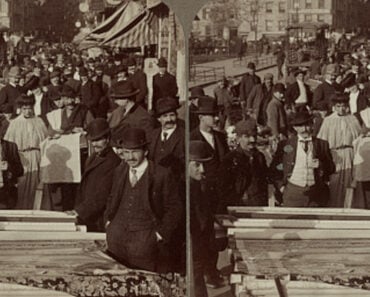
A New York City playground where traditional street games and urban recreation still come together. Photo: a katz / Shutterstock.com
Growing up in the Bronx, we spent most of our childhood hanging out on the streets because apartments were too small, and in the summer it was too hot to stay inside. We didn’t have organized sports for kids the way they do now. Of course, there were Little Leagues, usually baseball, but not every family could afford to put their kids in one. We played sports and games for free in the streets in front of our apartment buildings. It’s just what you did.
I don’t know how we learned how to play these games. I think it was in our DNA because we surely didn’t invent them, although we probably altered the rules. That was part of it. Every block had its own version, its own boundaries, and its own arguments over what counted as an out.
You didn’t really have to own much to play these games, with a few exceptions. The big one was the piece of equipment that fueled so many of them: the Spaldeen. It was a pink rubber ball. The ones we had featured a red line around them, and they often split in half. They still make Spaldeens today, but the newer ones aren’t exactly the same as the balls we played with.
There was always one guy who could hit the ball against the curb so hard that it would split. They weren’t expensive, usually around a quarter or 35 cents in my memory, but sometimes you had to wait for the kid who owned a Spaldeen to come downstairs before you could play. Very often, somebody would break a window with the ball and we would all run down the street. We were scared somebody was coming after us, but we were also ticked off because now we had lost our Spaldeen and couldn’t play anymore. That was city life.
Not every game required a Spaldeen. Some needed only a bottle cap, a penny, a piece of chalk, a jump rope, a broom handle, a wall, a stoop, or just a bunch of kids willing to play. These are the street games we played growing up in New York City, long before electronics changed childhood the way they have today. I miss those days.
1. Stickball
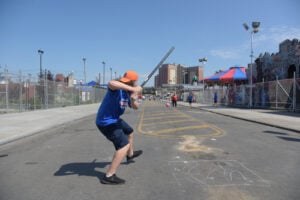
The Equipment: A sawed-off wooden broom or mop handle, a pink Spaldeen rubber ball, and sometimes white chalk.
The Court & Setup: We played directly in the middle of residential asphalt streets. Manhole covers, which we called sewers, could serve as home plate and other bases, while parked-car tires, curbs, lampposts, or whatever else was available helped define the field. Distance was often measured in sewers. If somebody hit one two or three sewers away, everybody knew exactly how far that ball had traveled.
How We Played: There were different versions. In one, a pitcher delivered the Spaldeen on a bounce and the batter swung at it with the broom handle. In another, the hitter tossed or bounced the ball for himself and hit it on the rebound. Like so many New York street games, the exact ground rules depended on the block. A roof, a parked car, a sewer grate, or somebody’s window could change the game very quickly.
2. Box Baseball (Three-Box / Two-Box Sidewalk Baseball)
The Equipment: A Spaldeen and the expansion joints already built into a concrete sidewalk.
The Court & Setup: The sidewalk itself became the field. We used consecutive concrete squares as boxes, with the exact setup depending on how many squares we had and which version we were playing.
How We Played: One player sent the ball toward another player’s box, and the return was made with an open palm or the side of the hand. The object was to place the ball where the other player couldn’t handle it cleanly. Depending on the block, certain boxes were dead, lines were out, and clean shots past the opponent could be treated like hits in baseball. The sidewalk gave you everything you needed.
3. Stoopball / Off the Point
The Equipment: A pink Spaldeen and a building stoop or street curb.
The Court & Setup: The thrower stood on the sidewalk facing a set of steps, or sometimes the curb, while the fielders spread out wherever the ball might ricochet.
How We Played: You threw the ball against the stoop and tried to catch the fielders by surprise with the rebound. The great shot was hitting the point or corner just right. When that Spaldeen caught the edge cleanly, it could shoot back like a line drive. Scoring rules varied from block to block, but the farther the ball got past the fielders, the better the hit.
4. Ace-King-Queen (Kings and Queens)
The Equipment: A Spaldeen or another high-bounce rubber ball.
The Court & Setup: We used sidewalk squares or a wall, depending on the version. The positions carried names such as Ace, King, Queen, and Jack, and players worked their way up or down the order as the game went on.
How We Played: The ball was slapped with an open hand into another player’s area, often after a single bounce or against the wall. If you missed, let the ball bounce too many times, hit it out of bounds, or broke one of that block’s rules, you dropped in the order and everybody below you moved up. The player at the top controlled the serve, and naturally everybody wanted that spot.
5. Skelly (Skully / Skellies / Deadbox)
The Equipment: Bottle caps and sidewalk chalk.
The Craft: This was one of those games where making your piece was almost part of the sport. Kids weighted bottle caps with wax, clay, tar, or whatever they thought would make the cap slide just right across rough pavement.
The Court & Setup: We drew the Skelly board directly on the asphalt or sidewalk. Courts and rules varied by neighborhood, but many versions used numbered boxes and a dangerous center area known as the skull or deadbox.
How We Played: Players flicked their bottle caps through the numbered course, trying to land accurately while avoiding traps and opponents. Once you completed the course, some versions turned your cap into a killer, allowing you to go after the other players’ pieces. It was strategy, accuracy, and neighborhood warfare played with a bottle cap.
6. Ringolevio (Ringoleevio / Cocolevio)
The Equipment: Nothing. You needed two teams and enough neighborhood territory to disappear into.
The Court & Setup: A block, or sometimes more than one block, became the playing field. A stoop, light pole, chalked square, or another familiar spot served as the jail.
How We Played: One team hid while the other went looking for them. A capture meant catching and holding the other player long enough to make the neighborhood’s agreed-upon call. Captured players went to jail, but somebody still free could try to race in and release them. It was hide-and-seek, tag, strategy, endurance, and escape all rolled into one game.
7. Johnny on a Pony (Buck Buck)
The Equipment: None.
The Court & Setup: We needed two teams and usually a brick schoolyard or apartment-building wall for the anchor.
How We Played: One team bent over and linked together to form the pony. The other team ran up one at a time and jumped onto their backs, trying to pile everybody on without falling off. If the pony collapsed, the jumping team had the advantage. If the jumpers slipped off or touched the ground, the sides could change. It wasn’t exactly a game designed by people worried about liability.
8. Punchball
The Equipment: A Spaldeen and a street wide enough to turn into a baseball field.
The Court & Setup: We used the same kind of improvised bases and boundaries we used for stickball. Sewers, parked cars, curbs, and landmarks on the block became part of the field.
How We Played: Punchball was baseball without the bat. You bounced the Spaldeen and drove it with your fist. From there, the game looked a lot like baseball: running bases, making force plays, catching fly balls, and arguing over whether something was fair or foul. A good punch could send that little rubber ball a long way down the street.
9. Hit the Penny
The Equipment: A penny, a Spaldeen, and a sidewalk seam.
The Court & Setup: The penny sat on or near the line separating sidewalk squares, and the players stood apart from one another with the coin as the target.
How We Played: We took turns throwing the Spaldeen at the penny. The challenge was simply to hit something incredibly small with a bouncing rubber ball. Different blocks had different scoring systems. Sometimes moving or flipping the penny earned more points. What never changed was how much harder the game was than it looked.
10. Double Dutch
The Equipment: Two long jump ropes, often clothesline or heavy rope.
The Court & Setup: All you needed was enough open sidewalk or asphalt for two turners and a jumper.
How It Was Played: Two people turned the ropes in opposite, alternating directions while the jumper entered the middle and kept the rhythm going. The best jumpers added footwork, turns, tricks, and rhymes. Double Dutch became deeply associated with New York street culture, particularly among Black girls in the city’s neighborhoods. In 1973, New York City Police Community Affairs detectives David A. Walker and Ulysses Williams began developing the street game into an organized competitive team sport. The first major tournament followed in 1974.
11. Off the Wall
The Equipment: A smooth brick wall and a Spaldeen.
The Court & Setup: Players lined up facing the wall, usually in a schoolyard, playground, or beside a building where there weren’t any windows to worry about.
How We Played: The first player threw the ball against the wall and the next player had to field it and get it back to the wall. Miss the ball, mishandle it, or make a bad throw and you were in trouble. Some versions included the infamous penalty that gave the game names like Butts Up. Like a lot of these games, the exact rules depended entirely on which neighborhood you grew up in.
12. Pitching Pennies
The Equipment: Pennies, nickels, or whatever small coins we were willing to risk.
The Court & Setup: Players stood behind an agreed-upon line and tossed coins toward a wall, curb, or another target line.
How We Played: The idea was to get your coin closer to the wall than anybody else’s without breaking whatever rule had been set for that round. A coin leaning against the wall could be called a leaner, while some blocks disqualified coins that struck the wall directly. The winner usually collected the coins that had been thrown. For kids without much money, even a handful of pennies gave the game some stakes.
13. Fire Escape Basketball
The Equipment: A basketball or rubber playground ball and the fire escape on an apartment building.
The Setup: This was pure city improvisation. If there wasn’t a real basket available, the vertical iron rails of a fire escape ladder could become the target.
How We Played: We played right on the sidewalk or street and tried to shoot the ball cleanly through the opening between the iron bars. Depending on the building, you could bank the ball off the brick wall or invent whatever rules made the space work. That was the beauty of growing up in the city. We didn’t need somebody to build us a court. We looked at what was around us and made one.
For more firsthand memories of growing up in the Bronx, read A Bronx Life on Bainbridge Ave and 204 Street and Life Along Mosholu Parkway in the Bronx. Readers interested in another part of everyday New York culture that changed across generations can also explore The Lost Art of Penmanship.
Sources
Museum of the City of New York — The City as Playground
Museum of the City of New York — At Home in New York: Inside and Outside
Tenement Museum — Child’s Play at 97 Orchard
National Double Dutch League — History of Double Dutch
Spalding — Spaldeen Product Catalog