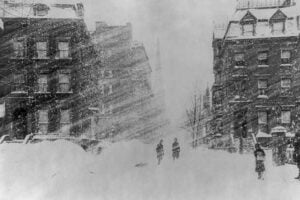
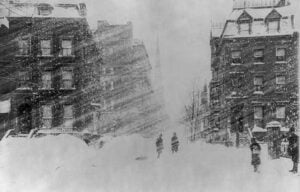
A New York City street buried in snow during the Great Blizzard of 1888. Photo: Library of Congress, public domain.
For nearly a century and a half, major winter storms have repeatedly brought New York City to a halt. Some buried the streets under record snow. Others crippled elevated trains, airports, buses, highways, and emergency services. A few became political disasters that changed the way New Yorkers judged City Hall.
The official snowfall record used throughout this article comes from Central Park, where continuous weather records date to 1869. But snowfall alone does not determine how disruptive a storm becomes. Wind, timing, temperature, transportation failures, abandoned vehicles, and the city’s ability to clear streets can turn a smaller storm into a much larger crisis. These 12 blizzards and major snowstorms stand out for the mark they left on New York.
1. The Great Blizzard of 1888
Dates: March 11-14, 1888
Official Central Park Snowfall: 21.0 inches
The Record & Impact: The Great Blizzard of 1888 remains one of the defining weather disasters in New York history. Rain on March 11 changed to heavy snow as temperatures plunged, and the city was battered by high winds, deep drifting, transportation failures, and widespread communications outages.
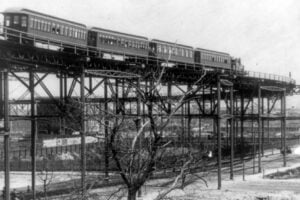
The Story: Elevated trains became stranded, surface transportation collapsed, and telegraph and telephone lines came down across the city. The storm did not single-handedly create the New York City subway, but the complete paralysis of above-ground transportation gave powerful new momentum to the argument for rapid transit beneath the streets. Construction of New York’s first subway began in 1900, and the first line opened in 1904. For more on the system that followed, see our guide to the 10 oldest subway stations in NYC still operating.
2. The Great Post-Christmas Blizzard of 1947
Dates: December 26-27, 1947
Official Central Park Snowfall: 26.4 inches
The Record & Impact: The 1947 storm established a Central Park single-storm snowfall record that stood for nearly six decades. More than 20 inches fell during a roughly 12-hour period at the height of the storm.
The Story: Forecasts had not prepared New Yorkers for a storm of this magnitude. Streets filled faster than plows could clear them, vehicles were abandoned, surface transportation stalled, and emergency movement became extraordinarily difficult. The 26.4-inch record survived until February 2006.
3. The Lindsay Snowstorm of 1969
Dates: February 9-10, 1969
Official Central Park Snowfall: 15.3 inches
The Record & Impact: The snowfall total was not one of the largest ever measured in Central Park, but the storm became one of the most politically consequential snow events in New York history.
The Story: Major Manhattan streets were cleared faster than many residential streets in the outer boroughs, and parts of Queens remained buried for days. Buses, deliveries, mail service, and emergency access were badly disrupted. Mayor John V. Lindsay’s visits to Queens produced angry confrontations with residents, and the cleanup failure became a lasting symbol of the political divide between City Hall and the outer boroughs. The storm was blamed for dozens of deaths and hundreds of injuries across the city.
4. The Blizzard of 1978
Dates: February 5-7, 1978
Official Central Park Snowfall: 17.7 inches
The Record & Impact: New York City received 17.7 inches, while portions of Long Island and New England were hit even harder. The storm disrupted roads, airports, commuter rail, schools, and businesses throughout the metropolitan region.
The Story: Heavy snow intensified rapidly as the nor’easter moved up the coast. Roads became difficult or impossible to navigate, vehicles were stranded or abandoned, and transportation systems struggled to recover as wind-driven snow continued to drift. The storm became one of the benchmark Northeast blizzards of the late 20th century.
5. The Megalopolitan Snowstorm of 1983
Dates: February 11-12, 1983
Official Central Park Snowfall: 17.6 inches
The Record & Impact: Snow began in the New York area shortly before 1 p.m. on February 11 and continued until the following morning. Central Park received 17.6 inches, and all local airports were closed during the storm.
The Story: The storm included thunder and gusty winds that produced heavy drifting and difficult travel. Kennedy Airport recorded more than 21 inches. Vehicles became stranded on highways and local roads as the dense snowfall overwhelmed normal transportation across the region.
6. The Blizzard of 1996
Dates: January 7-8, 1996
Official Central Park Snowfall: 20.2 inches
The Record & Impact: The Blizzard of 1996 buried New York during a storm that affected much of the East Coast. New York State declared a state of emergency, the city’s three major airports closed, and New York City restricted nonessential driving.
The Story: Public schools closed for two days, including New York City’s first snow day since 1978. More than a thousand city plows worked through the storm, and Mayor Rudolph Giuliani repeatedly toured the boroughs as the city dug out. The response was watched closely because the political memory of the Lindsay Snowstorm still hung over every mayor faced with a major winter emergency.
7. The Presidents’ Day Blizzard of 2003
Dates: February 16-17, 2003
Official Central Park Snowfall: 19.8 inches
The Record & Impact: The Presidents’ Day storm was a major East Coast snowstorm that dropped nearly 20 inches in Central Park and much larger totals across parts of the Mid-Atlantic and Northeast.
The Story: The holiday timing kept some commuters off the roads, but the sheer size of the storm caused widespread airport cancellations, highway problems, and commuter-rail delays. Deep snow buried parked vehicles and forced sanitation crews to keep plowing long after the heaviest precipitation had ended.
8. The Record-Breaking Snowstorm of 2006
Dates: February 11-12, 2006
Official Central Park Snowfall: 26.9 inches
The Record & Impact: Central Park recorded 26.9 inches, breaking the 26.4-inch record established by the 1947 storm.
The Story: An exceptionally intense band of snow settled over New York City, producing snowfall rates of 3 to 4 inches per hour at times. Thundersnow was reported as the heaviest band crossed the city. The combination of rapid accumulation, strong coastal winds, and near-blizzard conditions made travel extremely hazardous. The record lasted until 2016.
9. The Boxing Day Blizzard of 2010
Dates: December 26-27, 2010
Official Central Park Snowfall: 20.0 inches
The Record & Impact: This storm combined 20 inches of snow in Central Park with strong winds and a disastrous breakdown in street clearing and transportation. Some parts of the five boroughs received roughly two feet or more.
The Story: Hundreds of vehicles were abandoned, approximately 600 MTA buses became stuck, and emergency vehicles struggled to move through unplowed streets. An A train carrying passengers was stranded for about seven hours in Queens. The response became the subject of City Council hearings and a formal review that produced recommendations for improving future winter emergency operations.
10. Winter Storm Jonas, the Blizzard of 2016
Dates: January 22-24, 2016
Official Central Park Snowfall: 27.5 inches
The Record & Impact: With 27.5 inches measured in Central Park, the January 2016 blizzard became the largest single snowstorm in the city’s official record dating to 1869.
The Story: Blizzard conditions spread across New York City and Long Island as snow fell at rates exceeding 2 inches per hour during the storm’s most intense periods. Roads were restricted, above-ground transportation was curtailed, and the city largely shut down while thousands of snow-removal workers attacked an accumulation that exceeded two feet in many neighborhoods.
11. The Groundhog Day Nor’easter of 2021
Dates: January 31-February 3, 2021
Official Central Park Snowfall: 17.4 inches
The Record & Impact: The 2021 storm was notable for its duration. Snow fell over parts of the region for more than two days, with Central Park finishing at 17.4 inches.
The Story: The nor’easter arrived while New York was still operating under COVID-era disruptions, adding a major weather emergency to an already unusual period in city life. Hazardous-travel advisories were issued, alternate-side parking was suspended for several days, and prolonged snow removal affected roads and transit across the metropolitan region.
12. The Blizzard of February 2026
Dates: February 22-23, 2026
Official Central Park Snowfall: 19.7 inches
The Record & Impact: The February 2026 storm became New York City’s first blizzard since 2016. Central Park recorded 19.7 inches, while parts of eastern Staten Island exceeded two feet and some Manhattan neighborhoods reported more than 20 inches.
The Story: New York City declared a local state of emergency and imposed a temporary citywide travel ban covering streets, highways, bridges, and tunnels from Sunday night into Monday. Public schools received a traditional snow day, and wind gusts reached around 60 mph in parts of the city. The storm was a reminder that even with modern forecasting, coordinated sanitation operations, and decades of experience, a major blizzard can still bring New York to a near standstill.
New York City’s 12 Historic Snowstorms at a Glance
| Storm | Dates | Central Park Snowfall |
|---|---|---|
| Great Blizzard of 1888 | March 11-14, 1888 | 21.0 inches |
| Post-Christmas Blizzard of 1947 | December 26-27, 1947 | 26.4 inches |
| Lindsay Snowstorm | February 9-10, 1969 | 15.3 inches |
| Blizzard of 1978 | February 5-7, 1978 | 17.7 inches |
| Megalopolitan Snowstorm of 1983 | February 11-12, 1983 | 17.6 inches |
| Blizzard of 1996 | January 7-8, 1996 | 20.2 inches |
| Presidents’ Day Blizzard of 2003 | February 16-17, 2003 | 19.8 inches |
| Record-Breaking Snowstorm of 2006 | February 11-12, 2006 | 26.9 inches |
| Boxing Day Blizzard of 2010 | December 26-27, 2010 | 20.0 inches |
| Blizzard of 2016 | January 22-24, 2016 | 27.5 inches |
| Groundhog Day Nor’easter of 2021 | January 31-February 3, 2021 | 17.4 inches |
| Blizzard of February 2026 | February 22-23, 2026 | 19.7 inches |
For more on the parts of New York that these storms repeatedly tested, read our History of New York’s Central Park, 10 Oldest Subway Stations in NYC Still Operating, Life on the Long Island Expressway, and How to Get Around NYC: 65 Years of Local Advice from a Born-and-Raised New Yorker.
Sources
National Weather Service — Biggest Snowstorms at Central Park, 1869 to Present
Library of Congress — Great Blizzard of 1888
Library of Congress — New York Elevated Railways, the 1888 Blizzard, and the Subway
National Weather Service — The December 1947 New York Snowstorm
National Weather Service — Blizzard of 1983
National Weather Service Heritage — The Blizzard of 1996 in Retrospect
National Weather Service — Presidents’ Day Storm of 2003
National Weather Service — February 2006 New York Snowstorm
National Weather Service — Meteorology of the December 2010 Blizzard
NYC Emergency Management — December 2010 Snowstorm Response
National Weather Service — January 2016 Blizzard
National Weather Service — January 31-February 2, 2021 Major Winter Storm
National Weather Service — February 22-23, 2026 Blizzard
City of New York — February 2026 Blizzard State of Emergency and Travel Ban
12 Historic Blizzards That Paralyzed New York City article published on ClassicNewYorkHistory.com © 2026