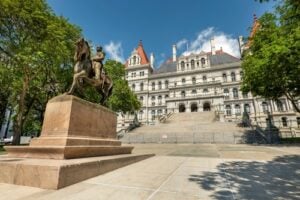
New York State Capitol in Albany. Photo: Cavan-Images / Shutterstock.com
The internet is flooded with legal urban legends about New York. Claims that it is illegal to throw a ball at someone’s head for fun, that women can be fined simply for wearing body-hugging clothing on the street, or that jumping off a building carries the death penalty have circulated for years. They are not reliable examples of current New York law.
There is plenty of genuinely strange material without resorting to myths. New York State and New York City still have highly specific provisions covering everything from public contact with big cats and hunting rabbits with ferrets to talc-coated rice, margarine labels, firearm-shaped food packages, and puppet performances displayed from building windows.
One frequently repeated example also no longer belongs on a list of laws still in force. New York Penal Law § 240.35(4), the old anti-mask loitering provision, was repealed in 2020. The 10 examples below were checked against current New York State and New York City code sources.
One important distinction: saying that a law is “still on the books” means the provision remains in the current statutory or administrative code. It does not necessarily mean that it is commonly enforced, and many of these laws contain exceptions or apply only in particular circumstances.
1. The Big-Cat “Tiger Selfie” Ban — New York Environmental Conservation Law § 11-0538
The Legal Code: NY Envtl. Conserv. Law § 11-0538
The Rule: New York prohibits people who are licensed or required to be licensed as animal exhibitors or dealers under the federal Animal Welfare Act, including their agents and employees, from knowingly allowing the public to have direct contact with a big cat.
The law’s definition of “direct contact” is what makes this one stand out. It includes not only actual physical contact but also proximity in which physical contact is possible. The statute specifically includes allowing a photograph to be taken without a permanent physical barrier separating the public from the animal. Lions, tigers, leopards, jaguars, mountain lions or cougars, and certain hybrids fall within the law’s definition of a big cat.
The penalty can reach $500 for a first offense and $1,000 for a second or subsequent offense, with each instance of prohibited direct contact treated as a separate offense.
2. New York City’s Strange Puppet Show Rule — NYC Administrative Code § 10-114
The Legal Code: NYC Admin. Code § 10-114
The Rule: New York City still has a section of its public-safety code titled “Street shows.” Among other things, it prohibits a person from using a window or other open space of a building to display to people on the street or sidewalk a performance involving puppet or other figures, dancing, comedy, farce, moving figures, a play, or other entertainment.
This is considerably stranger than the internet version of the story, but it is also more specific. The current law does not say that every puppet show in New York City requires a permit from the police commissioner. The provision is aimed at performances exhibited from a building to the public on the street or sidewalk.
A violation can carry a fine of up to $25, imprisonment for up to 30 days, or both.
3. Ferrets and Rabbit Hunting — New York Environmental Conservation Law § 11-0901
The Legal Code: NY Envtl. Conserv. Law § 11-0901(5)
The Rule: Varying hares may not be taken with ferrets, fitch-ferrets, or fitch. Cottontail rabbits also may not be taken with them unless the practice is permitted by Department of Environmental Conservation regulation or authorized by a department permit.
The statute goes one step further: possession of ferrets, fitch-ferrets, or fitch while afield is presumptive evidence of illegal use. The Department of Environmental Conservation may establish places where they can be used for cottontail rabbits, and permits can be issued in certain circumstances involving rabbits damaging occupied lands.
It is an unusually specific hunting restriction, but it is not a blanket statewide law making every use of a ferret in hunting illegal.
4. New York’s Sunday Public-Selling Law — General Business Law § 9
The Legal Code: NY Gen. Bus. Law § 9
The Rule: New York’s General Business Law still contains a provision stating that public selling or offering property for sale on Sunday is prohibited except for a long list of specifically identified exceptions.
The provision sits inside Article 2 of the General Business Law, which is still titled “Sabbath.” The exceptions include numerous familiar Sunday transactions, such as certain foods, meals, newspapers, gasoline, medicine, flowers, antiques, and other listed goods and services. The law also expressly permits public auctions of certain racehorses.
Real estate is not among the listed exceptions. That makes this one of the more remarkable surviving pieces of New York’s old Sunday-commerce framework, although the statute should not be read as a blanket prohibition on all business activity on Sundays.
5. New York City Still Specifically Regulates Ashes, Coal, and Windblown Dust — NYC Administrative Code § 16-118
The Legal Code: NYC Admin. Code § 16-118
The Rule: New York City’s littering law specifically prohibits throwing or casting ashes, garbage, paper, dust, and other rubbish into streets and other public places. Another subsection specifically addresses lime, ashes, coal, dry sand, hair, waste paper, feathers, and other substances capable of being blown by the wind.
The wording is a fascinating reminder of the city that existed before modern heating and sanitation systems. Ashes and coal are still named right alongside modern forms of litter and refuse. The same section also prohibits vehicles from dropping or spilling materials including ashes, manure, garbage, and other offensive matter in streets or public places.
6. New York’s Extremely Specific Margarine Labeling Law — Agriculture & Markets Law § 62
The Legal Code: NY Agric. & Mkts. Law § 62
The Rule: New York still maintains remarkably detailed requirements for substances designed to take the place of butter. Margarine or oleomargarine offered for sale must be packaged and labeled according to requirements set out in the statute.
The label must display the word “oleomargarine” or “margarine” in lettering at least as large as any other lettering on the label, state the net weight, and provide a full and accurate ingredient statement. The statute even specifies that individual portions inside the package must carry the words “oleomargarine” or “margarine” in type no smaller than 20-point type.
The same section also contains detailed restrictions involving coloring and representations associated with cheese substitutes and dairy products.
7. You Cannot Sell Talc-Coated Rice in New York — Agriculture & Markets Law § 214-L
The Legal Code: NY Agric. & Mkts. Law § 214-L
The Rule: New York law expressly prohibits selling, offering for sale, or exposing for sale rice that has been coated or treated with talc.
The statute even defines “talc coated rice” as milled rice coated in whole or in part with glucose and talc, and separately defines talc for purposes of the law. A first violation can bring a civil fine of up to $1,000, while a subsequent offense can bring a civil fine of up to $10,000.
The law provides an affirmative defense for a seller who did not know and could not reasonably have known that the rice contained talc.
8. The 500-Foot Firearm Buffer Includes Occupied Factories — Environmental Conservation Law § 11-0931
The Legal Code: NY Envtl. Conserv. Law § 11-0931(4)(a)(2)
The Rule: New York law generally prohibits discharging a firearm within 500 feet of several specified places, including an occupied or used dwelling or farm structure, a school building, school playground, public structure, occupied factory, or church. The same section establishes shorter distances for longbows and crossbows.
The inclusion of an “occupied factory” is the detail that makes the provision especially memorable. The statute contains exceptions, including provisions affecting owners or lessees and certain authorized activities, so the 500-foot rule should not be reduced to the simple internet claim that written permission from any nearby property owner automatically makes the restriction disappear.
9. Food Cannot Be Packaged in the Shape of a Firearm — Agriculture & Markets Law § 210
The Legal Code: NY Agric. & Mkts. Law § 210
The Rule: New York prohibits the manufacture, sale, offering, export, or possession for sale of food or food products packed in a container shaped like a firearm when the food is intended to be consumed from that packaging.
The law contains one conspicuous exception: alcoholic beverages are excluded. It also provides civil penalties and treats each packaged food product as a separate violation.
Of all the laws on this list, this may be one of the hardest to guess without actually reading the Agriculture & Markets Law.
10. New York Protects Maple, Birch, Walnut, and Beech Syrup from Imitations — Agriculture & Markets Law § 203
The Legal Code: NY Agric. & Mkts. Law § 203
The Rule: New York law prohibits manufacturing for sale, keeping for sale, or offering products that imitate or resemble pure maple sugar or maple syrup when they are not actually pure maple products.
What makes the statute especially unusual is how far it goes beyond maple. The current law contains comparable provisions for birch, walnut, and beech sugar and syrup. Each is specifically defined in relation to the sap or syrup from the corresponding tree.
New York has a long tradition of regulating agricultural products closely, but seeing maple, birch, walnut, and beech syrup spelled out individually in a modern state statute is a reminder of just how detailed the Agriculture & Markets Law can be.
New York’s Strangest Verified Laws at a Glance
| Law | Citation | What the Current Law Actually Does |
|---|---|---|
| Big-cat direct-contact ban | NY Envtl. Conserv. Law § 11-0538 | Bars covered exhibitors and dealers from allowing public direct contact with big cats, including certain barrier-free photo situations. |
| Street puppet performances | NYC Admin. Code § 10-114 | Prohibits specified public-facing entertainment, including puppet performances, displayed from a building to people on the street or sidewalk. |
| Ferrets and rabbit hunting | NY Envtl. Conserv. Law § 11-0901(5) | Bars using ferrets for varying hares and restricts their use for cottontail rabbits unless authorized. |
| Sunday public selling | NY Gen. Bus. Law § 9 | Prohibits public selling or offering property on Sunday except for statutory exceptions. |
| Ashes and windblown material | NYC Admin. Code § 16-118 | Specifically regulates disposal and exposure of ashes, coal, dust, and other refuse or windblown materials. |
| Margarine labeling | NY Agric. & Mkts. Law § 62 | Requires detailed labeling and packaging for margarine and other butter substitutes. |
| Talc-coated rice | NY Agric. & Mkts. Law § 214-L | Prohibits selling rice coated or treated with talc. |
| Firearm buffer around factories | NY Envtl. Conserv. Law § 11-0931 | Includes occupied factories among places protected by the general 500-foot firearm-discharge buffer. |
| Firearm-shaped food packaging | NY Agric. & Mkts. Law § 210 | Prohibits food packaged for consumption from containers shaped like firearms, with an alcohol exception. |
| Imitation tree syrups | NY Agric. & Mkts. Law § 203 | Regulates imitation maple, birch, walnut, and beech sugar and syrup. |
New York’s laws make more sense when viewed alongside the institutions, labor battles, and everyday rules that shaped the state. Readers interested in that wider story can explore our History of New York’s City Hall, our guide to turning right on red in New York City, and our look at the history of the minimum wage in New York.
Sources
- New York State Senate — Environmental Conservation Law § 11-0538
- New York City Administrative Code — § 10-114, Street Shows
- New York State Senate — Environmental Conservation Law § 11-0901
- New York State Senate — General Business Law § 9
- New York City Administrative Code — § 16-118, Littering Prohibited
- New York State Senate — Agriculture & Markets Law § 62
- New York State Senate — Agriculture & Markets Law § 214-L
- New York State Senate — Environmental Conservation Law § 11-0931
- New York State Senate — Agriculture & Markets Law § 210
- New York State Senate — Agriculture & Markets Law § 203
- New York State Senate — S8415, repeal of Penal Law § 240.35(4)
Disclaimer: This article is provided for historical, educational, informational, and general-interest purposes only. ClassicNewYorkHistory.com is not a law firm, and nothing in this article should be interpreted as legal advice or as a recommendation concerning any specific situation. Laws, regulations, interpretations, and enforcement practices can change over time. Readers should consult current official government sources or a qualified attorney before relying on any law discussed here for legal guidance.