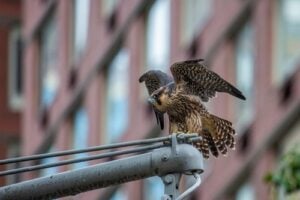
A peregrine falcon perched on urban infrastructure in New York City. Photo: BirbsofNY / Shutterstock.com.
To most people outside the five boroughs, the wildlife of New York City begins and ends with street pigeons, subway rats, and bold raccoons raiding trash cans. The city is often portrayed as an asphalt-and-concrete landscape where wild animals would have little chance of surviving.
The reality is very different. New York City sits along the Atlantic Flyway, is surrounded by ocean, harbor, rivers, bays, and estuaries, and contains more than 30,000 acres of municipal parkland, including thousands of acres of forests, wetlands, marshes, beaches, and other natural areas. Those habitats support an extraordinary variety of wildlife within one of the most densely populated cities in the United States.
Some of these animals live and breed in the five boroughs year-round. Others return seasonally to New York Harbor, Jamaica Bay, and the Atlantic waters off Queens and Brooklyn. From peregrine falcons nesting on bridge towers to coyotes raising families in city parkland and humpback whales feeding within sight of the skyline, these are 15 wild creatures that really can be found in New York City.
1. Peregrine Falcons (Falco peregrinus)
- Primary NYC Habitats: Bridges, skyscrapers, church towers, and other high structures
- Status: Breeding residents
The peregrine falcon is the fastest animal on Earth, capable of exceeding 200 miles per hour during a hunting dive. The species was nearly eliminated from the eastern United States during the 20th century as DDT and other pesticides caused eggshell thinning and breeding failures. New York’s recovery program eventually helped bring the birds back, and peregrines resumed breeding in New York City in 1983. The city’s bridges and tall buildings turned out to be excellent substitutes for the cliffs the birds use in the wild. MTA Bridges and Tunnels has maintained nesting boxes on the Verrazzano-Narrows, Throgs Neck, and Marine Parkway-Gil Hodges Memorial bridges, where chicks have been monitored and banded for decades. Pigeons and other city birds provide plenty of prey below.
2. Eastern Coyotes (Canis latrans)
- Primary NYC Habitats: The Bronx, with animals also known in Queens, Manhattan, and Staten Island
- Status: Established residents
Coyotes are no longer simply occasional visitors that wandered into New York City by mistake. According to the city’s WildlifeNYC program, ancestors of today’s local coyotes began moving into the Bronx during the 1990s as the species expanded its range across New York State. The Bronx remains their strongest foothold, but coyotes are now known in Queens, Manhattan, and Staten Island as well. They may live alone or in family groups rather than the large packs associated with wolves. Their ability to eat rodents, birds, insects, vegetation, and other available food has helped them adjust to urban forests and parkland. A coyote in New York City is still startling to see, but it is no longer an ecological accident.
3. Monk Parakeets / Quaker Parrots (Myiopsitta monachus)
- Primary NYC Habitats: Brooklyn, with established colonies also documented in Queens and the Bronx
- Status: Self-sustaining feral colonies
One of the strangest sights in Brooklyn is a flock of bright-green parrots flying over Brooklyn parkland or roosting around the monumental Gothic entrance to Green-Wood Cemetery. Monk parakeets are native to South America and reached the United States through the pet trade during the 1960s. The famous story that an entire shipment escaped from JFK Airport has been repeated for decades, but the precise origin of New York’s colonies has never been firmly established. What is certain is that the birds adapted. Unlike most parrots, monk parakeets build large communal stick nests, a behavior that helps them survive New York winters. Green-Wood’s colony remains one of the city’s best-known populations.
4. Humpback Whales (Megaptera novaeangliae)
- Primary NYC Habitats: Lower New York Bay, the New York Bight, and Atlantic waters off the Rockaways
- Status: Seasonal visitors
Seeing a humpback whale surface within sight of New York City would once have seemed almost impossible. Decades of improvements in wastewater treatment and harbor water quality have helped restore marine life to the region, while schools of Atlantic menhaden, commonly called bunker, provide an important food source for whales. Researchers have documented a dramatic increase in humpback activity in the New York Bight since systematic local observations began in 2011. Humpbacks can now be seen feeding in waters off the Rockaways and near the entrance to New York Harbor, and whale-watching boats regularly leave from the city during the warmer months. They do not breed in New York City waters, but they have become remarkable seasonal New Yorkers.
5. Horseshoe Crabs (Limulus polyphemus)
- Primary NYC Habitats: Jamaica Bay and Atlantic-facing beaches
- Status: Native seasonal spawning population
Horseshoe crabs have existed for more than 450 million years, long before the dinosaurs, and thousands still come ashore around Jamaica Bay each spring to reproduce. During spawning, females bury clusters of eggs in sandy beaches while males gather around them in the shallow water. Those eggs are an important food source for migratory shorebirds traveling north along the Atlantic Flyway. Among them is the rufa red knot, a federally threatened bird that depends heavily on coastal stopover habitat during its extraordinary migration to the Arctic. The sight of horseshoe crabs gathering on a New York City beach is a reminder that some of the city’s oldest residents are not people at all.
6. Diamondback Terrapins (Malaclemys terrapin)
- Primary NYC Habitats: Jamaica Bay salt marshes and shorelines
- Status: Native nesting population
Diamondback terrapins are the only North American turtles adapted exclusively to brackish coastal waters, and Jamaica Bay supports an important population. Their most famous New York behavior occurs beside John F. Kennedy International Airport. During the nesting season, female terrapins leave the bay searching for sandy ground above the high-tide line and sometimes enter airport property. In 2011, terrapins on Runway 4L and nearby taxiways caused temporary flight delays, and the Port Authority has since used fencing, monitoring, tagging, and wildlife crews to reduce conflicts. Hundreds may be handled during a busy nesting season. Few cities can claim that wild turtles occasionally interfere with international air traffic.
7. Red Foxes (Vulpes vulpes)
- Primary NYC Habitats: The Bronx and Staten Island
- Status: Resident breeding populations
Red foxes are native to the New York region and remain surprisingly successful within the city. WildlifeNYC reports that they are found predominantly in the Bronx and on Staten Island, where large parks, golf courses, open lots, and natural areas provide the mixture of cover and open ground they prefer. Foxes are mostly active at night, dawn, and dusk, which explains why many New Yorkers can live near them without ever seeing one. Their diet changes with what is available and can include mice, rats, rabbits, squirrels, birds, insects, fruit, and carrion. Their ability to remain almost invisible is one reason they have survived so well in an urban environment.
8. North American Beavers (Castor canadensis)
- Primary NYC Habitats: Bronx River and Staten Island waterways
- Status: Native returnees
Beavers occupy a special place in New York history. The enormous European demand for beaver pelts helped attract traders to the region during the colonial era, and beavers still appear on the official Seal of the City of New York. Overtrapping and habitat loss eventually eliminated them from the city. Then, in 2007, a beaver appeared in the Bronx River near the Bronx Zoo, becoming the first documented wild beaver in New York City in more than 200 years. He was named José in honor of Congressman José E. Serrano. A second beaver, eventually named Justin Beaver, appeared in 2010. After years without a confirmed Bronx River beaver, the Bronx River Alliance reported another beaver sighting in May 2025. WildlifeNYC also reports beavers on Staten Island and occasional sightings elsewhere in the city.
9. Harbor Seals (Phoca vitulina)
- Primary NYC Habitats: Lower New York Harbor, including the waters around Hoffman and Swinburne islands
- Status: Regular winter visitors
When the weather turns cold, harbor seals can become part of the New York Harbor landscape. The National Park Service identifies Hoffman and Swinburne islands, two former quarantine islands off Staten Island, as habitat used by seals as well as nesting birds. Harbor seals generally visit New York waters during the colder months, resting on rocks, islands, sandbars, and other haul-out sites before returning to the water to feed. Their presence is another sign of how much marine life exists just beyond the city shoreline, even when most New Yorkers are looking inland.
10. Eastern Wild Turkeys (Meleagris gallopavo)
- Primary NYC Habitats: Staten Island parkland and wooded areas
- Status: Wild resident population
Wild turkeys are not limited to Thanksgiving imagery or rural upstate roads. They also live in New York City. The birds are native to New York State but disappeared from much of the state during the 19th century as forests were cleared and hunting went largely unregulated. A major recovery followed during the 20th century, helped by natural expansion and state restoration programs. WildlifeNYC documents wild turkeys within the city, including groups on Staten Island. They forage on insects, seeds, nuts, fruit, and vegetation, roost in trees at night, and can fly despite spending much of their time walking across the ground.
11. Red-Tailed Hawks (Buteo jamaicensis)
- Primary NYC Habitats: Parks, trees, bridges, and buildings throughout the city
- Status: Breeding residents
Red-tailed hawks have become some of New York City’s most visible wild predators. The most famous was Pale Male, who began nesting near Central Park in the early 1990s and turned the ledges of 927 Fifth Avenue into one of the best-known urban bird nests in America. His fame helped show the public how successfully red-tailed hawks had adapted to city life. WildlifeNYC has documented nests on buildings, bridges, and other structures, and the birds can be seen hunting rodents in parks and open spaces. In 2016, at least 20 red-tailed hawk nests were documented in Manhattan alone.
12. White-Tailed Deer (Odocoileus virginianus)
- Primary NYC Habitats: Staten Island and the Bronx
- Status: Established breeding populations
White-tailed deer are firmly established within New York City. WildlifeNYC reports populations throughout Staten Island green spaces and in Van Cortlandt and Pelham Bay parks in the Bronx. The city says deer reached Staten Island by swimming from New Jersey, while Bronx deer expanded southward from Westchester. Their numbers became large enough on Staten Island that New York City launched a non-lethal Deer Impact Management Plan in 2016, combining population control through male sterilization with traffic-safety measures, habitat protection, monitoring, and public education. Deer can now appear in backyards, parks, golf courses, and along roads in parts of the city where a visitor might never expect to see them.
13. Virginia Opossums (Didelphis virginiana)
- Primary NYC Habitats: Parks, backyards, wooded edges, sewers, and other sheltered urban spaces
- Status: Native nocturnal residents
Virginia opossums are North America’s only native marsupials, and they have adapted remarkably well to New York City. They are mostly active at night and use tree hollows, logs, abandoned burrows, sewers, and spaces beneath buildings for temporary shelter. Their unusual anatomy includes grasping toes on their hind feet and a prehensile tail used for balance and climbing. Opossums eat an extremely broad diet that can include insects, fruit, seeds, eggs, reptiles, carrion, and food found around human development. Rabies is uncommon in opossums because of their low body temperature, but it is still possible, so they should be treated like any other wild animal and observed from a distance.
14. Striped Skunks (Mephitis mephitis)
- Primary NYC Habitats: Open lots, grassy parkland, and natural areas
- Status: Uncommon but established city wildlife
Striped skunks are relatively rare in New York City, but WildlifeNYC reports sightings across the boroughs. They prefer open areas and may den beneath buildings, inside hollow logs, or in burrows originally dug by other animals. Skunks are opportunistic feeders, eating insects, small mammals, birds, vegetation, nuts, reptiles, amphibians, and other available foods. Their famous spray can travel several feet and is usually used only after warning behaviors such as stomping, hissing, and raising the tail. The smartest response to a New York City skunk is the same one the animal usually wants: plenty of distance.
15. Black-Crowned Night Herons (Nycticorax nycticorax)
- Primary NYC Habitats: New York Harbor islands, Jamaica Bay, and park waterways
- Status: Breeding waterbird in serious local decline
Black-crowned night herons are among the most striking birds found around New York City’s waterways. Adults have black crowns and backs, gray wings, pale underparts, and bright red eyes. They feed mainly during the evening and at night, standing nearly motionless beside water before striking at fish, crustaceans, frogs, and other prey. For decades they were one of the most abundant members of the colonial waterbird colonies nesting on islands in New York Harbor, and they can also be seen around Jamaica Bay and waterways in parks such as Prospect Park. Their future in the city is now uncertain. NYC Bird Alliance has documented a severe decline and warned in 2025 that the species could disappear from New York Harbor within a decade without successful conservation efforts.
Wildlife should always be observed from a safe distance. Never feed coyotes, deer, foxes, skunks, seals, or other wild animals, and never approach or handle wildlife unless you are a trained and authorized professional.
For more on the natural side of New York City, explore our histories of Central Park, Prospect Park, the Bronx Zoo, and the New York Aquarium.
Sources
- WildlifeNYC — Animals of New York City
- New York State Department of Environmental Conservation — Peregrine Falcon
- MTA Bridges and Tunnels — Peregrine Falcon Nesting Program
- WildlifeNYC — Eastern Coyotes
- The Green-Wood Cemetery — Monk Parakeets
- New York City Department of Environmental Protection — New York Harbor Wildlife and Water Quality
- National Park Service — Horseshoe Crabs at Jamaica Bay
- National Park Service — Diamondback Terrapin
- Port Authority of New York and New Jersey — Terrapins at JFK Airport
- WildlifeNYC — Red Foxes
- WildlifeNYC — Beavers
- Bronx River Alliance — Beavers Back in the Bronx River
- National Park Service — Hoffman and Swinburne Islands
Published September 8, 2026.