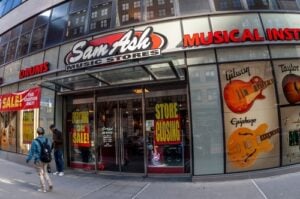
Sam Ash Music Store on West 34th Street in Manhattan displaying store-closing signs in March 2024. Photo by rblfmr / Shutterstock.com.
For exactly one hundred years, Sam Ash Music was a fixture of the musical instrument business. Generations of musicians bought their first guitars, drum kits, amplifiers, keyboards, and sheet music from the family-owned chain. What began in a small Brooklyn storefront grew into a national retailer, with stores that gave customers a chance to handle instruments, ask questions, and hear what they sounded like before making a purchase.
So whatever happened to Sam Ash Music Stores? The company closed all of its remaining physical stores in 2024 after mounting debts, declining sales, and changing shopping habits pushed it into Chapter 11 bankruptcy. But the name did not disappear altogether. Mexico-based Gonher acquired the Sam Ash brand and its online business, which relaunched as an internet-only retailer called Sam Ash Direct in 2025. The old stores are gone; the Sam Ash name survives online.
For New Yorkers, the closings marked the end of something more personal than a familiar chain. Sam Ash had been part of the city’s musical life since the 1920s, and its Manhattan stores were fixtures of West 48th Street’s celebrated Music Row. The history of the company is also the history of a Brooklyn family, the growth of Long Island’s suburbs, the arrival of rock and roll, and the transformation of musical instrument shopping.
The Brooklyn Beginnings of Sam Ash Music
The history of the company is a classic New York immigrant success story. Sam Ash, born Sam Ashkynase, came to the United States from Europe as a child and settled with his family in Brooklyn. He worked as a violinist, performing at weddings and other events, but the hours and unpredictability of a musician’s income made it difficult to build a settled family life. He and his wife, Rose, decided to open a business based on what he knew best: music.
According to the Ash family’s account, Rose pawned her engagement ring for $400 to help finance their first store. They opened the small business in Brooklyn’s Brownsville neighborhood in May 1924, selling phonographs, sheet music, and a modest selection of instruments. The family lived behind the store, and their children grew up surrounded by both the rewards and the difficulties of running a neighborhood business.
Those early years were far from easy. The Great Depression put tremendous pressure on the shop, and changes in the way people listened to music affected sales. The family persevered, moving to a larger location on Utica Avenue in 1944. Their sons Jerome, known as Jerry, and Paul became increasingly involved. Paul developed a record department, while the family expanded the store’s instrument business.
From Brooklyn to Long Island: The Ash Family Expands
Sam Ash died in 1956, just as rock and roll was changing the music business. Jerry and Paul recognized the growing demand for electric guitars, amplifiers, and other equipment. Brands such as Fender and Gibson joined the instruments and supplies the store already sold. Sam Ash was no longer serving only traditional students, orchestral players, and working musicians; a new generation wanted to make the sounds it heard on records and radio.
The brothers also saw how many customers were traveling into Brooklyn from the growing suburbs of Long Island. In 1961, they opened a second store in Hempstead. Its success helped establish the model for the company’s expansion: large stores carrying a wide assortment of instruments and staffed by people who understood the equipment. Later stores served more communities across the New York metropolitan area before the company moved into other states.
Long Island remained central to the business even as its reach grew nationwide. The company maintained its corporate headquarters in Hicksville, keeping an important connection to the region where the Ash family had built one of its first major successes outside Brooklyn.
Sam Ash on 48th Street: New York City’s Famous Music Row
One of the most memorable chapters in Sam Ash history unfolded on West 48th Street in Manhattan. For decades, the block between Sixth and Seventh Avenues was known as Music Row because of its concentration of instrument dealers. It was a place where a guitarist could compare instruments, a drummer could look for new equipment, and a working musician could talk with salespeople who knew what was happening in the business.
Sam Ash arrived on Music Row in 1969 and gradually expanded into additional storefronts. Its neighbors included other celebrated music retailers, among them Manny’s Music, a store with its own remarkable history and connections to generations of performers. In 1999, Sam Ash acquired Manny’s, although the famous Manny’s shop later closed in 2009. The transaction symbolized how much the street and the instrument business had changed.
There was an appeal to Music Row that an online catalog could not replace. Musicians could try an instrument before committing to it, compare tones and equipment in person, and run into other people who shared their interests. For someone buying a first electric guitar, those experiences could be almost as memorable as the purchase itself. Sam Ash’s own identity was closely tied to that hands-on culture.
But the 48th Street era eventually ended. In 2013, Sam Ash announced the opening of a 30,000-square-foot superstore at 333 West 34th Street, consolidating its former 48th Street operations into a single location. The new store preserved a Manhattan presence for another decade, although it could not preserve the older world of Music Row.
How Sam Ash Grew Into a National Music Store Chain
During the second half of the twentieth century, the company expanded well beyond its New York beginnings. The third generation of the Ash family became involved in the business, and stores opened in other regions of the country. By the time of its final collapse, Sam Ash had become one of the best-known names in American musical instrument retailing.
The stores offered a broad assortment of guitars, basses, drum sets, keyboards, brass and woodwind instruments, recording equipment, and accessories. Over time, digital recording, synthesizers, and live-sound technology became increasingly important parts of the business. Sam Ash also operated online and had its own distribution and wholesale interests.
That variety was part of the appeal but also part of the challenge. A full-service instrument store requires considerable space, substantial inventory, knowledgeable employees, and customers willing to visit. As internet shopping became more convenient, the economics of maintaining large stores grew increasingly difficult.
Why Did Sam Ash Music Stores Close?
Despite a century of historical success, Sam Ash struggled with major changes in consumer behavior. Online retailers gave shoppers more ways to compare prices and order instruments without going to a store. The COVID-19 pandemic intensified the problem by sharply reducing in-person traffic, a serious blow to a business built around the experience of visiting a music shop.
Financial pressures added to the difficulty. According to Reuters’ reporting on the bankruptcy, Sam Ash generated about $145 million in physical-store revenue and $42 million in online sales in 2023, both substantially below its pre-pandemic business levels. When the company entered bankruptcy, it owed approximately $20 million to its main lender and another $20 million to landlords and suppliers. The company was also having trouble paying some vendors, which affected the flow of inventory into its stores.
In March 2024, Sam Ash announced plans to close a number of locations, initially hoping to reduce costs and preserve the business. The situation continued to deteriorate. In early May, the company announced that all 42 remaining stores would close. For customers, employees, and musicians who had visited the chain for decades, the decision brought an abrupt end to a hundred years of physical retailing.
Bankruptcy and the Gonher Acquisition
On May 8, 2024, Sam Ash Music Corporation and affiliated companies filed for Chapter 11 bankruptcy protection in the United States Bankruptcy Court for the District of New Jersey. Although Chapter 11 sometimes allows a company to reorganize and continue operating, the Sam Ash proceedings led to the sale of assets and the liquidation of the old store business.
An auction took place on June 20, 2024. After competing bids, Mexico-based Gonher emerged as the successful buyer with a bid valued at $15.2 million. The transaction involved the Sam Ash e-commerce business and related assets, as well as Samson Technologies, a wholesale equipment company associated with the former retailer. The sale did not mean the closed Sam Ash stores would reopen.
Gonher was itself a longstanding family-run music business, founded in Mexico in 1956. The acquisition meant that a retailer with roots in another country’s musical instrument industry would carry the Sam Ash name into its next chapter. The original company’s bankruptcy liquidation plan was confirmed in August 2024.
Is Sam Ash Still in Business Today?
Yes, but not as the familiar chain of walk-in music stores. Following the acquisition, Sam Ash returned as an online-focused retailer. In March 2025, the business announced its relaunch as Sam Ash Direct, continuing to sell musical instruments, recording equipment, and professional audio products through SamAsh.com.
The revived business has emphasized online ordering and remote advice from music gear specialists. That preserves the Sam Ash brand, but it is not the same experience as wandering through the guitar department, trying amplifiers, or speaking face-to-face with a drummer or guitarist working behind the counter. The distinction is important: the original family-owned national store chain ended in 2024, while the name and online operations continued under new ownership.
What Sam Ash Music Stores Meant to New York Musicians
The history of Sam Ash goes beyond the growth and closing of a retail company. It tells a story about how New Yorkers learned and shared music. The original Brooklyn store was created by a working musician who saw the need for a neighborhood place to buy instruments. The family’s later stores made musical equipment accessible to generations of students, hobbyists, and professionals.
Sam Ash was also part of a New York tradition of specialty stores that offered much more than merchandise. The best instrument shops functioned as informal gathering places. Their employees could explain why one guitar sounded different from another, suggest equipment for a first band, or help a working musician solve a problem before a performance. The loss of those places changes the experience of making music in a city.
Sam Ash Music Stores disappeared after a hundred years, but the chain’s influence remains in the instruments people bought, the bands they formed, and the experiences they remember. The name may continue on a website, yet the lasting New York story is the one that began with Sam and Rose Ash in Brooklyn in 1924.
For more stories about New York’s changing music and retail landscape, read our articles on 25 lost NYC record stores and vinyl shops, 45 legendary New York nightclubs and music venues, and 10 legendary lost New York music venues and clubs.