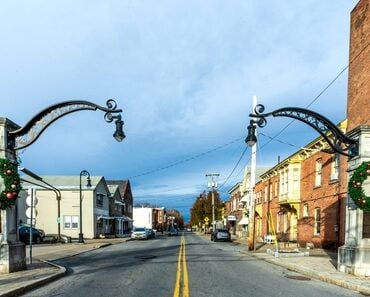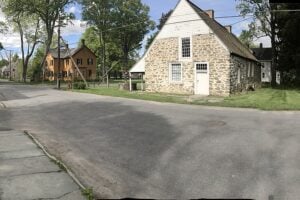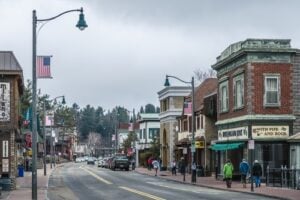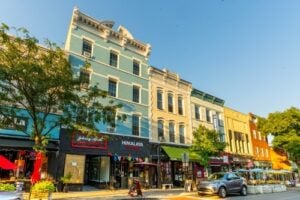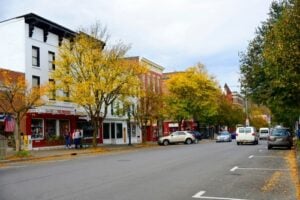
A colorful autumn scene along a downtown street in Cooperstown, New York. Photo: Dennis MacDonald / Shutterstock.com.
Most people arrive in Cooperstown knowing exactly what they want to see. They walk along Main Street toward the National Baseball Hall of Fame, visit Doubleday Field, or make their way down to Otsego Lake. Yet the history of this small Central New York village extends far beyond baseball. Writers, scientists, publishers, judges, artists, and people who helped shape American culture have called Cooperstown home.
The village sits at the southern end of Otsego Lake, where the Susquehanna River begins its long journey south. William Cooper established a settlement here in the late eighteenth century, and his son James Fenimore Cooper later made the surrounding landscape famous in American literature. The lake became the Glimmerglass of Cooper’s fiction. Over the generations, the town also developed an unusual concentration of museums, schools, charitable institutions, and cultural organizations for a community of its size.
There is an important distinction to make when looking at famous people from Cooperstown. Some were born here but grew up elsewhere. Others arrived as children or spent formative teenage years in the village. Each person on this list has a documented birthplace or meaningful early-life connection to Cooperstown. Simply moving here as an established adult, owning a summer home, or visiting the Baseball Hall of Fame is not enough.
And while Cooperstown’s baseball mythology remains familiar, one famous name deliberately does not appear here: Abner Doubleday. The old claim that he invented baseball in the village in 1839 is not supported by reliable historical evidence. The town has enough remarkable stories without repeating that one as fact. Here are fifteen people whose authentic connections to Cooperstown deserve to be remembered.
1. James Fenimore Cooper
James Fenimore Cooper was born in Burlington, New Jersey, in 1789, but his family relocated to the settlement founded by his father when he was still very young. He grew up around Otsego Lake, in a community that was only beginning to develop the streets and institutions familiar to later generations. His childhood surroundings mattered to his writing: the woods, farms, shoreline, and changing relationships between settlers and Native Americans became central elements in his fictional picture of the early American frontier.
Cooper eventually became one of the first American novelists to achieve a substantial international readership. His Leatherstocking Tales introduced the frontiersman Natty Bumppo, often known as Hawkeye, and included The Pioneers, The Last of the Mohicans, and The Deerslayer. Although those books range across different settings, The Pioneers and The Deerslayer are especially closely connected to the Otsego Lake region.
Cooper spent periods away from the village, including years at sea, in New York City, and in Europe, but he returned to Cooperstown and died there in 1851. His relationship with the place was not simply a childhood detail. It provided a landscape he repeatedly transformed into literature, helping make the name Cooperstown recognizable long before the baseball museum existed.
2. Kenneth Bainbridge
Physicist Kenneth Tompkins Bainbridge was born in Cooperstown on July 27, 1904. His family later lived in New York City, where he attended Horace Mann School, so it would be inaccurate to describe him as growing up beside Otsego Lake. His connection to Cooperstown is his documented birthplace, rather than a long village childhood. His interest in radio and engineering led him to the Massachusetts Institute of Technology and then to doctoral research in physics at Princeton.
Bainbridge became known for work in mass spectrometry, which helped scientists make highly precise measurements of atomic masses. During World War II, his expertise brought him into the Manhattan Project at Los Alamos. He directed the Trinity test, the first detonation of a nuclear device, conducted in New Mexico on July 16, 1945. The scale and implications of that event placed him at a turning point in world history.
After the war, Bainbridge returned to Harvard and became a prominent critic of nuclear testing and the arms buildup. His later position is an essential part of his story: he was not simply a scientist associated with a successful wartime experiment, but someone who wrestled publicly with the consequences of the technology he had helped demonstrate.
3. Stephen Carlton Clark
Stephen Carlton Clark was born in Cooperstown in 1882 into a family whose wealth came from its connection to the Singer sewing machine business. He studied at Yale and Columbia Law School and served in the New York State Assembly, but his enduring significance lies in the institutions he helped establish and support at home. His family had resources that few residents possessed; Clark chose to direct a meaningful portion of them toward public history, art, and community life.
In the 1930s, Clark became a driving force behind the National Baseball Hall of Fame and Museum. He acquired an old baseball connected with the disputed Doubleday story and helped assemble an early display of baseball memorabilia. The Hall of Fame was established in 1936 and its museum opened in 1939. The museum’s own history identifies Clark as the principal financier of its construction and its first president.
Clark’s cultural influence was not confined to baseball. He was also a serious collector of American art and folk art, and his gifts became foundational holdings of the Fenimore Art Museum. The connection between the museum, the Hall of Fame, and Cooperstown’s identity as a destination is one of the most visible legacies of a man who could have spent his life far from the village in which he was born.
4. Erastus Flavel Beadle
Erastus Flavel Beadle was born in Pierstown, near Cooperstown, in 1821. His family’s movements took him to Michigan and western New York before he returned to the Cooperstown area as a teenager. His decisive local connection came through the printing shop of H. & E. Phinney, where he learned the trade that eventually made his name nationally known. This was an apprenticeship, not a childhood spent entirely in the village, and it is the reason he belongs in Cooperstown’s publishing history.
Beadle developed skills in typesetting, printing, binding, and other parts of the business before moving to Buffalo and later New York City. In 1860, his publishing enterprise helped launch the mass-market dime novel: inexpensive, portable popular fiction sold to readers who could not necessarily afford costly books. The format became associated with Western adventures, sensational plots, and a new commercial scale for American storytelling.
The Cooperstown apprenticeship offers an appealing connection between local history and a national change in reading habits. Beadle did not invent popular fiction, but the publications bearing his name helped reshape how Americans purchased and consumed it. That process began with the practical skills he learned in a small Upstate printing establishment.
5. Lauren Groff
Novelist Lauren Groff was born and raised in Cooperstown. Unlike many writers whose hometown connections are reconstructed by later biographers, she has spoken and written extensively about her upbringing there. She has recalled living near the National Baseball Hall of Fame and Otsego Lake, reading widely, and growing up in a small community where neighbors’ lives were difficult to keep separate from one another.
That experience helped shape The Monsters of Templeton, her 2008 debut novel, whose fictional community draws on Cooperstown’s landscape, lore, and closely observed local relationships. Groff went on to write Arcadia, Fates and Furies, Matrix, and The Vaster Wilds, establishing herself as a widely read and critically recognized American novelist. Her fiction often examines how private lives are shaped by family, place, history, and the stories people tell about themselves.
Groff has described the beauty of Cooperstown without pretending that small-town life is always idyllic. That combination of attachment and critical distance makes her especially interesting in a list of famous local figures. For her, the village is not just a birthplace on a biographical record; it remains material for serious literary work.
6. Bud Fowler
Bud Fowler, born John W. Jackson Jr. in Fort Plain in 1858, moved with his family to Cooperstown when he was a small child. He grew up in the village, attended local schools, and became one of the most important early Black figures in professional baseball. His documented relationship with Cooperstown is much more substantial than the legendary association between the village and Abner Doubleday.
Fowler pursued a baseball career in an era when racial exclusion increasingly restricted opportunities for Black players. He played professionally for many years, taking the field at several positions and repeatedly moving between teams and leagues. He also helped organize and promote Black baseball. His career illuminates a history that the popular story of baseball’s invention in Cooperstown long overshadowed.
The National Baseball Hall of Fame elected Fowler in 2022, and the village has honored him with Fowler Way near Doubleday Field. He is not only a major baseball pioneer who once lived in Upstate New York; he is someone whose formative years were spent in the very community that later became baseball’s best-known historical destination.
7. Susan Fenimore Cooper
Susan Augusta Fenimore Cooper was born in Scarsdale, New York, in 1813, the daughter of novelist James Fenimore Cooper and Susan De Lancey Cooper. Her family moved to Cooperstown during her infancy, and the village and Otsego Lake region became central to her life. She later spent time abroad and in other communities, but the landscape around her family’s home remained an important subject of her work. Her literary identity should not be reduced to her famous father’s name.
Her best-known book, Rural Hours, appeared in 1850. Organized around the changing seasons, it described plants, birds, weather, agricultural routines, and daily life in the Cooperstown area with unusually attentive observation. The book predates Henry David Thoreau’s Walden by four years and has attracted renewed interest from scholars of American nature writing and environmental history.
Cooper also edited and helped preserve her father’s work, wrote for younger readers, and remained involved in the intellectual and charitable life of her community. Her importance lies in her own writing as well as in her place within a literary family. Reading Rural Hours today reveals a Cooperstown that existed long before baseball tourism: a place whose woods, waters, seasons, and working landscapes merited close study.
8. Mary Graham Bonner
Children’s author Mary Graham Bonner was born in Cooperstown in 1890, although she spent much of her upbringing in Halifax, Nova Scotia. Her family origins remained important to her writing. An obituary published after her death recalled the Cooperstown family’s attachment to baseball, which became one of the subjects she later addressed for younger readers.
Bonner built a remarkably productive career writing children’s stories and nonfiction. She wrote animal tales, books about sports and nature, and educational works including Canada and Her Story, which received the Constance Lindsay Skinner Award in 1942. Her writing also reached families through syndicated bedtime stories, an important form of everyday reading before television became widespread. Some of her baseball writing appeared under the initials M. G. Bonner.
Bonner may be less immediately recognizable than James Fenimore Cooper or Lauren Groff, but her work reached generations of children. Her biography also reminds us that a Cooperstown birthplace did not always lead to a lifelong residence in the village: her literary career and education unfolded well beyond Otsego County.
9. Nancy Hatch Dupree
Nancy Hatch Dupree was born in Cooperstown in 1927. Her birth in New York was intentional: in an interview about her life, she explained that her mother traveled from India to Cooperstown for the birth. Dupree then spent much of her childhood abroad, especially in India. That international upbringing helps explain her later interest in different societies, but it would be misleading to invent a long Cooperstown childhood for her.
Dupree became one of the best-known advocates for preserving Afghanistan’s historical and cultural record. After arriving in Kabul in 1962, she researched historic sites and wrote accessible guides to the country’s cities and monuments. She later worked with archaeologist Louis Dupree, whom she married, and helped assemble and protect documentary collections as Afghanistan experienced war, displacement, and profound political upheaval.
The Afghanistan Center at Kabul University became one of the clearest expressions of that commitment: a place where materials about Afghanistan could be preserved and made available to Afghan researchers. Dupree’s life took her far from the small village where she was born, but the Cooperstown connection is documented, and her achievement in protecting cultural memory deserves recognition on its own terms.
10. Jana Bennett
Jana Bennett was born in Cooperstown in 1955, the daughter of an English professor. Her family later moved to Britain when she was a teenager. She therefore belonged to Cooperstown by birth and early life, rather than by a full career spent in the region. After settling in England, she pursued education and work that led her into television at a time when relatively few women occupied senior leadership positions in the industry.
Bennett joined the BBC and developed a reputation for ambitious television programming and management. She also worked for Discovery Communications, where she helped bring popular lifestyle and factual formats to a wider American audience, before returning to the BBC as director of television. Later positions included senior leadership in American cable television. Her career unfolded across both sides of the Atlantic and helped shape the kinds of programs that reached large audiences.
Her 2022 obituary in The Guardian identifies Cooperstown as her birthplace and documents her family’s move to England. That is a much more specific—and more interesting—story than simply calling her a local television executive. A person born in a small Upstate village became a major figure in British broadcasting.
11. Robert L. “Hoot” Gibson
Robert Lee “Hoot” Gibson was born in Cooperstown on October 30, 1946. His official NASA biography makes clear that he considered Lakewood, California, his hometown, and he later graduated from Huntington High School on Long Island. Cooperstown was his birthplace, not the community in which he spent his entire childhood. That distinction is worth keeping because it makes the connection precise without diminishing what he went on to accomplish.
Gibson became a Navy aviator and test pilot before joining NASA’s astronaut corps in 1978. He flew on five Space Shuttle missions, beginning as pilot on Challenger in 1984 and later serving as commander on four missions. He commanded the 1995 STS-71 flight, which accomplished the first docking of an American Space Shuttle with Russia’s Mir space station. Over his NASA career, Gibson accumulated more than 36 days in space.
He also served in leadership positions within NASA’s astronaut office and participated in work connected to the investigation of the Challenger accident and improvements to shuttle safety. His biography is a reminder that a person with a Cooperstown birth certificate can have a life story that stretches from Long Island and California to the Navy’s flight decks and ultimately into orbit.
12. F. Ambrose Clark
Frederick Ambrose Clark was born in Cooperstown in 1880 into the same extended family that helped shape many of the village’s most recognizable institutions. While some relatives concentrated on museums, hotels, and public philanthropy, F. Ambrose Clark developed a serious interest in horses, racing, and agriculture. In 1902 he began developing Iroquois Farm near Cooperstown, eventually creating a large operation with stables, breeding activities, and other agricultural enterprises.
His sporting interests reached far beyond New York State. The family became connected with international steeplechase racing, including the 1933 Grand National in England, won by Kellsboro’ Jack under the ownership of Clark’s wife, Florence. That racing connection was one part of a much wider equestrian life; the local farms and facilities were tangible expressions of a wealthy patron’s engagement with the sport.
The landscape around Cooperstown bears traces of the Clark family’s different interests, and F. Ambrose’s contribution is distinct from his brother Stephen’s role in baseball history. His was a story about the breeding, training, and care of horses and the land used to support them. It provides a different window on how national wealth reshaped the countryside around the village.
13. Edward Severin Clark
Edward Severin Clark, the older brother of Stephen Carlton Clark and F. Ambrose Clark, was born in France in 1870. He grew up partly in New York City and Cooperstown and later became one of the most consequential builders in the village’s modern history. His local connection includes those family years as well as the unusually direct impact he had on Cooperstown’s buildings, institutions, and development as a destination.
Clark helped develop the Otesaga Hotel, which opened in 1909, and supported projects associated with recreation, health care, and the village’s public life. He was particularly important in the creation of the hospital named for Dr. Mary Imogene Bassett. Bassett Healthcare Network recounts how Clark’s admiration for the physician led him to fund a substantial new hospital building and how she served as its first chief of staff.
The mansion Clark built on the former Cooper family property later became the home of Fenimore Art Museum. After Edward’s death in 1933, his brother Stephen helped transfer important properties and collections into museum use. Much of the Cooperstown visitors encounter today is connected in some way to Edward Severin Clark’s determination to develop and support the village. Cooperstown is also featured in our look at historic small towns in Upstate New York.
14. Michaela Dietz
Voice actress Michaela Dietz was born in South Korea and adopted as an infant by a family in Cooperstown, where she grew up. Her connection to the village is both direct and personal: in interviews she has discussed her childhood there, including the experience of being a Korean American adoptee in a small, predominantly white community. Those memories have informed the way she speaks about identity, family, and belonging.
Dietz went on to build a career as an actor and voice performer. She is particularly well known for portraying Amethyst on Cartoon Network’s Steven Universe, a character whose search for identity and self-acceptance resonated with many viewers. Her credits also include Barney & Friends, The Owl House, and The Ghost and Molly McGee. The work has introduced her voice to audiences far beyond New York State.
In her own biographical material and interviews, Dietz openly identifies Cooperstown as home. She is an especially valuable addition to this list because her story is not another connection to the village’s founding families: it reflects a more recent generation and a different kind of cultural contribution.
15. John M. Bowers
Attorney John Myer Bowers was born in Cooperstown in 1849, into a family with longstanding connections to the village and its Lakelands estate. The similar name of an earlier family member, John Myer Bowers, who briefly served in Congress and died in 1846, can cause confusion in historical searches. The younger Bowers profiled here was the New York lawyer associated with major Gilded Age and early twentieth-century litigation, not the former congressman.
Bowers studied law in New York City and developed a successful courtroom practice. His best-known case came in 1915, when he represented former President Theodore Roosevelt in a libel suit brought by William Barnes, the powerful Republican newspaper publisher and political figure. The dispute attracted national attention, and Roosevelt emerged with a favorable verdict. The case placed a Cooperstown-born lawyer at the center of an important struggle within New York Republican politics.
The New-York Historical Society’s Bowers family papers, described in an archival finding aid maintained by New York University, trace the family’s Cooperstown property and identify the attorney’s role in the Roosevelt trial. That record establishes both the local connection and the professional distinction without relying on vague claims that he was one of the nation’s most feared lawyers.
Cooperstown’s History Beyond the Baseball Hall of Fame
It would be difficult to find another New York village of comparable size with such a varied collection of connections. James Fenimore Cooper and Lauren Groff wrote about the place itself. Susan Fenimore Cooper recorded the village’s natural world, while Erastus Beadle learned the printing trade here. Kenneth Bainbridge played a role in one of the defining scientific events of the twentieth century, and Robert Gibson later flew aboard the Space Shuttle. Nancy Hatch Dupree spent decades trying to preserve another country’s cultural inheritance. Others built institutions or worked in law, sport, or entertainment.
These stories also reveal different meanings of being “from” somewhere. Some people spent their childhoods in Cooperstown, while others were born there and moved away. Several went away to build careers elsewhere but maintained formative ties to the village. What matters is that each connection can be documented and explained. That is a more useful measure of Cooperstown’s influence than simply adding every famous baseball visitor to the list.