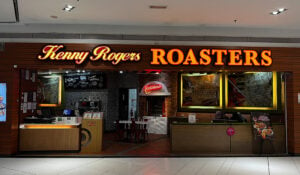
Photo: Larsdominic, via Wikimedia Commons, CC BY-SA 4.0.
For those of us who remember the restaurant chains that came and went in New York during the 1990s, Kenny Rogers Roasters stands out for two reasons. There was the wood-roasted chicken, served with corn muffins and a generous selection of side dishes. Then there was the enormous red chicken sign that drove Kramer out of his apartment on one of the funniest episodes of Seinfeld. Even people who never ate at Kenny Rogers Roasters probably remember that episode.
Whatever happened to Kenny Rogers Roasters restaurants in New York? After expanding rapidly during the 1990s, the company filed for bankruptcy protection in 1998. Nathan’s Famous acquired the brand the following year and attempted to rebuild it, including opening restaurants on Long Island. Those efforts were short-lived, and the chain eventually disappeared from the American restaurant landscape.
Yet the story of Kenny Rogers Roasters did not end there. The restaurant chain that New Yorkers associate with a brief period of the 1990s has been serving customers in parts of Asia for more than three decades. There is also an extraordinary real-life New York story behind that famous television episode, involving a lawyer, a restaurant sign and the right to free speech.
From Country Music to Rotisserie Chicken
By the time Kenny Rogers entered the restaurant business, he had enjoyed a remarkable career in music. He had moved from the jazz group the Bobby Doyle Three to the New Christy Minstrels and then to the First Edition before establishing himself as one of the most successful country and pop singers of his generation. Records such as The Gambler and Lucille had made him recognizable to audiences far beyond country music.
His partner in the new venture was John Y. Brown Jr., who had served as governor of Kentucky from 1979 to 1983. Brown brought considerably more to the partnership than political experience. In 1964, he and a group of investors purchased Kentucky Fried Chicken from Colonel Harland Sanders. Brown helped transform KFC into a major international restaurant chain before selling the business in 1971.
In August 1991, Rogers and Brown opened the first Kenny Rogers Roasters restaurant in Coral Springs, Florida. Rather than competing directly with KFC by serving another version of fried chicken, the partners built their restaurant around rotisserie-roasted poultry. Rogers brought a familiar face and name to the business, while Brown brought decades of experience in developing restaurant chains.
Why People Loved Kenny Rogers Roasters
The restaurant arrived at a time when Americans were developing a greater interest in alternatives to traditional fast food. Kenny Rogers Roasters offered chicken slowly cooked on a rotisserie over a wood fire. Customers could order portions of chicken accompanied by mashed potatoes, macaroni and cheese, vegetables and corn muffins. It was the kind of meal that could be brought home for the entire family, rather than a collection of individually wrapped sandwiches and orders of fries.
Music was an important part of the atmosphere. Memorabilia from Rogers’ career decorated the restaurants, and recordings by the singer could be heard while customers ate. The restaurants also benefited from a name that was already familiar to millions of Americans. There was no need to explain who Kenny Rogers was when introducing the chain to a new community.
By February 1996, contemporary reporting placed the chain at approximately 300 American locations, most of them franchised. The pace of expansion was extraordinary for a business that had opened its first restaurant less than five years earlier. However, rapid growth also brought the challenge of maintaining consistent operations across a large network of independently operated restaurants.
A Real New York Dispute Over a Restaurant Sign
In 1996, several months before Seinfeld made Kenny Rogers Roasters part of television history, the restaurant chain was involved in an unusual dispute in New York City. Attorney Aaron Lichtman worked in an office above one of the restaurants. He objected to the establishment’s signs and lights and placed a handwritten sign in his own window that read “Bad Food.”
The restaurant took legal action to have the sign removed. In April 1996, New York State Supreme Court Justice Charles Ramos dismissed the suit, finding that the attorney’s sign expressed an opinion protected by the right to free speech. The decision received national news coverage. A disagreement over a neighborhood chicken restaurant had become a legal story about the limits of commercial interests and freedom of expression.
The similarities between that incident and the television episode that followed later in the year are remarkable. Subsequent accounts have identified the dispute as inspiration for the writers of Seinfeld. The real restaurant and the fictional one both had a neighbor who was unhappy with its lights and decided to make his objections known through a sign in his window.
The Kenny Rogers Roasters Seinfeld Episode
On November 14, 1996, NBC broadcast the eighth-season episode of Seinfeld titled “The Chicken Roaster.” A Kenny Rogers Roasters restaurant opens across the street from Jerry and Kramer’s apartment building, illuminating Kramer’s apartment with an enormous red chicken sign. Unable to sleep, Kramer protests the restaurant and eventually trades apartments with Jerry.
Things get complicated when Newman introduces Kramer to the restaurant’s chicken. Kramer becomes so attached to the food that he no longer wants the restaurant to close, even though its sign has made his apartment practically uninhabitable. Meanwhile, Jerry begins behaving more like Kramer as he spends his nights in the red glow. The restaurant is central to the comedy rather than simply appearing in the background of a scene.
For Kenny Rogers Roasters, the appearance represented national exposure that few restaurant companies could have afforded to purchase. Contemporary accounts of the broadcast indicate that the company welcomed the publicity. The irony is that the episode’s fictional restaurant closes at the end, while the real chain was already encountering business difficulties that would lead to the disappearance of hundreds of its outlets.
Why Did Kenny Rogers Roasters Go Out of Business in America?
Although Kenny Rogers Roasters attracted plenty of attention, it was hardly alone in the rotisserie chicken business. Boston Chicken, which became Boston Market, was expanding aggressively with a similar emphasis on roast chicken and home-style side dishes. Kentucky Fried Chicken even introduced roasted chicken products of its own. The market that had seemed so promising at the beginning of the decade was becoming increasingly crowded.
The chain faced legal disputes as well, including a conflict with the competing Cluckers restaurant business. Meanwhile, the enormous restaurant network that had been assembled in just a few years began to shrink. The difficulties involved the business behind the restaurants, not simply whether customers enjoyed the chicken. The lack of financial and operational support eventually made it difficult for some franchisees to justify remaining with the chain.
On March 24, 1998, Roasters Corp. filed for Chapter 11 bankruptcy protection. Its franchising subsidiary followed in May. The bankruptcy did not mean that every restaurant immediately closed. Independently operated outlets could continue serving customers while the company’s future was being decided. However, the business that Rogers and Brown had created was no longer in a position to sustain its earlier expansion.
Nathan’s Famous Takes Over Kenny Rogers Roasters
The next chapter in the chain’s history was particularly interesting for New Yorkers. On April 1, 1999, Nathan’s Famous acquired the intellectual property of the bankrupt Roasters companies for $1.25 million, plus approximately $340,000 in related costs. The purchase included trademarks, recipes and franchise agreements, but not the company’s own restaurants. Nathan’s established a subsidiary called NF Roasters to manage the acquired business.
Nathan’s was already one of New York’s most famous restaurant names. The company that began selling hot dogs at Coney Island in 1916 was attempting to build a broader restaurant business in the late 1990s. Its acquisitions included the Miami Subs chain, and it was also incorporating Arthur Treacher’s Fish & Chips into selected restaurants. Kenny Rogers Roasters offered Nathan’s another recognizable name and a menu centered on a different kind of food.
The strategy was not necessarily to recreate all the original standalone Kenny Rogers Roasters restaurants. Nathan’s could also serve the brand’s chicken alongside its own products in restaurants that already had an established customer base. Nevertheless, it did attempt to operate a pair of traditional Kenny Rogers Roasters restaurants on Long Island.
Remembering the Kenny Rogers Roasters Restaurants on Long Island
Nathan’s corporate records document a revival that many accounts of the chain’s history overlook. On March 21, 2000, the company opened a Kenny Rogers Roasters restaurant in Rockville Centre. A second opened in Commack the following month. Both operated in freestanding buildings with drive-through service, rather than as small counters inside shopping malls.
These restaurants featured the familiar Roasters chicken menu alongside Nathan’s hot dogs, crinkle-cut fries and hamburgers. The Rockville Centre restaurant even offered Arthur Treacher’s products. A family could essentially order food associated with three different restaurant chains in one building. The company decorated the restaurants with weathered-looking wood, murals and memorabilia.
The experiment did not bring about the revival Nathan’s had hoped for. Corporate filings indicate that the Rockville Centre restaurant was performing below expectations, and Nathan’s began seeking a buyer. By March 30, 2003, the company had stopped operating both its Rockville Centre and Commack Kenny Rogers Roasters restaurants.
There was also a smaller operation inside the Nathan’s restaurant in Oceanside. It opened in April 2002 as part of a remodeling project and offered a limited Kenny Rogers menu. That operation survived until June 2005. The Oceanside outlet is an important part of the story because it demonstrates that Kenny Rogers Roasters did not simply vanish from Long Island when its original parent company went bankrupt in 1998.
What Happened to the Rest of the American Restaurants?
As Nathan’s concentrated more heavily on its own hot dog business, the opportunities for a Kenny Rogers Roasters revival diminished. The company increasingly used the name and its recipes as an additional menu offering rather than operating an extensive chain of standalone chicken restaurants. Other franchisees left the system entirely.
On April 23, 2008, Nathan’s sold NF Roasters to Roasters Asia Pacific for approximately $4 million. The agreement identified a single remaining American franchised Kenny Rogers Roasters restaurant, located at the Ontario Mills shopping mall in Ontario, California. That restaurant closed at the end of 2011, bringing the original American chain’s run to an end.
Kenny Rogers Roasters Is Still in Business
One of the most surprising aspects of the Kenny Rogers Roasters story is that its international operations were developing long before the American bankruptcy. A Malaysian franchise operation was established in 1994, and the first restaurant opened in that country in November of the same year. The Philippines followed in 1995. Those markets ultimately proved far more durable than the original American restaurant network.
When Roasters Asia Pacific acquired the brand in 2008, it was part of Malaysia’s Berjaya Corporation, which already had experience operating the restaurants overseas. Instead of introducing a completely unfamiliar restaurant concept, the company acquired worldwide rights to a business it had been developing in its home market for years.
Today, Kenny Rogers Roasters continues to serve customers in Malaysia, the Philippines and other international markets. Its restaurants still specialize in rotisserie chicken, muffins and assorted side dishes, but the menus have evolved to accommodate regional preferences. In Malaysia, for example, the chain has offered versions of local favorites alongside its traditional chicken meals. In the Philippines, its restaurants are found in numerous cities and shopping centers.
There are no verified operating Kenny Rogers Roasters restaurants in New York today. The brand’s survival overseas does not mean that all of its international markets have been equally successful, but it does mean that the restaurant is far from a forgotten name in much of Asia. Kenny Rogers died in March 2020, yet the restaurant business he helped establish continues to carry his name.
For New Yorkers, the chain remains a reminder of the years when rotisserie chicken restaurants seemed to be opening everywhere. It also belongs to that rather unusual category of businesses whose television legacy has outlasted their American storefronts. Thanks to Seinfeld, every new generation that discovers the show gets an introduction to Kenny Rogers Roasters, even if its nearest restaurant is thousands of miles away.
For more stories about the restaurants New Yorkers remember, explore our articles on the history of Nathan’s Famous at Coney Island, What Happened to Arthur Treacher’s Fish & Chips?, Whatever Happened to Ponderosa Steakhouse?, and Whatever Happened to Howard Johnson’s Restaurants?.