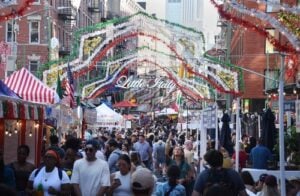
Crowds fill the streets of Little Italy during the Feast of San Gennaro in New York City. Photo by Joe Tabacca / Shutterstock.com
Every September, the aroma of Italian sausage, peppers, zeppole, and espresso settles over Mulberry Street as Little Italy fills with lights, music, food stands, religious traditions, and crowds moving through one of New York City’s best-known Italian-American celebrations. In 2026, the Feast of San Gennaro marks its 100th anniversary.
The Feast of San Gennaro (Festa di San Gennaro) began in 1926 as a one-day religious observance created by Neapolitan immigrants honoring the patron saint of Naples. A century later, it has grown into an 11-day festival while retaining a spiritual connection to the Shrine Church of the Most Precious Blood and the Italian-American history of Little Italy.
When Is the Feast of San Gennaro in 2026?
The 100th Annual Feast of San Gennaro runs from Thursday, September 17, through Sunday, September 27, 2026. The dates surround September 19, the feast day of San Gennaro. According to the official 2026 schedule, the Solemn High Mass celebrating the patron saint of Naples is scheduled for September 19 at 2:00 p.m., while the Grand Procession is scheduled for September 26 at 2:00 p.m.
Where Is the San Gennaro Festival in NYC?
- Primary Corridor: Mulberry Street between Canal Street and Houston Street.
- Hester Street: Between Baxter Street and Centre Street.
- Grand Street: Between Baxter Street and Centre Market Place.
- Religious Center: Shrine Church of the Most Precious Blood, 113 Baxter Street.
- Nearby Subway Stations: Grand Street (B, D), Canal Street (6, J, N, Q, R, W, Z), Spring Street (6), and Prince Street (N, R, W). Riders should check the MTA for service changes before traveling.
The Origins: A 1926 Neapolitan Block Party
During the great waves of Italian immigration to New York in the late 19th and early 20th centuries, newcomers often settled near people from the same towns and regions of Italy. Neapolitans became especially associated with Mulberry Street, while other Italian regional communities established themselves on nearby streets. That pattern helped turn the neighborhood into the cultural landscape now remembered as Little Italy. The broader immigration story can also be seen in the history of Ellis Island.
In September 1926, Neapolitan immigrants on Mulberry Street organized a one-day block party honoring San Gennaro, or Saint Januarius, the patron saint of Naples. Early organizers erected a small street shrine for the saint and invited neighbors to join the celebration. Devotees pinned offerings to ribbons attached to the saint’s image or statue, with money used to help people in need.
The celebration reflected the devotion immigrants had brought with them from Naples. San Gennaro was a bishop of Benevento who was martyred during the early fourth century and became the patron saint of Naples. In Catholic tradition, relics of his blood are kept in Naples, where the reported liquefaction of the blood is associated most famously with his September 19 feast day.
What began as a local religious observance grew into an annual neighborhood tradition and eventually into the 11-day festival that now stretches through the historic core of Little Italy.
The Shrine Church of the Most Precious Blood
The spiritual center of the New York feast is the Shrine Church of the Most Precious Blood at 113 Baxter Street. The church is the National Shrine Church of San Gennaro and houses the statue carried through the streets during the feast.
The church itself grew out of the needs of the Italian immigrant community in Lower Manhattan. Italian Catholics in the neighborhood had often faced discrimination and inadequate access to established churches. Most Precious Blood was created specifically to serve that growing population and remains closely tied to the religious traditions of Little Italy.
The Religious Processions and September 19
Despite the carnival atmosphere surrounding the feast, September 19 remains its most important religious date. The official 2026 calendar lists a Solemn High Mass at 2:00 p.m. at the Shrine Church of the Most Precious Blood, followed by a religious procession with the statue of San Gennaro.
The larger Grand Procession is scheduled separately for Saturday, September 26, 2026, at 2:00 p.m. The procession traditionally brings the statue through Little Italy with bands, religious participants, community groups, and crowds lining the streets.
The custom of pinning monetary offerings to ribbons associated with the statue remains one of the feast’s most recognizable religious traditions. The practice connects today’s enormous street festival to the charitable and devotional origins of the original neighborhood celebration.
Iconic Foods to Eat at San Gennaro
Food is one of the great attractions of San Gennaro, and the festival has long been associated with Italian and Italian-American dishes prepared along the street. The exact vendor lineup changes, but several foods have become inseparable from the feast.
- Sausage, Peppers, and Onions: Italian sausage cooked on large grills with peppers and onions and served on hero rolls remains one of the unmistakable aromas of Mulberry Street during the feast.
- Zeppole: Fried dough served hot and covered with confectioners’ sugar is one of the festival’s enduring sweets.
- Cannoli: Crisp pastry shells filled with sweet ricotta are closely associated with Little Italy and with food competitions held during many editions of the feast.
- Torrone: Traditional Italian nougat made with ingredients such as honey, egg whites, and nuts remains an old-world specialty associated with Italian celebrations.
- Italian Pastries and Espresso: Little Italy institutions add another layer to the feast experience. Caffè Roma dates to 1891, while Ferrara Bakery & Cafe traces its history to 1892.
These foods are part of a much larger New York culinary history. The neighborhood’s bakeries, cafés, restaurants, and street vendors helped turn regional Italian traditions into an enduring part of the city’s identity.
San Gennaro in The Godfather Part II
The Feast of San Gennaro became part of American movie history through Francis Ford Coppola’s The Godfather Part II (1974). In the film’s early New York sequence, the feast provides the backdrop as the young Vito Corleone, played by Robert De Niro, follows Don Fanucci through the crowded streets and across the tenement rooftops.
The scene uses the procession, music, lights, food stands, crowds, and statue of San Gennaro to recreate the atmosphere of an early Italian immigrant neighborhood. Coppola later recalled his own affection for Italian street feasts and specifically identified the downtown celebration depicted in the sequence as the Feast of San Gennaro.
The Feast’s Charitable Tradition
The modern feast is produced by the nonprofit Figli di San Gennaro. According to the organization, it has donated more than $2 million since 1996 to charities and community organizations, including schools, religious organizations, senior programs, children’s charities, and other nonprofit groups.
That charitable work preserves an important connection to the earliest years of the feast, when offerings made in honor of San Gennaro were used to assist people in need within the immigrant community.
The 100th Anniversary of San Gennaro in New York
The 2026 celebration represents a remarkable milestone: the 100th Annual Feast of San Gennaro. What started as a one-day observance by Neapolitan immigrants in 1926 has survived enormous changes in Little Italy, including population shifts, redevelopment, the expansion of neighboring Chinatown, and the transformation of Mulberry Street into an international tourist destination.
The neighborhood is much smaller than it was during the height of Italian immigration, but for 11 days each September, the feast restores something of the scale, sound, food, faith, and street life that made Little Italy one of New York’s most famous immigrant communities.
More Little Italy and New York Street History
For more on the neighborhood and the streets surrounding the feast, read Little Italy, What You Need to Know, explore Where Was Five Points in NYC?, learn about the immigrant gateway in our History of Ellis Island, and see more annual celebrations in Where Are the Best Street Fairs in NYC? The History of New York Street Markets.
Sources
The Feast of San Gennaro: Official History
The Feast of San Gennaro: 2026 Event Calendar
The Feast of San Gennaro: Supported Charities
Basilica of St. Patrick’s Old Cathedral: Shrine Church of the Most Precious Blood
National Park Service: Chinatown and Little Italy Historic District
Two Bridges Neighborhood Council: Chinatown and Little Italy Historic District
Ferrara Bakery & Cafe: History Since 1892
National Register of Historic Places Registration: Chinatown and Little Italy Historic District
Updated August 20, 2026.