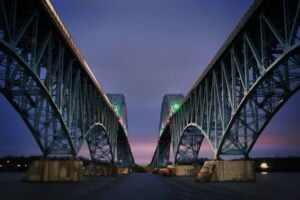
The Verrazzano-Narrows Bridge opened on November 21, 1964, linking Staten Island directly to Brooklyn and the rest of New York City by road. Designed under the direction of legendary bridge engineer Othmar Ammann, its 4,260-foot main span was the longest suspension-bridge span in the world when it opened and remains the longest suspended span in North America. Today the double-deck bridge carries 13 lanes of Interstate 278 across the Narrows between Fort Wadsworth on Staten Island and Fort Hamilton in Brooklyn.
The bridge is more than a transportation link. It stands at the entrance to New York Harbor, where ships arriving from the Atlantic pass beneath it on their way into the city. For Staten Island, its opening transformed daily travel and development. For Brooklyn, it completed an important highway connection. For New York as a whole, the Verrazzano-Narrows Bridge became one of the great engineering landmarks of the twentieth century.

Feature Photo: iofoto / Shutterstock
When Was the Verrazzano-Narrows Bridge Built?
Construction of the bridge began in 1959. The upper level opened to traffic on November 21, 1964. The lower level, which had been anticipated in the original engineering, opened on June 28, 1969, as traffic across the Narrows continued to grow.
The bridge was built under the Triborough Bridge and Tunnel Authority during the era when Robert Moses controlled much of New York City’s highway and bridge development. Othmar Ammann, whose work also included the George Washington Bridge, Bayonne Bridge, Bronx-Whitestone Bridge, and Throgs Neck Bridge, served as the bridge’s chief designer.
How Long Is the Verrazzano-Narrows Bridge?
The Verrazzano-Narrows Bridge is approximately 13,700 feet long from end to end, or about 2.6 miles. Its suspended structure measures 6,690 feet, including a 4,260-foot main span and two side spans of 1,215 feet each.
The towers rise roughly 690 feet above mean high water, while the bridge provides approximately 228 feet of clearance beneath the center of the span. That clearance is critical because the Narrows is the principal maritime entrance to New York Harbor for large cruise ships, cargo vessels, and other ocean-going traffic.
The upper level carries seven lanes, including a reversible HOV lane, while the lower level carries six lanes. Together, the two decks carry 13 lanes of Interstate 278 between Brooklyn and Staten Island.
Why Was the Verrazzano-Narrows Bridge Built?
Before the bridge opened, Staten Island had no direct road connection to another New York City borough. Ferries connected Staten Island with Manhattan and Brooklyn, while bridges connected the island with New Jersey. A direct highway crossing of the Narrows promised to connect Staten Island physically with Brooklyn and the larger New York City highway system.
The idea of crossing the Narrows was not new. During the first half of the twentieth century, planners repeatedly studied bridges and tunnels between Brooklyn and Staten Island. One proposal involved a subway and railroad tunnel. Other plans called for vehicular tunnels. Engineer David B. Steinman also promoted a suspension bridge across the Narrows during the 1920s.
None of those early plans moved to completion. Costs, military concerns, disagreements over routes, neighborhood opposition, and competition between bridge and tunnel proposals delayed a permanent crossing for decades.
The Staten Island Tunnel That Never Happened
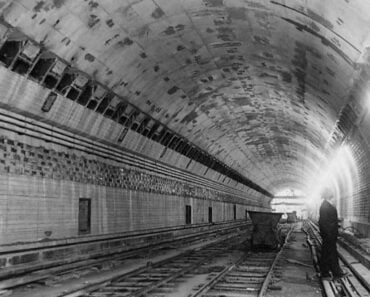
One of the most fascinating alternatives was a proposed transit tunnel connecting Brooklyn with Staten Island. Work on an earlier tunnel project began during the 1920s, but it was abandoned before a usable crossing could be completed.
Later proposals continued to envision rail or vehicular tunnels beneath the Narrows. Supporters believed a tunnel could connect Staten Island with Brooklyn without placing a massive bridge above the harbor. Opponents and competing agencies disagreed over cost, design, financing, and how the crossing would connect with the rest of the city’s transportation network.
By the postwar era, Robert Moses strongly favored a bridge. The bridge ultimately won the political and financial battle, permanently changing the way Staten Island connected with the rest of New York City.
Robert Moses and the Final Push for the Bridge
After World War II, Robert Moses revived the bridge proposal through the Triborough Bridge and Tunnel Authority. The project still faced serious resistance, particularly in Bay Ridge, where residents knew that a major bridge approach would require demolition and dramatically alter the neighborhood.
Federal military approval was also necessary because the Narrows was the entrance to one of the nation’s most important harbors. Concerns had long been raised that a destroyed bridge could block the channel during wartime. By 1949, federal approval was granted for a bridge crossing, clearing one of the most important obstacles.
Financing and agency agreements took additional years to resolve. By the late 1950s, the project finally moved toward construction. Groundbreaking ceremonies were held in 1959, beginning one of the largest bridge projects in American history.
Readers interested in Moses and the enormous transportation network that reshaped metropolitan New York can also read our look at Robert Moses and his impact on New York.
Bay Ridge Paid a Heavy Price for the Bridge
The bridge created a vital connection, but its construction came with a substantial human cost. The Brooklyn approaches required the demolition of hundreds of homes and displaced thousands of residents in Bay Ridge.
Neighborhood opposition had existed for years because residents understood that the bridge and its highway approaches would permanently alter the community. Robert Moses nevertheless pushed the project forward as part of a larger regional expressway system.
The resulting bridge made travel between Brooklyn and Staten Island dramatically easier, but the destruction of homes remains an essential part of the story. The Verrazzano-Narrows Bridge cannot be understood only as an engineering triumph. Like many large New York public works projects of the Moses era, it also reshaped neighborhoods and uprooted people.
Who Designed the Verrazzano-Narrows Bridge?
Othmar Ammann was the principal engineer behind the Verrazzano-Narrows Bridge. By the time the project moved forward, Ammann had already become one of the most important bridge engineers in American history.
The Verrazzano was one of the culminating achievements of his career. The bridge used four enormous main cables to support its suspended roadway. Each tower had to carry tremendous vertical and lateral forces while standing on opposite sides of a busy saltwater channel.
The scale was so great that the curvature of the Earth had to be considered in the geometry of the towers. Because both towers stand vertically relative to the Earth’s surface, their tops are slightly farther apart than their bases.
Why Is It Called the Verrazzano-Narrows Bridge?
The bridge was named for Giovanni da Verrazzano, the Italian explorer sailing for France who entered New York Harbor in 1524. The Narrows is the tidal strait separating Brooklyn and Staten Island and connecting Upper New York Bay with Lower New York Bay.
The name therefore combines the explorer with the body of water the bridge crosses. However, for decades the explorer’s surname was officially misspelled with only one “z”: Verrazano.
Why Did the Spelling Change From Verrazano to Verrazzano?
Giovanni da Verrazzano spelled his surname with two z’s, but the bridge’s official name used only one for more than half a century. The misspelling appeared in the original naming legislation and construction documents and became embedded on signs, maps, and government records.
After years of efforts to correct the mistake, New York State legislation was signed into law in 2018 formally changing the official spelling from Verrazano-Narrows Bridge to Verrazzano-Narrows Bridge.
The old one-z spelling remains familiar because it appeared everywhere for decades, and it also survives in older URLs, photographs, books, and historical documents.
The Bridge Opens on November 21, 1964
The upper deck opened on November 21, 1964. At the time, the bridge’s 4,260-foot center span surpassed the Golden Gate Bridge and became the longest suspension-bridge span in the world.
The opening was a major public event. Government officials, engineers, and thousands of spectators celebrated a project that had taken decades of proposals, political battles, engineering work, and construction to complete.
Three workers died during construction of the bridge. Laborers were angered that construction workers were not given a prominent role in the official opening ceremonies, and some workers instead attended a memorial Mass honoring the men who had died.
The bridge immediately altered travel patterns. Cars that once depended on ferries or indirect routes could now cross directly between Staten Island and Brooklyn. The bridge also became part of a continuous highway route through Staten Island, Brooklyn, and the larger metropolitan region.
The Lower Level Opens in 1969
The bridge’s enormous towers and suspension system had been designed with future traffic growth in mind. The upper level initially carried the traffic, but increasing demand quickly demonstrated the need for additional roadway capacity.
The six-lane lower level opened on June 28, 1969. With the later addition of a reversible HOV lane on the upper level, the bridge eventually reached its present 13-lane configuration.
Is the Verrazzano-Narrows Bridge Still the Longest Suspension Bridge?
No. The Verrazzano-Narrows Bridge is no longer the longest suspension bridge in the world. It held the world record from 1964 until the Humber Bridge opened in England in 1981.
Its 4,260-foot main span nevertheless remains the longest suspended span in North America. That is especially remarkable for a bridge that has been carrying New York traffic since the 1960s.
ClassicNewYorkHistory.com also includes a broader look at the most iconic bridges in New York, along with individual histories of the Bayonne Bridge, Goethals Bridge and Outerbridge Crossing, and Manhattan Bridge.
How Much Is the Verrazzano-Narrows Bridge Toll?
As of August 2026, the standard passenger-car toll is collected in both directions. The current one-way rate is $7.46 for customers using a properly mounted New York Customer Service Center E-ZPass and $12.03 for Tolls by Mail. Certified Staten Island residents participating in the resident discount program can pay an effective toll of $2.75 per crossing with an eligible vehicle and account.
Toll rates and discount programs can change, so drivers should check the Metropolitan Transportation Authority’s current Bridges and Tunnels toll schedule before traveling.
Why Are Tolls Collected in Both Directions Again?
From 1986 until 2020, the Verrazzano-Narrows Bridge used one-way tolling. Drivers traveling from Brooklyn toward Staten Island paid a doubled toll, while motorists traveling from Staten Island to Brooklyn did not pay at the bridge.
The system was originally adopted to reduce congestion and pollution associated with the Staten Island toll plaza. Over time, however, one-way tolling was blamed for encouraging some motorists to change routes in order to avoid paying at other crossings.
Split tolling returned on December 1, 2020. With cashless tolling technology, the MTA could collect a one-way toll electronically in each direction without rebuilding traditional toll booths.
The Verrazzano-Narrows Bridge and New York Harbor
The bridge stands across the maritime gateway to New York Harbor. Large vessels arriving from the Atlantic Ocean pass beneath the span before continuing toward terminals in New York and New Jersey.
The approximately 228-foot clearance at the center of the bridge has therefore influenced ship design and port operations for generations. Cruise ships and large commercial vessels must be able to clear the Verrazzano before they can reach many harbor destinations.
The bridge’s location also gives it enormous symbolic power. For passengers entering New York Harbor by ship, the Verrazzano-Narrows Bridge can serve as one of the first great New York structures they see.
The Giant American Flags on the Verrazzano
The bridge has also been used as a dramatic display site for the American flag. In January 1976, during the nation’s Bicentennial year, an enormous flag was hung from the bridge. The experiment did not go as planned. Wind pushed the fabric against the suspension cables, and the giant flag tore apart only days after it was installed.
A different large flag display was mounted for the July 4, 1980, celebration using a design intended to avoid the problems that destroyed the earlier flag.
The tradition returned in 2026 for the 250th anniversary of the United States. A large American flag was displayed on the Verrazzano-Narrows Bridge as New York joined the national semiquincentennial celebration.
Can You Walk or Bike Across the Verrazzano-Narrows Bridge?
Under normal conditions, the Verrazzano-Narrows Bridge does not have a public pedestrian or bicycle path. It was built as a motor-vehicle crossing, and proposals for permanent walking and cycling access have been debated for years.
There are special events when parts of the bridge are closed to ordinary traffic and used by participants. Most famously, the New York City Marathon begins on Staten Island and sends runners across the upper level of the Verrazzano into Brooklyn.
The Bridge Continues to Be Rebuilt and Upgraded
A bridge this large is never truly finished. MTA Bridges and Tunnels has carried out major reconstruction projects to replace original roadway decks, rehabilitate approaches, modernize lighting and electrical systems, improve safety, and protect the bridge’s structural components.
The MTA’s long-range capital planning continues to include major work on the Verrazzano-Narrows Bridge. Current programs include structural rehabilitation and work designed to preserve the enormous main cables so the bridge can remain in service for decades to come.
The Verrazzano-Narrows Bridge Legacy
Few structures changed Staten Island as dramatically as the Verrazzano-Narrows Bridge. The crossing made automobile travel to Brooklyn and the rest of New York City far easier, accelerated development on Staten Island, and permanently changed commuting and transportation patterns throughout the region.
It also changed Bay Ridge, displaced residents, and became part of the complicated legacy of Robert Moses and mid-twentieth-century urban development. That combination of achievement and consequence is what makes the bridge such an important New York story.
More than sixty years after the upper deck opened, the Verrazzano-Narrows Bridge remains one of the defining sights of New York Harbor. Cars and buses cross it, marathon runners race over it, ships pass beneath it, and its towers continue to frame the Narrows between Brooklyn and Staten Island.
Verrazzano-Narrows Bridge History at a Glance
| Year | Milestone |
|---|---|
| 1920s | Bridge and tunnel proposals seek a permanent Brooklyn-Staten Island connection |
| 1949 | Federal military approval clears an important obstacle to a Narrows bridge |
| 1959 | Construction of the Verrazzano-Narrows Bridge begins |
| 1964 | Upper level opens on November 21; the 4,260-foot main span becomes the world’s longest suspension span |
| 1969 | Six-lane lower level opens on June 28 |
| 1976 | Giant Bicentennial American flag is displayed and quickly damaged by wind and the suspender cables |
| 1981 | England’s Humber Bridge surpasses the Verrazzano’s world-record main span |
| 1986 | One-way toll collection begins |
| 2018 | New York State officially corrects the spelling from Verrazano to Verrazzano |
| 2020 | Split tolling returns, with electronic tolls collected in both directions |
| 2026 | Bridge continues carrying 13 lanes of I-278; a large American flag marks the 250th anniversary of the United States |
Sources
Jackson, Kenneth T. The Encyclopedia of New York City. New Haven, CT: Yale University Press, 2011.
Haskell, David. The Encyclopedia of New York. New York: Avid Reader Press, an imprint of Simon & Schuster, Inc., 2020.
History of the Verrazzano-Narrows Bridge: When It Was Built, Length, and Tolls article published on ClassicNewYorkHistory.com © 2026