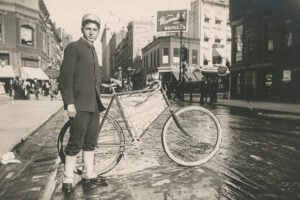
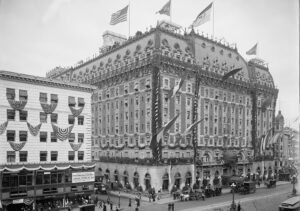
Astor House, Broadway, New York, c. 1900. Photo: Detroit Publishing Co., Library of Congress, Prints and Photographs Division, LC-D4-10662. Public Domain.
During the Gilded Age and the early decades of the 20th century, New York City became the epicenter of American wealth, ambition, and architectural extravagance. Railroad barons, industrial titans, European royalty, political power brokers, entertainers, and travelers converged on Manhattan, giving rise to a new kind of grand hotel. These palatial establishments were more than places to sleep. They were social worlds filled with ballrooms, dining rooms, roof gardens, private clubs, and public spaces designed to impress.
New York has never been sentimental about its skyline. Even some of the city’s most celebrated hotels eventually became vulnerable to changing neighborhoods, new transportation projects, rising land values, and the wrecking ball. These 10 lost grand hotels helped define New York in their time, and their former sites tell another story about how quickly the city remakes itself.
1. The Astor House
Active Years: 1836–1926
Location: Broadway between Vesey and Barclay Streets, Lower Manhattan
Built by fur and real estate magnate John Jacob Astor and designed by architect Isaiah Rogers, the Astor House was one of America’s earliest great urban luxury hotels. Its massive granite Greek Revival facade faced City Hall Park, and its scale, service, and conveniences helped establish a new standard for metropolitan hospitality.
The hotel became a gathering place for politicians, businessmen, writers, and other public figures. Abraham Lincoln stayed there during his 1860 New York visit for the Cooper Union speech, one of the most important appearances of his rise to the presidency.
The Demise: The Astor House disappeared in two stages. The southern portion was demolished in 1913 during subway construction. The northern half remained until 1926, when it was razed for redevelopment.
What’s There Today: The former hotel footprint is now divided between later office buildings. The Astor House Building at 217 Broadway occupies the southern portion of the old site, while the Transportation Building at 225 Broadway stands where the northern wing once remained.
2. The Fifth Avenue Hotel
Active Years: 1859–1908
Location: Fifth Avenue and 23rd Street, Madison Square
When developer Amos R. Eno built a monumental white-marble hotel at Fifth Avenue and 23rd Street, the location seemed unusually far uptown for fashionable New York. The gamble paid off. The Fifth Avenue Hotel helped shift the city’s social center toward Madison Square and became one of the most prestigious hotels of the 19th century.
One of its most discussed technological novelties was an early passenger elevator designed by Otis Tufts. The screw-driven device was known as a “vertical railway,” an extraordinary attraction at a time when climbing stairs was still expected in nearly every multistory building.
The hotel also became a political institution. A section of its lobby known as the Amen Corner became closely associated with Republican political boss Thomas C. Platt and the politicians, reporters, and power brokers who gathered around him.
The Demise: By the opening years of the 20th century, New York’s fashionable hotel district had moved farther uptown. The Fifth Avenue Hotel closed in 1908 and was demolished.
What’s There Today: The Fifth Avenue Building rose on the site and later became famous as part of the International Toy Center. The surviving office building at 200 Fifth Avenue now includes Eataly Flatiron at street level.
3. The Original Ritz-Carlton
Active Years: 1911–1951
Location: Madison Avenue and 46th Street, Midtown Manhattan
The original New York Ritz-Carlton opened at Madison Avenue and 46th Street as a new expression of European-style luxury in Midtown. Robert Walton Goelet was instrumental in bringing the project to New York, while Warren & Wetmore, the architects associated with Grand Central Terminal, designed the hotel.
Its great culinary legacy came from French chef Louis Diat. In the summer of 1917, Diat created the chilled leek-and-potato soup that became known as vichyssoise, drawing inspiration from the soups of his childhood in France. The dish became one of the most enduring culinary creations associated with a New York hotel.
The Demise: The hotel lost some of its earlier social dominance after the Depression and World War II. Its valuable Midtown site was ultimately redeveloped, and the Ritz-Carlton was demolished in 1951.
What’s There Today: A 25-story office building replaced the hotel. That property was later dramatically reconstructed and readdressed; the site is now occupied by the modern office tower at 390 Madison Avenue.
4. The Savoy-Plaza Hotel
Active Years: 1927–1965
Location: Fifth Avenue between 58th and 59th Streets, Grand Army Plaza
Designed by McKim, Mead & White, the 33-story Savoy-Plaza stood on one of the most prestigious corners in Manhattan. Its high-rise profile joined the Plaza and the Sherry-Netherland in creating one of New York’s most memorable concentrations of luxury hotels around Grand Army Plaza and the entrance to Central Park.
The hotel developed a glamorous nightlife reputation through spaces such as the Savoy Room and the Café Lounge. Musicians, singers, dancers, comedians, and cabaret performers helped make the Savoy-Plaza a destination even for New Yorkers who were not staying overnight.
The Demise: Hilton Hotels acquired the property in 1958. Plans for a major office development were announced in 1964, setting off protests by preservationists. The campaign failed, and the Savoy-Plaza was demolished in 1965.
What’s There Today: The site became the General Motors Building at 767 Fifth Avenue. The Fifth Avenue Apple Store’s glass cube now occupies the plaza in front of the building.
5. Hotel Astor
Active Years: 1904–1967
Location: Broadway between 44th and 45th Streets, Times Square
Commissioned by William Waldorf Astor and designed by Clinton & Russell, Hotel Astor opened in 1904 just as the surrounding district was becoming the center of New York’s theater and entertainment world. Its elaborate public rooms, banquet spaces, restaurants, and roof garden made it one of the defining landmarks of early Times Square.
The hotel became famous for spaces including its Grand Ballroom and sprawling rooftop facilities. The Astor Bar also became one of New York’s celebrated gathering places, particularly during the years surrounding World War II.
The Demise: Hotel Astor closed in 1967 and was demolished as Times Square entered another era of large-scale commercial redevelopment.
What’s There Today: The 54-story One Astor Plaza at 1515 Broadway occupies the site. The building includes the Minskoff Theatre, which opened in the 1970s.
6. The Original Plaza Hotel
Active Years: 1890–1905
Location: Fifth Avenue and Central Park South
The world-famous Plaza Hotel standing at Central Park South today was not the first hotel to carry the name on that site. Construction on the original Plaza began in the 1880s, and after a complicated development history, the first hotel opened on October 1, 1890.
The first Plaza occupied a magnificent location overlooking the southeastern entrance to Central Park, but within only 15 years its owners concluded that an even larger and grander hotel could make better use of the site.
The Demise: The original Plaza was demolished in 1905. Construction immediately followed on the larger hotel that would become one of New York’s most recognizable landmarks.
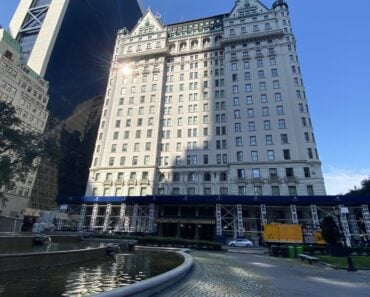
What’s There Today: The present Plaza Hotel opened on October 1, 1907. Its extraordinary history of ownership, celebrity, and reinvention is explored in our article Who Owns the Plaza Hotel? History of New York’s Most Famous Hotel.
7. The Netherland Hotel
Active Years: 1893–1926
Location: Fifth Avenue and 59th Street, northeast corner
Financed by William Waldorf Astor and designed by architect William H. Hume, the 17-story Hotel Netherland rose over Grand Army Plaza as one of the most imposing early luxury towers on Fifth Avenue. Ground was broken in 1892, and the hotel opened in 1893.
The steel-framed building was designed in a Romanesque style and offered the kind of height, elaborate interiors, and Central Park views that anticipated the luxury residential hotels that would transform Fifth Avenue in the decades that followed.
The Demise: The Netherland was demolished in 1926 as its exceptionally valuable Fifth Avenue site was prepared for a new generation of luxury development.
What’s There Today: The Sherry-Netherland, which opened in 1927, occupies the corner at 781 Fifth Avenue and remains an operating luxury hotel.
8. The Grand Union Hotel
Active Years: Late 1860s–1914
Location: Park Avenue between 41st and 42nd Streets, opposite Grand Central
The Grand Union Hotel did not spring fully formed from a single building. It developed gradually from smaller hotels and neighboring structures on the block, including the Westchester Hotel associated with Samuel P. Shaw and Simeon Ford. Over time, the properties expanded into the sprawling Grand Union, perfectly positioned for travelers arriving at the railroad terminal on 42nd Street.
Ford became one of the best-known hotel personalities in New York, celebrated for his humor and hospitality. The Grand Union’s dining rooms and public spaces served generations of travelers and city regulars as the area around the railroad terminal grew into one of Manhattan’s busiest crossroads.
The Demise: The Grand Union closed in 1914 and was demolished as the city remade the blocks around the new Grand Central Terminal and expanded the subway infrastructure beneath 42nd Street.
What’s There Today: The former hotel block is occupied by major commercial buildings including the Pershing Square Building and the former Bowery Savings Bank building. Nearby Pershing Square remains one of the most distinctive pieces of the Grand Central streetscape, while Grand Central Terminal continues to dominate the neighborhood.
9. The Hoffman House
Active Years: 1864–1915
Location: Broadway between 24th and 25th Streets, Madison Square
The Hoffman House became one of late-19th-century Manhattan’s great gathering places for politicians, theatrical figures, sportsmen, businessmen, and celebrities. Edward S. Stokes became closely associated with the hotel, but the most famous room in the building was its bar.
Behind the bar hung William-Adolphe Bouguereau’s enormous 1873 painting Nymphs and Satyr. The provocative canvas became a New York attraction in its own right, drawing visitors who wanted to see a work of art that seemed almost inseparable from the mythology of the hotel. The Hoffman House was also strongly associated with Tammany Hall politicians, who treated it as an unofficial headquarters.
The Demise: As the center of Broadway entertainment moved farther north, the Hoffman House lost the geographical advantage it once enjoyed. The hotel closed in March 1915 and was demolished soon afterward.
What’s There Today: The redevelopment now known as 10 Madison Square West occupies much of the former Hoffman House site along Broadway and Madison Square.
10. The Original Waldorf-Astoria
Active Years: 1893–1929; unified as the Waldorf-Astoria from 1897
Location: Fifth Avenue between 33rd and 34th Streets
Few vanished New York hotels better represent Gilded Age extravagance than the original Waldorf-Astoria. William Waldorf Astor opened the Waldorf Hotel at Fifth Avenue and 33rd Street in 1893. His relative John Jacob Astor IV later built the adjoining Astoria Hotel on the corner of 34th Street. In 1897, the two hotels were connected and operated together as the Waldorf-Astoria under hotelier George C. Boldt.
The enormous complex became one of the defining social institutions of elite New York. Its famous connecting corridor, Peacock Alley, became a place to see and be seen, while the hotel’s restaurants, ballrooms, guest rooms, and events turned the property into a symbol of an era.
The Demise: By the late 1920s, the hotel stood on one of the most valuable development sites in Manhattan. The property was sold, the original Waldorf-Astoria closed, and the buildings were demolished in 1929.
What’s There Today: The Empire State Building rose on the former Waldorf-Astoria site, opening in 1931 and replacing one New York symbol with another.
More New York History
New York’s vanished hotels are part of a much larger story of a city that repeatedly replaces one generation of landmarks with another. For more on that transformation, read our histories of Times Square, Grand Central Terminal, the Empire State Building, and the Plaza Hotel.
Sources
New York City Design Commission: Frank Cousins Collection, Astor House
New York Public Library: Fifth Avenue Hotel Records, 1859–1891
Eataly: NYC Flatiron at 200 Fifth Avenue
Library of Congress: Ritz-Carlton Hotel, Madison Avenue and 46th Street
The New Yorker: Louis Diat and the creation of vichyssoise
390 Madison Avenue: Current Office Property
New York Preservation Archive Project: Savoy-Plaza Hotel
General Motors Building: Current Site at 767 Fifth Avenue
Library of Congress, Historic American Buildings Survey: Hotel Astor
The Plaza Hotel: Historical Timeline
The Sherry-Netherland: Official Site and History
Peabody Essex Museum: The Night the Grand Union Hotel Became a Memory
Library of Congress: Hoffman House Bar and Nymphs and Satyr
New York Public Library: Waldorf-Astoria Hotel Records, 1893–1929