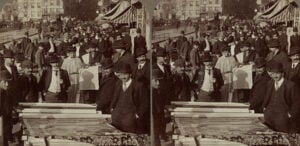
A New York City pushcart market around 1915, when street vendors and open-air shopping were a familiar part of everyday life. George Grantham Bain Collection / Library of Congress. No known restrictions on publication.
New York City is famous for traditions that have survived for generations, from the Macy’s Thanksgiving Day Parade to the New Year’s Eve celebration in Times Square. But the city also had countless customs, habits, and rituals that once seemed just as permanent, only to quietly disappear.
Some vanished because technology changed. Others were pushed aside by new laws, new forms of entertainment, changing fashions, or the simple fact that New York grew too large for the old custom to make sense anymore.
Here are 10 New York traditions that were once part of everyday city life and are now largely gone.
1. Moving Day on May 1
The Era: Colonial era through World War II
The Custom: For generations, May 1 was New York’s notorious Moving Day. Many leases and rental arrangements ended at the same time, sending thousands of New Yorkers into the streets with furniture, trunks, carts, wagons, and everything else they owned. Nineteenth-century visitors repeatedly described Manhattan as if the entire city were packing up and moving at once. Moving companies and cart drivers were in extraordinary demand, sidewalks became clogged with household goods, and the annual ritual turned the city into organized chaos.
Why It Vanished: The system was already weakening by the early 20th century as lease practices changed. Wartime housing shortages, rent regulation, and the disruption of World War II finally broke the custom’s hold on the city. New Yorkers continued moving, of course, but no longer on one giant citywide moving day.
2. New Year’s Day Calling
The Era: Dutch New York through the late 19th century
The Custom: New Year’s Day once meant an exhausting round of social visits. Men dressed for the occasion and called at the homes of women they knew, while women remained at home to receive callers. In prosperous households, tables were prepared with food, cakes, punch, wine, and other refreshments. Popular men might try to make dozens of visits in a single day, leaving calling cards and exchanging New Year’s greetings as they moved from house to house.
Why It Vanished: The ritual became harder to maintain as New York’s population and geography exploded. By the late 19th century, etiquette writers were already describing the custom as endangered. Calling cards increasingly substituted for personal visits, and many fashionable families simply left town for the holiday. A New Year’s tradition inherited from old New York gradually disappeared.
3. Ragamuffin Day on Thanksgiving
The Era: About 1870 through the 1950s
The Custom: Long before Halloween became the major American costume holiday, New York children dressed up on Thanksgiving Day. Many wore oversized and discarded adult clothing, masks, painted faces, and deliberately ragged outfits. They roamed streets and neighborhoods asking adults, “Anything for Thanksgiving?” and were often rewarded with pennies, apples, or candy.
Why It Vanished: By 1930, New York school officials and social organizations were publicly discouraging what they considered children’s street begging. Organized Thanksgiving parades were promoted as alternatives. The custom lingered longer in parts of Brooklyn, the Bronx, and other outer-borough neighborhoods, but Halloween trick-or-treating and the growing popularity of the Macy’s Thanksgiving Day Parade eventually pushed Ragamuffin Day into obscurity.
4. The September 15 Straw Hat Deadline
The Era: Early 1900s through the 1920s
The Custom: There was once an unwritten rule governing exactly when a New York man was supposed to stop wearing his summer straw hat. September 15 became the traditional deadline. Men who continued wearing boaters after the accepted date risked being mocked or having their hats knocked off and smashed.
Why It Vanished: The custom became notorious in September 1922, when hat smashing escalated into several nights of street violence remembered as the Straw Hat Riot. Gangs of youths roamed parts of Manhattan knocking hats from men’s heads, and some victims who resisted were beaten. As the straw boater declined in popularity and American men gradually stopped treating hats as mandatory daily clothing, the seasonal deadline disappeared with it.
5. Newsboys Shouting the Latest Headlines
The Era: Late 19th century through the mid-20th century
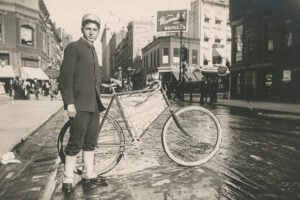
The Custom: New York streets once rang with the voices of newspaper sellers. Newsboys and other street vendors collected bundles from newspaper offices and sold editions to pedestrians at busy intersections, bridges, railroad terminals, and transit hubs. When a major story produced an extra edition, shouted headlines became part of the sound of the city. Lewis Hine’s photographs documented young New York news sellers working Park Row, the Brooklyn Bridge, and other locations at all hours of the day and night.
Why It Vanished: Home delivery, permanent newsstands, newspaper vending boxes, radio, and eventually television changed the way New Yorkers received breaking news. Newspapers remained enormously important, but the army of street sellers shouting headlines gradually disappeared.
6. The 8:40 Broadway Curtain
The Era: Early 20th century through 1970
The Custom: Broadway once ran on a much later clock. In the 1930s, an 8:40 p.m. curtain was so familiar that the 1934 Broadway revue Life Begins at 8:40 took its title from it. Later, 8:30 became the more common standard. The late start gave theatergoers time to finish dinner in Midtown before walking to the theater, and it helped create an evening rhythm in which dinner came first and the show followed.
Why It Vanished: Broadway spent the late 1960s experimenting with earlier times. In January 1971, most Broadway theaters moved their evening curtain from 8:30 to 7:30 in an effort to make theatergoing easier for suburban commuters and other audiences who wanted to get home earlier. Restaurants objected to losing the pre-theater dinner crowd, and 8:00 soon emerged as a compromise. Broadway schedules later became far more varied, ending the old tradition of one nearly universal late curtain.
7. Shopping the Lower East Side Pushcart Markets
The Era: Late 1800s through the 1930s
The Custom: Shopping from pushcarts was once part of everyday life on New York’s Lower East Side. Immigrant vendors crowded streets such as Hester, Orchard, and Grand with handcarts piled with fruits, vegetables, fish, clothing, household goods, and countless other necessities. Shoppers moved from cart to cart through streets that functioned as enormous open-air markets. For many newly arrived immigrants, operating a pushcart also offered one of the most accessible ways to start a small business in New York.
Why It Vanished: City officials increasingly viewed the dense pushcart markets as sources of congestion and sanitation problems. New York began regulating vendors in the early 20th century, and during the administration of Mayor Fiorello La Guardia the city accelerated efforts to move pushcart merchants into enclosed public markets. Essex Street Market opened in 1939 in part to replace the Lower East Side pushcart system. Street vending never disappeared from New York, but the sprawling neighborhood pushcart markets that once defined the Lower East Side largely did.
8. Evacuation Day on November 25
The Era: 1783 through the early 20th century
The Custom: For generations, November 25 was one of New York City’s great patriotic holidays. Evacuation Day commemorated the departure of the last British troops from New York in 1783 and George Washington’s triumphant return to the city. New Yorkers marked the anniversary with parades, military drills, fireworks, banquets, patriotic plays, and public ceremonies. At its height, the celebration rivaled the Fourth of July in importance in New York.
Why It Vanished: As the generations with direct connections to the Revolutionary era disappeared, enthusiasm gradually weakened. Thanksgiving also grew into a major national holiday at almost exactly the same point on the calendar. Evacuation Day continued to be commemorated into the early 20th century, but the citywide holiday eventually faded from public life.
9. Buying and Dropping Subway Tokens
The Era: 1953–2003
The Custom: For 50 years, carrying subway tokens was part of being a New Yorker. Riders bought the small pieces of transit currency from station booths, kept extras in pockets and purses, handed them to children and family members, and dropped them into mechanical turnstiles. Different generations of tokens came and went as fares changed, but the little brass objects became symbols of the subway and the city itself.
Why It Vanished: MetroCard testing began in 1993, and electronic fare payment gradually replaced the token. Tokens were sold until April 2003, stopped being accepted in subway turnstiles in May, and remained usable on buses only through the end of that year. The familiar clink of a token entering a turnstile disappeared from the New York commute.
10. Central Park’s Red-Ball Skating Signal
The Era: 19th century through the early 20th century
The Custom: Before artificial ice rinks guaranteed a skating season, New Yorkers waited for nature to freeze Central Park’s lakes and ponds. When conditions were considered safe, a white flag bearing a large red ball signaled that the ice was open. By the 1920s, the red-ball flag flew from the Arsenal, and New Yorkers understood what it meant: skating was on. Newspapers and radio eventually began reporting the same information, but the flag remained a wonderfully simple city signal.
Why It Vanished: New York no longer had to depend entirely on natural lake ice. Wollman Rink opened in Central Park in 1950, giving skaters a refrigerated rink and a more predictable season. The Central Park Conservancy notes that the Lake no longer freezes sufficiently for skating. The old red-ball signal disappeared, even though ice skating remains one of the park’s great winter traditions.
Readers interested in more vanished and changing New York traditions can continue with our History of Macy’s Thanksgiving Day Parade, our History of the NYC Subway Token, our History of the Rink at Rockefeller Center, and our History of Times Square TKTS Ticket Booth and Bleachers.
Sources
- Project Gutenberg — Ebenezer Davies, American Scenes, and Christian Slavery: New York Moving Day
- Project Gutenberg — James D. McCabe, The Secrets of the Great City: New Year’s Calls
- The New York Public Library — Thanksgiving Ragamuffin Parade
- The New York Public Library — The Straw Hat Riots of 1922
- Library of Congress — Lewis Hine Photograph of New York Newsboys and Newsgirl, Park Row, 1910
- The Broadway League — History of Broadway Curtain Times
- Library of Congress — Push Cart Market, East Side, ca. 1915
- The New York Public Library — Evacuation Day: New York’s Former November Holiday
- Metropolitan Transportation Authority — Token and MetroCard Fare-Payment History
- The New Yorker — Central Park’s Red-Ball Skating Flag
- Central Park Conservancy — The History of Ice Skating in Central Park