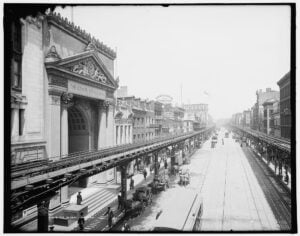
The Bowery in New York City around 1905, when elevated trains and horse-drawn traffic created a very different city soundscape. Detroit Publishing Co. / Library of Congress. No known restrictions on publication.
The soundscape of New York City has always changed at breakneck speed. As transportation modernized, horses gave way to automobiles, mechanical displays gave way to digital screens, and technologies once heard every day disappeared from ordinary city life.
Some of the sounds on this list are not literally extinct. A few hand-operated elevators still survive, and mobile knife sharpeners lasted far longer than most people realize. But these sounds no longer define daily life in New York the way they once did. They belong to an older city of brass tokens, ocean liners, elevated steam trains, street trades, mechanical signs, and machines that announced themselves before anyone ever saw them.
# 1 – The Brass Clink of a Subway Token in a Mechanical Turnstile
The Era: 1953–2003
The Sound: The metallic clink of a brass token dropping into the slot, followed by the click and heavy ratcheting movement of the turnstile as a rider pushed through.
The History: New York City’s subway token entered service on July 25, 1953, when the fare rose from 10 cents to 15 cents. The existing turnstiles were designed around single-coin fares and could not simply collect a dime and a nickel from every passenger, so the Transit Authority introduced a special token representing one complete fare. The first familiar token was dime-sized, made of solid brass, and identified by its distinctive Y-shaped cutout. The MetroCard gradually replaced tokens after its introduction in the 1990s. At midnight on May 3 going into May 4, 2003, subway turnstiles stopped accepting tokens, ending a 50-year ritual—and one of the most recognizable little sounds of the New York commute.
# 2 – The Deep Whistles and Horns of Luxury Liner Row
The Era: 1930s–1960s
The Sound: Long, low ship-whistle and horn blasts rolling across the Hudson River, mixed with tugboat signals and the working noise of the West Side piers.
The History: Manhattan’s West Side passenger piers became known as “Luxury Liner Row” during the great age of transatlantic ocean travel. The new superliner piers at 88, 90, and 92 were built in the 1930s to accommodate ships that had outgrown older facilities. The Normandie docked at Pier 88, the Queen Mary at Pier 90, and the SS United States used Pier 86. Photographs from the 1950s show great liners lined up along the Hudson in numbers that are almost impossible to imagine today. Arrivals and departures brought ship whistles, tug signals, engines, crowds, and waterfront activity into the soundscape of Midtown’s West Side. Air travel, containerization, and changes in passenger shipping eventually ended the era when ocean liners dominated this stretch of Manhattan.
# 3 – The Bell and Grinding Wheel of the Traveling Knife Sharpener
The Era: Late 19th century through the 20th century, with rare survivors later
The Sound: A handbell or truck bell moving slowly down a residential block, followed by the metallic rasp of a knife or pair of scissors being worked against a spinning grinding wheel.
The History: Traveling knife and scissors sharpeners were once part of neighborhood life in New York. Early grinders carried their equipment on pushcarts, frames, bicycles, horse-drawn vehicles, and eventually trucks. Many Italian immigrant families became associated with the trade. One New York company, Ambrosi Knife Service, traces its history to 1930, when Giacomo Ambrosi traveled through the Bronx with a horse-drawn cart and foot-powered grindstone. The sound did not disappear as early as people might think. City Lore documented a Brooklyn grinding truck in 2008 whose bell still summoned customers to the curb. The trade survives in specialized forms, but the familiar neighborhood ritual of hearing the sharpener coming down the block has largely vanished.
# 4 – The Flap-Flap-Flap of the Train Departure Board
The Era: 1960s–2010s
The Sound: A rapid cascade of mechanical flaps turning letter by letter and row by row as train destinations, departure times, and track information changed.
The History: Split-flap departure boards gave major New York railroad terminals a sound that digital screens cannot reproduce. Grand Central Terminal installed a Solari board in 1967. It was replaced in 1985 by a computer-controlled Omega split-flap board, which preserved the familiar mechanical chatter until that board was removed in 1996. New York Penn Station also used split-flap displays; its last Solari-style board disappeared in 2016. One often-repeated date needs a distinction: the famous Amtrak board removed in 2019 was at Philadelphia’s 30th Street Station, not New York Penn Station. For generations of travelers, the sudden clattering of an entire board changing at once was an audible signal to look up.
# 5 – The Rattle and Steam of Manhattan’s Elevated Trains
The Era: 1870s–1903 for steam-powered elevated service
The Sound: Steam exhaust, steel wheels pounding over rail joints, brakes, and the vibration of trains moving across iron structures only yards from upper-story windows.
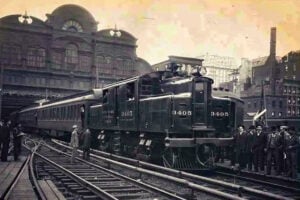
The History: Before New York’s first subway opened in 1904, elevated railways carried huge numbers of Manhattan passengers above Second, Third, Sixth, and Ninth Avenues. Early elevated service used small steam locomotives pulling lightweight passenger coaches. Contemporary and later transit histories repeatedly describe steam operation as dirty and noisy, with smoke and cinders adding to the disruption at street level. The Manhattan Railway began converting its elevated system to electric multiple-unit operation in 1901. The conversion proceeded line by line, and by 1903 steam locomotives no longer hauled regular passenger trains on Manhattan’s elevated system. The elevated trains themselves survived for decades on several routes, but the chuffing steam locomotive above the avenue disappeared.
# 6 – The Whoosh and Thud of New York’s Pneumatic Mail Tubes
The Era: 1897–1953
The Sound: A rush of compressed air followed by the heavy arrival of a steel mail canister at a postal receiving station.
The History: New York began pneumatic-tube mail service in 1897. Steel carriers were propelled through underground tubes by air pressure, allowing mail to move between major post offices without fighting street congestion. U.S. Postal Service history describes New York carriers roughly 24 inches long and eight inches wide, weighing about 21 pounds empty. Smithsonian records show that they could carry hundreds of letters and travel at speeds of about 35 miles per hour. At its greatest extent, the New York network covered roughly 27 miles, including a line carried across the Brooklyn Bridge. Service was suspended during World War I and later restored. The Brooklyn connection ended in 1950, and the remaining New York service was suspended in 1953 and never reinstated. Unlike most sounds on this list, the pneumatic system was largely heard by postal employees rather than by pedestrians above it.
# 7 – The Clatter of Horses and Wagons on Belgian Block Streets
The Era: Mid-19th century through the early 20th century
The Sound: Iron horseshoes, wagon wheels, harnesses, and heavily loaded carts striking granite paving blocks in a constant hard-edged rhythm.
The History: Before motor vehicles took over New York’s streets, horses powered an enormous share of the city’s passenger and freight transportation. One historical estimate places roughly 130,000 horses in Manhattan around 1900. Many heavily traveled streets were paved with rectangular granite blocks commonly called Belgian blocks. The rough surface and joints gave horses better footing than smoother paving, especially when pulling heavy loads, but the blocks also contributed to the tremendous noise of horse-drawn traffic. New York University research on 19th-century 42nd Street describes the granite-block paving as noisy but necessary. As automobiles and trucks replaced horses and asphalt covered more stone-paved streets, that relentless combination of hoofbeats and wagon wheels faded remarkably quickly.
# 8 – The Gate Slam and Operator’s Call of a Manual Elevator
The Era: Late 19th century to the present, now rare
The Sound: A folding or sliding gate closing, the mechanical movement of the cab, and the elevator operator announcing floors or telling passengers to step in or out.
The History: Before automatic elevators became standard, elevator travel depended on a human operator. The operator controlled the cab with a car switch or lever, watched the landings, opened and closed gates and doors, and stopped the car level with the floor. The job was once common enough that New York City’s 1938 Building Code contained specific qualifications, training rules, and instructions for elevator operators. Automation eliminated most of those positions, but not every manual elevator has disappeared. A small number have survived in older New York buildings, which is why this sound is better described as nearly lost rather than literally extinct.
# 9 – The Coin Bells and Rotary Whir of a Three-Slot Payphone
The Era: Early 20th century through the 1960s and 1970s
The Sound: Distinct bell and gong tones as nickels, dimes, and quarters passed through the coin mechanism, followed on rotary models by the whir and clicking return of the dial.
The History: The classic three-slot Bell System payphone did more than collect money. Its internal coin mechanism used different audible signals so an operator could determine which coins had been deposited. A nickel produced one bell signal, a dime two, and a quarter a deeper gong. In New York City, the price of a local payphone call increased to 10 cents at the beginning of 1951, making the dime an especially familiar part of the ritual. Western Electric’s three-slot design remained in production through 1964. In 1965, the Bell System introduced a redesigned single-slot payphone in which electronic signaling replaced the old mechanical coin bells. Rotary payphones survived much longer, but that particular combination of coin gongs and dial return belonged to an earlier telephone age.
# 10 – The Shouts of Newsboys Selling the Latest Edition
The Era: 1830s through the early and mid-20th century
The Sound: Newspaper names, headlines, and cries of “Extra!” shouted above traffic as sellers tried to catch pedestrians before the competition did.
The History: Street newspaper selling became part of New York life during the rise of the penny press. The Library of Congress notes that Benjamin Day’s New York Sun, founded in 1833, owed part of its success to newsboys hired to hawk the paper through the city. New York newspapers also issued special extra editions when major events demanded another press run. Sellers did not necessarily recite the movie-version phrase “Extra! Extra! Read all about it!” word for word; what mattered was the shouted headline, the newspaper’s name, and the promise that something had just happened. Home delivery, radio, television, changing labor practices, and eventually digital news transformed the business. The once-familiar chorus of newspaper hawkers competing for attention on busy New York corners faded from everyday street life.
Readers interested in more sounds, trades, and technologies that disappeared from everyday New York can continue with our history of the NYC subway token, our look at 10 old-fashioned street jobs that once defined New York City, our guide to 10 lost New York transit lines, terminals, and ferries, and our collection of 10 lost New York City traditions.
Sources
- New York Transit Museum — History of the 1953 subway token
- The Washington Post — The end of the New York City subway token, May 2003
- South Street Seaport Museum — Manhattan’s Luxury Liner Row
- NYC Department of Records and Information Services — West Side superliner piers
- City Lore — The sound of a New York cutlery-grinding truck
- 6sqft — Grand Central’s split-flap departure-board history
- New York City Landmarks Preservation Commission — History of Manhattan elevated steam service and electrification
- United States Postal Service — Pneumatic Tube Mail Service
- Smithsonian National Postal Museum — New York pneumatic tube canister
- New York University — Granite block paving and horse traffic on 42nd Street
- The Henry Ford — Horse-drawn transportation in American cities
- NYC Department of Buildings — 1938 Building Code provisions for elevator operators
- Bell System Memorial — Western Electric three-slot and single-slot payphone history
- The New Yorker — New York City’s 1951 change to a 10-cent payphone call
- Library of Congress — The Sun, extra editions, and New York newsboys