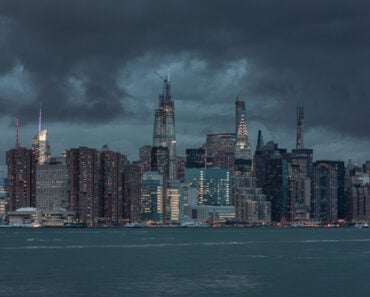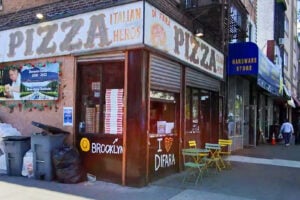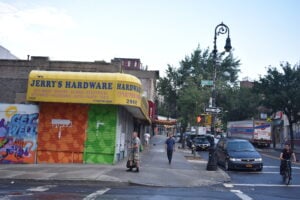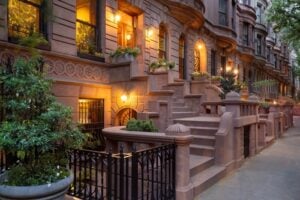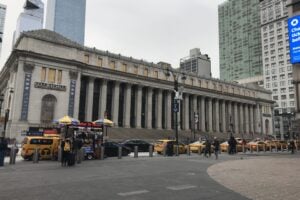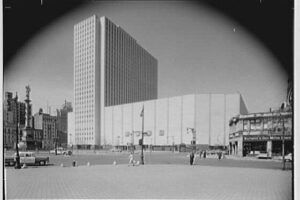
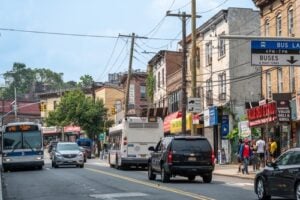
A neighborhood street scene on Staten Island, New York. Photo: Massimo Parisi / Shutterstock.com
Staten Island’s neighborhood names preserve some of New York City’s oldest layers of history. Dutch and English place-names share the map with French Huguenot settlements, colonial estates, ferry landings, oyster villages, military sites, railroad communities, resort beaches, industrial company towns, and quiet residential districts that still carry the names of families who lived there generations ago.
The borough is also unusual because so much of its earlier landscape can still be recognized in its modern geography. Creeks, hills, shorelines, old roads, and former villages continue to shape the way Staten Islanders describe where they live. This guide looks at the stories behind 40 Staten Island neighborhood and community names, from St. George and Tottenville to Todt Hill, Sandy Ground, Richmondtown, and Charleston.
1. St. George
Origin: Named for financier and developer George Law during the creation of Staten Island’s major ferry and railroad terminal in the 1880s.
The Story: Businessman Erastus Wiman was working to consolidate Staten Island’s railroad and ferry connections when waterfront land was needed for a new terminal. Staten Island tradition, supported by contemporary historical accounts, holds that Wiman promised to “canonize” George Law if the land rights could be secured, turning George Law into the very unofficial “St. George.” The terminal opened in 1886 and helped make the neighborhood the borough’s transportation and government center. The area is also home to the historic St. George Theatre.
2. Tottenville
Origin: Named for the prominent Totten family, whose members were longtime South Shore landowners, merchants, mariners, and businesspeople.
The Story: The southwestern tip of Staten Island had earlier been associated with the Manor of Bentley and other local names. During the 19th century, the Totten family became closely identified with the growing settlement, owning property and businesses including Totten’s Landing and a general store. The name Tottenville became established during the 1860s, and the village was incorporated in 1869. Oyster harvesting, shipbuilding, and maritime trades became central to the community’s economy. Tottenville is also home to the Conference House, where an unsuccessful peace conference was held during the American Revolution in 1776.
3. Todt Hill
Origin: The exact origin of Todt is disputed. One long-standing explanation connects it with a word meaning “dead” and with the early use of the hill as a burial place.
The Story: Dutch settlers earlier called the elevation Yserberg, or “Iron Hill,” because limonite iron ore was found in its serpentine rock. New York City Landmarks records several competing explanations for the later Todt Hill name, including burial-ground traditions and an old “Toad Hill” story. What is certain is the geography: at roughly 410 feet above sea level, Todt Hill contains the highest natural point in New York City.
4. New Dorp
Origin: From the Dutch Nieuwe Dorp, meaning “New Village” or “New Town.”
The Story: A newer settlement developed on Staten Island after the establishment of the earlier community remembered as Oude Dorp, or Old Town. The Dutch-derived name survived English rule in anglicized form as New Dorp. By the Revolutionary War, the community was well established; British General William Howe used the area as a headquarters after British forces landed on Staten Island in 1776. New Dorp later became one of the island’s important railroad and commercial centers.
5. Old Town
Origin: From the Dutch Oude Dorp, meaning “Old Village.”
The Story: In 1661, a group of European settlers established what became the first permanent non-Indigenous settlement on Staten Island. The community included Dutch, Walloon, and French-speaking settlers. After newer settlements developed elsewhere on the island, the original village became remembered as Oude Dorp and later Old Town. The name remains one of Staten Island’s clearest links to its 17th-century colonial history.
6. Huguenot
Origin: Named for the French Huguenots, Protestant refugees and settlers who became an important part of Staten Island’s early European population.
The Story: French-speaking Protestant settlers were present on Staten Island from the earliest permanent European settlement in 1661, and additional Huguenot families arrived during the later 17th century. They established farms, families, and religious communities across the island. The Huguenot name became firmly attached to the South Shore area and was reinforced by the Staten Island Railway station and the Reformed Church of Huguenot Park.
7. Port Richmond
Origin: A maritime name combining the community’s role as a port with Richmond County, the official county name of Staten Island.
The Story: The North Shore waterfront had long served as a ferry and trading point across the Kill Van Kull. During the 1830s, the Port Richmond name became established as local leaders attempted to expand the village’s commercial and maritime importance. The Staten Island Whaling Company was incorporated there in 1836, and the waterfront later supported shipping, manufacturing, lumber, coal, and other industries.
8. Stapleton
Origin: Named for developer William J. Staples.
The Story: In 1832, William J. Staples and Minthorne Tompkins acquired land from the Vanderbilt family and laid out a new street network along the northeastern shore. The name Stapleton was applied to the new community, which Staples and Tompkins promoted during the 1830s along with ferry service to Manhattan. Rail service, industry, and major breweries later helped turn Stapleton into one of Staten Island’s busiest 19th-century waterfront communities.
9. Tompkinsville
Origin: Named for Daniel D. Tompkins (1774–1825), governor of New York and later vice president of the United States.
The Story: Tompkins purchased substantial property along Staten Island’s northeastern shore in 1814 and developed a community there during the following years. He promoted roads and ferry transportation and helped improve connections between Staten Island, Manhattan, and routes toward New Jersey and Philadelphia. The settlement took the name Tompkinsville, preserving one of the most important political names in Staten Island history.
10. Great Kills
Origin: From the Dutch word kil, meaning a creek, channel, or waterway.
The Story: The southeastern shoreline was shaped by tidal creeks, marshes, and a protected harbor, making a Dutch-derived waterway name especially appropriate. The community was known at different times by names including Clarendon and Giffords, but Great Kills eventually became the lasting neighborhood name. Its harbor remained closely associated with fishing, oysters, boating, and maritime recreation.
11. Dongan Hills
Origin: Named in honor of Thomas Dongan, the Irish-born colonial governor of New York from 1683 to 1688.
The Story: The area had earlier been associated with names including Garretson, Hillside Park, and Linden Park. The community later adopted the name Dongan Hills to honor Governor Thomas Dongan, an important figure in colonial New York and Staten Island history. The “Hills” portion reflects the elevated terrain along the eastern side of Staten Island’s central ridge.
12. Mariners Harbor
Origin: A maritime name reflecting the neighborhood’s long connection with mariners, shipyards, oyster boats, ferries, and waterfront trades.
The Story: Located along the Kill Van Kull and near Newark Bay, the North Shore community developed around water transportation and industry. Generations of residents worked as captains, pilots, shipbuilders, oystermen, dockworkers, and marine tradespeople. The straightforward name Mariners Harbor preserved that waterfront identity even as the area became increasingly industrialized.
13. Travis
Origin: Named for Colonel Jacob E. Travis, whose family was associated with the community during the 19th century.
The Story: The West Shore settlement carried several names over the centuries, including New Blazing Star, Long Neck, Deckertown, Travisville, and eventually Linoleumville after the American Linoleum Manufacturing Company established a major factory there in the 1870s. After the plant closed, residents voted in 1930 to replace the industrial company-town name. They selected Travis, reviving the older local family name. The community remains famous for its long-running Fourth of July parade.
14. Sandy Ground
Origin: A descriptive name for the sandy upland soil of the historic community near Rossville.
The Story: Sandy Ground is one of the most important Black historic communities in New York City. In 1828, free Black ferry operator John Jackson purchased property in the area. During the middle of the 19th century, Black oystermen and their families, including migrants from Maryland who faced restrictive laws there, joined the growing community. Residents owned property, boats, and businesses and built institutions including the Rossville A.M.E. Zion Church. New York City has described Sandy Ground as New York’s first free Black community and one of the nation’s earliest such settlements.
15. Rossville
Origin: Named for Colonel William E. Ross, a prominent 19th-century resident.
The Story: The southwestern community carried several earlier names, including Smoking Point and Blazing Star. During the 19th century, William E. Ross became a notable local landowner, and the Rossville name gradually replaced the older designations. The neighborhood is closely connected with the history of Sandy Ground and Staten Island’s oyster trade.
16. Clifton
Origin: A 19th-century residential development name likely chosen for the area’s cliff-like East Shore terrain and the prestige associated with the English place-name Clifton.
The Story: Clifton was laid out during the 1830s as Staten Island’s northeastern waterfront developed into a series of residential villages and ferry communities. Its elevated position provided broad views toward New York Harbor. The village later became part of Edgewater, while the older Clifton name survived as the identity of the surrounding neighborhood and railway station.
17. West New Brighton
Origin: Developed from the older New Brighton name, inspired by the famous English seaside resort of Brighton.
The Story: During the 1830s, developers promoted New Brighton as a fashionable North Shore residential and resort community. As development spread westward along Richmond Terrace, the adjoining section became known as West New Brighton. The area later developed a stronger industrial and working waterfront character while keeping the resort-era name.
18. Grymes Hill
Origin: Named for the Grymes family, whose estate occupied the elevated neighborhood during the 19th century.
The Story: Suzette Grymes acquired an estate on the high ridge overlooking New York Harbor during the 1830s. Her family became strongly associated with the hill, and the name Grymes Hill entered local usage and maps. The elevated neighborhood later became home to major institutions, including Wagner College, while retaining its historic residential character.
19. Emerson Hill
Origin: Named for Judge William Emerson, brother of writer and philosopher Ralph Waldo Emerson.
The Story: William Emerson established a country home on Staten Island during the 19th century. His brother Ralph Waldo Emerson visited, and Henry David Thoreau lived on Staten Island in 1843 while tutoring William Emerson’s children. The family’s association with the wooded hill gave the neighborhood the enduring name Emerson Hill.
20. Lighthouse Hill
Origin: Named for the Staten Island Range Light, commonly called the Staten Island Lighthouse.
The Story: The wooded elevation above Richmondtown had carried earlier local names, but its modern identity came from the lighthouse constructed by the federal government in 1912. The tower served as a navigational range light for ships approaching New York Harbor. Its highly visible position on the ridge made Lighthouse Hill a natural name for the surrounding residential area.
21. Richmondtown (Historic Richmond Town)
Origin: Named for Richmond County, which was created in 1683 and named for the Duke of Richmond.
The Story: The crossroads settlement developed near the center of Staten Island and became the seat of Richmond County government in 1728. Courts, public offices, churches, shops, homes, and trades clustered around the village. After Staten Island joined the consolidated City of New York in 1898, government functions gradually shifted to St. George. Today, Historic Richmond Town preserves dozens of historic structures and tells the story of centuries of Staten Island life.
22. Annadale
Origin: Named for Anna Seguine, a member of Staten Island’s prominent Seguine family.
The Story: The Seguines were important South Shore landowners, farmers, merchants, and industrialists. Historical research ties the Annadale name to Anna Seguine, whose family was closely associated with this section of Staten Island. The arrival of the Staten Island Railway strengthened the place-name as the station became the center of a growing residential community.
23. Eltingville
Origin: Named for the Elting family, which was associated with local commerce and property.
The Story: The South Shore area remained predominantly agricultural through much of the 19th century. As railroad service and local businesses encouraged development, the Elting family became closely identified with the crossroads around the station. The community adopted the name Eltingville, which remains one of the borough’s many neighborhood names derived from local families.
24. Prince’s Bay
Origin: An old colonial maritime place-name whose exact royal reference is uncertain.
The Story: Prince’s Bay appears in early records and maps as the name of the sheltered South Shore inlet. Historical accounts have connected the name with a Prince of Wales, but identifying exactly which royal figure inspired it is difficult. What is much clearer is the neighborhood’s maritime history: Prince’s Bay became famous for oysters, shipping, summer homes, and the lighthouse complex built on the bluff overlooking Raritan Bay.
25. Castleton Corners
Origin: Named for the old Town of Castleton and the important crossroads at Victory Boulevard and Manor Road.
The Story: Castleton developed from the colonial Manor of Cassiltowne associated with Governor Thomas Dongan. The busy interior intersection was long known as Four Corners. As the surrounding area became more suburban and commercial, Castleton Corners emerged as the lasting name for the neighborhood around the junction.
26. Silver Lake
Origin: Named for Silver Lake, the body of water at the center of the neighborhood and park.
The Story: The lake and surrounding hills became an important North Shore recreation area. During the 19th century, ice was harvested from Staten Island ponds and lakes for commercial use. In the early 20th century, Silver Lake became part of the borough’s water-supply system, serving as a reservoir connected with New York City’s larger water infrastructure. The lake gave its name to both Silver Lake Park and the surrounding residential neighborhood.
27. Fort Wadsworth
Origin: Named in 1865 for James Samuel Wadsworth, a Union general who died from wounds received at the Battle of the Wilderness in 1864.
The Story: The Narrows had been defended by military works for generations before the Civil War. The major fortification then known as Fort Richmond was renamed Fort Wadsworth by War Department order in 1865. The name was later applied to the broader military reservation. Today, Fort Wadsworth is part of Gateway National Recreation Area and stands beside the Staten Island approach to the Verrazano-Narrows Bridge.
28. Rosebank
Origin: A picturesque 19th-century name generally associated with the area’s rose-covered waterfront and estates, although its precise origin is not firmly documented.
The Story: Before the Rosebank name became established, parts of the community were associated with older names including Peterstown and Clifton. During the 19th century, wealthy families built waterfront estates in the area, and by around 1880 Rosebank had become the familiar neighborhood name. Italian immigrants soon established an important community there. Rosebank is also closely associated with inventor Antonio Meucci, Italian patriot Giuseppe Garibaldi, and photographer Alice Austen.
29. Arrochar
Origin: Named for Arrochar in Scotland.
The Story: Scottish-born merchant William W. MacFarland established an estate in this section of Staten Island during the 19th century and used the Scottish place-name Arrochar. The name survived as the surrounding East Shore community developed. Its location near the Narrows and the old settlement of Old Town gives Arrochar an unusually deep connection to Staten Island’s earliest European history.
30. Grasmere
Origin: Named after Grasmere in England’s Lake District.
The Story: The Staten Island community developed in an area marked by ponds, wooded hills, and scenic country property. Historical accounts connect the name with the English Lake District village made famous by poet William Wordsworth. The literary and picturesque name suited a neighborhood whose landscape was once dotted with country estates and freshwater ponds.
31. Concord
Origin: Named in the 1840s after Concord, Massachusetts.
The Story: The community had earlier been called Dutch Farms. In 1845, the Concord name was adopted, drawing on the historical and literary reputation of the Massachusetts town. The association was especially appropriate because Judge William Emerson lived nearby and Henry David Thoreau spent part of 1843 on Staten Island tutoring Emerson’s children.
32. Sunnyside
Origin: A picturesque 19th-century residential name suggesting a bright, pleasant suburban setting.
The Story: The interior area around Clove Road remained largely rural for generations. As country homes and later suburban development spread across Staten Island, the optimistic name Sunnyside became attached to the community near present-day Clove Lakes Park. Unlike some Staten Island neighborhood names, its origin is not tied to one clearly documented founder or family.
33. Grant City
Origin: Named for Union general and future president Ulysses S. Grant.
The Story: The community had earlier been associated with the name Frenchtown. During the Civil War era, the Grant name was adopted in honor of the Union military leader. Railroad service helped establish the new identity as development expanded along Staten Island’s East Shore. Streets in the area also preserve names connected with Civil War-era national figures.
34. Oakwood & Oakwood Beach
Origin: The Oakwood name dates to the colonial era and reflects the wooded character of the southeastern Staten Island landscape.
The Story: New York City Landmarks research traces the Oakwood name to a large 17th-century property acquired by French settler Jacques Guyon. The community remained largely agricultural for generations. Later railroad development reinforced the Oakwood name, while the shoreline became known as Oakwood Beach. The area’s wetlands, shoreline, and nearby Great Kills Harbor preserve much of its connection to Staten Island’s natural landscape.
35. Midland Beach
Origin: A resort-era name associated with the Midland transportation company and the East Shore beachfront.
The Story: At the end of the 19th century, private developers transformed Staten Island’s eastern beaches with hotels, bathing pavilions, theaters, beer gardens, amusement attractions, and boardwalks. Midland Beach became one of the island’s major seaside destinations and was closely linked with trolley and rail transportation. Although the old resort infrastructure largely disappeared, the neighborhood retained the Midland Beach name.
36. South Beach
Origin: A direct geographic name for the sandy East Shore beach south of Staten Island’s northeastern communities.
The Story: South Beach developed into one of Staten Island’s great resort areas during the late 19th and early 20th centuries. Hotels, bathing pavilions, entertainment venues, and amusement parks drew large summer crowds. The most famous attraction was Happyland Amusement Park, which opened in 1906. The resort era faded, but the beach, boardwalk, and neighborhood continue to carry the straightforward South Beach name.
37. Bulls Head
Origin: Named for the historic Bull’s Head Tavern at the important interior crossroads near today’s Victory Boulevard and Richmond Avenue.
The Story: Taverns were essential landmarks in colonial Staten Island, serving travelers, stage routes, merchants, and local residents. The Bull’s Head Tavern was identified by its memorable sign and became so closely associated with the surrounding crossroads that the tavern name outlived the building itself. Bulls Head remains one of Staten Island’s clearest examples of a neighborhood named for a vanished local business.
38. Charleston (Historic Kreischerville)
Origin: The modern Charleston name replaced Kreischerville during the World War I era, when the German-sounding company-town name became unpopular.
The Story: Bavarian immigrant Balthasar Kreischer established a major fire-brick manufacturing operation on Staten Island during the 19th century, and the surrounding company town became known as Kreischerville. New York City archaeological research shows that the area began being called Charleston during World War I, likely because of anti-German sentiment. After the brick works closed in 1927, Charleston became the accepted neighborhood name. The precise reason Charleston itself was selected is less firmly documented.
39. Arden Heights
Origin: A late-19th-century place-name connected with Arden Avenue and the older Woods of Arden designation.
The Story: Staten Island historian records note that developer Erastus Wiman bestowed the name Woods of Arden on a wooded area in 1886. The later neighborhood name Arden Heights became associated with the inland residential district around Arden Avenue. The exact evolution of the name is less certain than some other Staten Island place-names, so claims that it honored a particular person named Arden are best avoided.
40. Pleasant Plains
Origin: A descriptive name adopted when the Staten Island Railroad extended service through the South Shore in 1860.
The Story: The railroad established a station on Amboy Road and gave it the inviting name Pleasant Plains. The name soon spread from the station to the surrounding rural community. Its broad, comparatively level South Shore landscape made the description especially appropriate. Pleasant Plains remains one of Staten Island’s neighborhood names most directly tied to the island’s railroad era.
For more Staten Island history, read our History of Staten Island’s St. George Theatre, History of the Verrazano-Narrows Bridge, and History of Staten Island’s Outerbridge Crossing and Goethals Bridges. You can also explore our guide to the 10 Oldest Neighborhoods in New York City.
Sources
New York City Municipal Archives — Richmond County and Staten Island Historical Records
New York City Landmarks Preservation Commission — Todt Hill and the Gillett-Tyler House
New York City Landmarks Preservation Commission — Reformed Church of Huguenot Park
City of New York — Stapleton Historical Development
New York City Landmarks Preservation Commission — Tottenville Historical and Archaeological Research
City of New York — Sandy Ground History
Historic House Trust of New York City — Historic Richmond Town
National Park Service — James Samuel Wadsworth and Fort Wadsworth
New York City Landmarks Preservation Commission — Charleston and Kreischerville Historical Research
New York City Landmarks Preservation Commission — Oakwood Historical Development
NYC Parks — History of Staten Island’s South and Midland Beaches
New York Public Library — Staten Island Railway and Neighborhood History