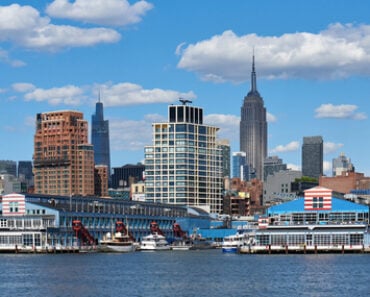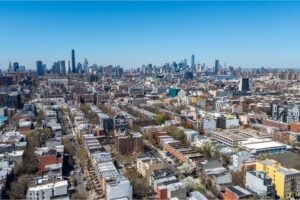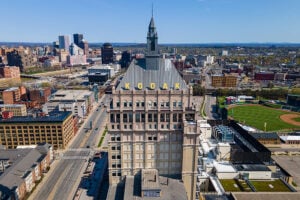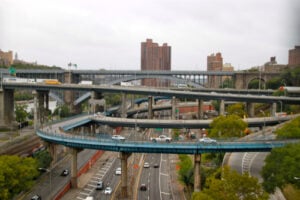
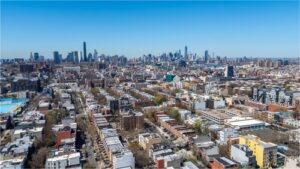
A view across Brooklyn toward the Manhattan skyline. The two were separate cities until New York City’s consolidation in 1898. Photo: Andrew Baum / Shutterstock.com.
As someone who was born in Manhattan and raised in the Bronx, I have always had a fascination with the origins of the boroughs where I have made my home. Well, the history of New York’s five boroughs began long before I first set foot on planet Earth via the great city of New York.
On January 1, 1898, the modern City of New York was officially born. Under legislation passed by the New York State Legislature, New York expanded from a city centered on Manhattan and the adjoining Bronx into a five-borough metropolis encompassing roughly 300 square miles. The reason New York City became five boroughs was not simply that neighboring communities wanted to share a name. Business leaders, political figures, and civic reformers believed that a single city could coordinate transportation, public services, and development while strengthening New York’s place among the world’s great cities.
Dubbed the Great Consolidation, and remembered by some opponents in Brooklyn as the “Great Mistake,” the union of Manhattan, Brooklyn, Queens, the Bronx, and Staten Island was hardly inevitable. It was the culmination of decades of political maneuvering, economic ambition, technological breakthroughs, and intense regional rivalry.
I. The Fragmentation of the Harbor Region
Before 1898, the area surrounding New York Harbor was a patchwork of independent municipalities, towns, and villages, with separate charters, tax systems, and political leadership. They shared a harbor and an expanding regional economy, but they did not share one city government.
The City of New York originally occupied Manhattan. In 1874, it annexed the western portion of what is now the Bronx from Westchester County, and in 1895 it absorbed territory east of the Bronx River. Those areas were part of New York City before the five-borough consolidation took effect, but the Bronx did not yet exist as a separate borough or county.
Across the East River stood the City of Brooklyn, an independent, booming metropolis in its own right. By 1890, Brooklyn was the fourth-largest city in the United States, with a thriving industrial waterfront and a fiercely independent civic identity. Its boundaries expanded during the nineteenth century until the city included all of Kings County by 1896. Brooklynites had plenty of reasons to consider themselves residents of their own city, rather than an extension of Manhattan.
To the east lay Queens County, comprising towns such as Flushing, Jamaica, Newtown, Hempstead, North Hempstead, and Oyster Bay, as well as the separate municipality of Long Island City. Farther south, Staten Island, or Richmond County, was divided into towns and villages with their own local traditions. Some of these communities were becoming industrial and suburban centers, while others retained farmland and relatively rural landscapes.
II. The Drivers of Unification
The movement toward consolidation was championed by civic reformers, business leaders, real estate interests, and politicians who argued that municipal fragmentation could hinder the region’s economic growth and infrastructure development. Supporters believed that a city of this size needed a government capable of thinking beyond the boundaries of one island or one town.
Infrastructure, Water, and Public Services
As the population grew through immigration and industrial expansion, neighboring municipalities faced related challenges involving water supplies, sanitation, streets, policing, and transportation. Each community had developed arrangements of its own, but a shared metropolitan economy increasingly crossed municipal lines. Advocates of consolidation argued that coordinating these services and financing major improvements would be easier under one government.
Water was an especially powerful argument. Brooklyn had its own water system, just as Manhattan had long relied on water brought from outside the city’s boundaries. Consolidation supporters pointed to the possibility of financing improvements with a broader tax base, including the valuable commercial real estate of Manhattan. A single city would not magically solve every public-health or infrastructure problem, but it offered a different way to pay for and administer regional projects.
The Impact of Physical Connections
The opening of the Brooklyn Bridge in 1883 fundamentally altered the relationship between Manhattan and Brooklyn. For the first time, the two independent cities were connected by a permanent bridge, making travel across the East River more direct and reinforcing the economic ties that already existed through ferries and shipping.
Elevated railroads and the prospect of an expanded rapid-transit network added to the argument that the region’s daily life no longer fit neatly within separate municipal boundaries. The bridge did not make consolidation inevitable, but it showed how closely two supposedly independent cities could become connected.
Economic Competition and Global Ambition
The political debate also reflected competition among America’s expanding cities. Chicago’s dramatic territorial growth in 1889 gave New York’s boosters another reason to worry about the city’s standing. Supporters argued that uniting the harbor region would create a larger metropolitan population, a wider tax base, and a government better positioned to compete with other major commercial centers.
For some supporters, consolidation was a practical answer to questions about bridges, water, and public works. For others, it was a declaration that the New York region should be governed and recognized as a great world city. Those interests did not always agree on the details, but they helped build the coalition that eventually carried the proposal forward.
III. Political Warfare and Andrew Haswell Green’s Greater New York
One of the intellectual and political engines behind consolidation was Andrew Haswell Green, a former New York City comptroller and president of the Central Park Commission. Often remembered as the “Father of Greater New York,” Green argued for bringing the surrounding municipalities together decades before the merger finally took place. He advanced the idea publicly in the 1860s, and a state commission formed in 1890 examined the boundaries and government of the proposed larger city.
However, consolidation faced fierce political resistance, particularly in Brooklyn. Many residents worried that their independent city’s identity would be swallowed by New York and that local decisions would come under the influence of Manhattan’s powerful Tammany Hall political machine. Critics also feared that the costs of the new government would not be shared fairly. Supporters answered that access to a larger tax base could help finance Brooklyn’s future growth.
Political calculations were rarely simple. Republican leader Thomas C. Platt came to see consolidation as a potential political opportunity, while factions associated with Tammany and other local machines weighed how the merger might change their influence. The disagreement was not merely between one party that favored consolidation and another that opposed it. The question cut across local loyalties, business interests, and political alliances.
The battle came to a head on November 6, 1894, when voters in the affected areas were asked to express their views in a nonbinding referendum. Brooklyn’s result illustrated just how divided the public remained: 64,744 votes favored consolidation, while 64,467 opposed it. The winning margin was only 277 votes out of 129,211 cast. Brooklyn, the city whose independence was most visibly at stake, had agreed to the change by the narrowest of margins.
The referendum did not itself create Greater New York. State legislators still had to settle the boundaries and legal structure of the proposed city. With Platt’s support, the consolidation law passed in 1896 under Governor Levi P. Morton. The legislature then took up the new city’s governing charter. On May 4, 1897, Governor Frank S. Black signed that charter into law, establishing the framework for consolidation on January 1, 1898.
IV. How the Five-Borough Framework Worked
The 1898 charter brought the municipalities together under a central mayor and city government while recognizing five boroughs with their own borough presidents. It also established a Board of Estimate and a two-house legislative body called the Municipal Assembly, consisting of a Council and a Board of Aldermen. The original structure was revised in 1901, when the two-house arrangement gave way to a single Board of Aldermen. The modern City Council did not exist in its present form in 1898.
The new city consisted of the following five boroughs:
Manhattan (New York County): The established commercial and financial center of New York, with a municipal history dating back centuries.
Brooklyn (Kings County): The formerly independent City of Brooklyn, which surrendered its separate municipal government and became a borough of the larger city.
The Bronx (part of New York County until 1914): Territory annexed from Westchester County in 1874 and 1895. The Bronx became a borough in 1898 but did not become a separate county until 1914.
Queens (part of Queens County in 1898): The western portion of the old county, including Long Island City, Newtown, Flushing, Jamaica, and the Rockaway Peninsula. The remaining eastern towns, principally Hempstead, North Hempstead, and Oyster Bay, stayed outside New York City and became Nassau County in 1899.
Staten Island (Richmond County): The island’s towns and villages became the Borough of Richmond. The borough’s official name changed to Staten Island in 1975, while the county retained the name Richmond.
The borough and county distinction is worth remembering. New York City had five boroughs in 1898, but not yet five counties matching their boundaries. The Bronx was still part of New York County, and Queens County still included territory outside the new city. Both situations changed in the following years.
V. What Consolidation Changed for New York City
The consolidation of 1898 reshaped American urban history. The new City of New York could make plans and raise funds on a scale that had not been possible for the separate governments. Robert Van Wyck became the first mayor of Greater New York, taking office as the city began the complicated process of joining agencies and services that had previously operated independently.
The city’s subsequent growth included an expanding subway system, major East River bridges, and efforts to secure and distribute water across an enormous population. The first Interborough Rapid Transit subway opened in 1904, while the Catskill water system was developed in the decades that followed. These achievements had roots in planning that began before consolidation; they should not all be credited to a single act of legislation. But the five-borough government became the framework within which much of New York’s twentieth-century development took place.
Consolidation also came with arguments that never entirely disappeared. New Yorkers continued to identify strongly with their boroughs, and questions about local representation, spending, and political power remained. Brooklyn did not stop being Brooklyn because it ceased to be an independent city. Nor did Queens, the Bronx, or Staten Island lose the differences that made them recognizable communities.
For me, that is one of the most fascinating parts of the story. New York City became one city in 1898, but it never became one uniform place. Its five boroughs brought together different histories, neighborhoods, and loyalties under a shared city government. That mix of unity and local identity is still what makes New York unlike anywhere else. Just try a slice of pizza in the Bronx, and then Brooklyn, Queens, Manhattan, and Staten Island. They will all be fabulous, yet taste different. That’s New York City!
To explore more about the places and communities that make up New York City, read our histories of how Bronx neighborhoods got their names, how Brooklyn neighborhoods got their names, how Queens neighborhoods got their names, and how Staten Island neighborhoods got their names.