Feature Photo: Phillip Pessar, CC BY 2.0, via Wikimedia Commons
Long before big-box stores and online shopping changed American retail, a trip downtown often meant a visit to the local five-and-dime. These stores sold the ordinary things that families needed, from sewing supplies and kitchen utensils to inexpensive clothing, toys, and candy. Woolworth’s and W.T. Grant became familiar names across the country, but another chain with deep roots in Western New York also belonged to that world: Neisner’s.
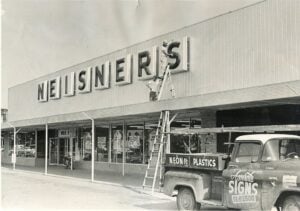
Founded in Rochester in 1911 by brothers Abraham and Joseph Neisner, the company grew far beyond its Upstate New York beginnings. At its height in 1967, Neisner’s operated approximately 192 stores across the United States. Its stores became part of downtown shopping districts, and its lunch counters gave people another reason to stop inside even when they had little shopping to do.
So whatever happened to Neisner’s Five-and-Dime Stores? The company struggled as shopping patterns changed and the discount-store business grew more competitive. It filed for bankruptcy protection in December 1977, and Ames Department Stores acquired the business in 1978. Some stores closed, while others were folded into Ames or operated briefly under transitional names. By about 1980, the Neisner’s name had largely disappeared from American retail.
The story is especially interesting because Neisner’s did not remain a small regional operation. It became a national chain headquartered in Rochester, tried to compete in the emerging discount department store market through its Big N division, and left a corporate landmark that still bears the Neisner name today.
1. The Rochester Origins of Neisner Brothers
Abraham and Joseph Neisner opened the Rochester store that established Neisner Brothers in 1911. The original location was at 200 East Main Street, in a downtown shopping district where pedestrians could visit several businesses in one outing. The brothers had previous retail experience, but Rochester became the headquarters and lasting identity of the chain that carried their surname.
Historical business records preserved by Harvard Business School describe an initial investment of $12,000. The company sold general merchandise at prices ranging from five cents to one dollar. That is an important correction to the popular idea that everything in an old five-and-dime cost only a nickel or a dime. Those prices gave the store category its name, but Neisner’s early business already included merchandise at higher price points.
The appeal was easy to understand. A shopper could enter for a small household necessity and discover other affordable goods without going to a specialized retailer for each one. In growing industrial cities, that convenience made variety stores a regular stop for families watching their budgets.
The brothers incorporated Neisner Brothers, Inc., in New York in 1916. By then the company had five stores and annual sales exceeding $500,000, according to the archived corporate history. By 1927, it operated 22 stores and reported sales of $6.5 million. What began on East Main Street was already becoming a substantial business with locations in several states.
2. How Neisner’s Became a National Chain
Neisner’s followed the growth of the American variety-store industry during the 1920s and 1930s. Its stores spread well beyond Western New York into communities in Pennsylvania, Ohio, Michigan, Illinois, and other states. The chain could adapt a familiar merchandising formula to shopping districts where working families wanted practical goods at predictable prices.
The company also ventured into international retail. In 1929, it acquired an interest in British Home Stores, a British variety-store business. That expansion was relatively short-lived, but it shows the ambition of a Rochester company that was becoming known far beyond its original market. Neisner Brothers common stock was listed on the New York Stock Exchange in October 1929, the same month associated with the stock market crash.
Like many retailers, Neisner’s experienced financial pressure during the Great Depression. Its sales and earnings did not move in the same direction: archival records show that sales rose in 1930 while net income fell sharply. The company later recovered. By 1937, it had 108 stores and employed nearly 3,800 people.
Growth continued through the middle decades of the century. A retail-history inventory and later reporting in the Rochester Business Journal identify 192 stores in 1967, considerably more than the 150 locations sometimes attributed to the chain. Neisner’s was no longer merely a Rochester or Northeastern retailer. It was a national variety-store business that had begun in Upstate New York.
3. Shopping at Neisner’s: Merchandise, Candy, and Lunch Counters
What customers remembered most was not necessarily the corporate size of Neisner Brothers. It was the experience of going into one of the stores. Five-and-dimes occupied a useful place between a neighborhood specialty shop and a large department store. They offered everyday household goods, personal accessories, sewing notions, inexpensive clothing, and other merchandise that people could buy without making a special trip to a distant shopping center.
Many stores of this era also offered candy counters and places to eat. Neisner’s was no exception. A well-documented example was its Mobile, Alabama, location, where advertisements in the 1940s promoted a luncheonette offering complete meals at modest prices. Shoppers could stop for something to eat while they were downtown. The menu at one location should not be assumed to have been identical at every Neisner’s, but the surviving advertisements establish that food service was an important part of the chain’s history.
It is easy to see why such stores became part of people’s memories. For children, a few coins might buy a small treat. For adults, the same building could provide the thread, kitchen item, or inexpensive gift they needed. There was no need to turn an ordinary shopping trip into a major excursion. That mixture of convenience and affordability gave the five-and-dime a particular place in American daily life.
In Rochester, the East Main Street flagship carried additional meaning. Neisner’s was a hometown business that had expanded into a national name while keeping its headquarters in the city. Local shoppers did not need to know the chain’s annual sales figures to understand that the company was part of Rochester’s identity.
4. The Big N Discount Stores: Neisner’s Attempt to Adapt
By the early 1960s, the American retail industry was changing. Larger discount department stores were attracting shoppers with broader selections, greater floor space, and parking designed for customers arriving by car. Downtown variety stores faced a competitive problem: they could not necessarily offer the size or convenience of the new suburban retailers.
Neisner’s responded with its Big N discount-store division. These were larger stores intended to compete in the growing discount department store market rather than simply recreate the traditional five-and-dime. Big N demonstrates that the company’s managers recognized the changing market and were willing to experiment with a different format.
The timing is well documented in Western New York. A newspaper index maintained by Genesee County records construction of a Big N location in Batavia in March 1963 and the installation of its sign that July. Later reports describe expansions there, including additional space in the early 1970s. Big N was therefore part of Neisner’s strategy by 1963; giving 1965 as the definite launch date would be misleading.
Some larger locations continued operating and expanding even as the traditional variety-store business came under increasing pressure. That is one reason Neisner’s decline should not be described as a sudden refusal to modernize. It tried a new model. The problem was that it was competing in a market where the size of stores, the cost of merchandise, real estate, and consumers’ shopping habits were all changing.
5. Why Neisner’s Went Bankrupt in 1977
The postwar growth of suburban shopping centers had already weakened many downtown retailers. During the 1960s and 1970s, chains such as Kmart and other discount operators placed further pressure on the traditional variety-store format. The everyday goods that once drew customers into five-and-dimes could increasingly be purchased at larger stores built around automobile access and wider product selections.
Neisner’s was caught between two businesses. Its older locations belonged to downtown retail districts whose fortunes were changing, while Big N required the company to compete with established discount stores. That combination left the chain vulnerable. It would be too simple to blame the collapse on one factor, such as suburban malls, inflation, or the expense of opening Big N stores, without financial records demonstrating the relative weight of each cause.
On December 1, 1977, Neisner Brothers sought bankruptcy protection. Federal court records identify the filing as a petition for an arrangement under Chapter XI of the former Bankruptcy Act. That is the historically correct terminology; describing the 1977 filing as one under today’s Chapter 11 would apply a later bankruptcy system to an earlier event.
For employees and customers, the consequences were immediate. Contemporary Batavia newspaper records show that Neisner’s announced plans in January 1978 to close 31 stores, including the local Big N. The fact that a relatively large Big N location was among those affected shows that the company’s troubles were not confined to aging downtown five-and-dime shops.
6. The Ames Takeover and the Disappearance of Neisner’s
Neisner’s did not recover as an independent national chain. In 1978, Ames Department Stores acquired the business. Ames, a discount retailer with roots in New England, was expanding through acquisitions, and Neisner’s offered store locations and other assets at a time when the older company was going through bankruptcy reorganization.
The acquisition did not mean every Neisner’s store immediately reopened as Ames. Some stores were closed and liquidated, while others continued under modified or transitional names as their future was determined. Historical retail accounts describe both Neisner’s-Ames and Ames-Big N names during the transition. The outcome varied by location.
For longtime shoppers, the change meant that the Neisner’s name they had known for years was disappearing from storefronts. Some of the buildings continued in retail use, but they were no longer part of the chain founded by Abraham and Joseph Neisner. The original Rochester flagship at 200 East Main Street had closed by 1980.
The purchase by Ames ended the independent corporate chapter of Neisner Brothers, but it did not guarantee that every former location survived. Ames had its own expansion strategy, and stores that did not suit that strategy could close. The disappearance of Neisner’s was therefore a combination of the 1977 financial collapse, the closing of individual stores, and the absorption of remaining operations into another retailer.
7. What Remains of Neisner’s in Rochester Today?
Although its five-and-dime stores are gone, Neisner’s name has not disappeared from Rochester. The company occupied corporate offices at 49 East Avenue, separate from the downtown flagship store at 200 East Main Street. Those offices became a physical reminder that Rochester had once been headquarters to a national variety-store company.
After the retail chain closed, the East Avenue office building eventually sat vacant for years. A Rochester developer, Riedman, undertook a major renovation that converted the historic property into 54 apartments. The building reopened in 2025 as The Neisner at East End. This is a reuse of the former headquarters, not a revival of the five-and-dime stores, but it keeps the company’s name visible in its home city.
That distinction matters when looking back at former retailers. A surviving building does not mean the original store remains, and a new business inside an old property is not the same as the company that once operated there. In this case, however, the reuse of Neisner’s former offices offers a tangible connection between Rochester’s retail past and its present.
Whatever Happened to Neisner’s Five-and-Dime Stores?
Neisner’s began in Rochester in 1911, developed into a national chain of approximately 192 stores by 1967, and attempted to adjust to changing shopping habits with its Big N discount stores. Those changes were not enough to save the business. The company filed for bankruptcy protection on December 1, 1977, Ames acquired it in 1978, and the Neisner’s retail name was largely gone by about 1980.
For people who remember shopping there, however, the history is about more than a bankruptcy and an acquisition. Neisner’s belongs to the era when downtown stores offered inexpensive everyday purchases, and a lunch counter could be part of a routine trip to Main Street. From one Rochester storefront, the brothers built a business recognized across the country. That is a remarkable piece of Upstate New York retail history, even if the signs have long since disappeared.
For more stories about vanished New York retailers, explore our histories of Woolworth’s, McCrory’s Five-and-Dime Stores, Caldor Discount Stores, and Bradlees Department Stores.