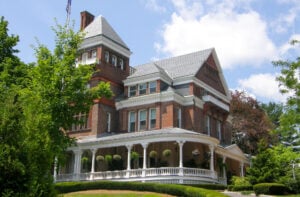
The New York State Executive Mansion at 138 Eagle Street in Albany, the official residence of New York’s governors since 1875. Photo by Ritu Manoj Jethani / Shutterstock.com.
New York elected its first state governor while the Revolutionary War was still being fought. British troops occupied New York City, the new state government met wherever circumstances permitted, and George Clinton had to lead a state whose future was not secure. Nearly two and a half centuries later, the governorship has become one of the most consequential offices in American state government. Its occupants have confronted wars, canals, slavery, industrialization, financial crises, public-health emergencies, and repeated debates over the relationship between state and local power.
The governor does not govern alone. Laws are enacted by the legislature, interpreted by the courts, and carried out through agencies and local governments. Yet governors can set priorities through budgets, appointments, vetoes, emergency powers, and public leadership. Those powers have changed substantially since 1777. The original constitution provided a three-year term and created councils that shared important appointment and veto functions; later constitutions abolished the councils, revised voting rights, and reshaped executive authority.
The length of the term changed several times, too. New York moved from three-year terms to two-year terms under the 1821 constitution, returned to three-year terms in the late nineteenth century, then went back to two years under the 1894 constitution. Voters approved a four-year term in 1937, beginning with the 1938 election. The modern office has no gubernatorial term limit. These changes are worth keeping in mind when comparing people who served for decades with governors whose entire administrations lasted only months or weeks.
The following chronological list contains all 57 individuals recognized in New York’s gubernatorial succession, including acting governors who took over when an elected governor died, resigned, or was removed. A governor elected to separate terms appears once, with both periods shown. The dates refer to years in office, not necessarily the year of election. Each biography focuses on an identifiable challenge, policy, or historical development rather than an assessment of whether the governor was a success or failure.
Every New York State Governor, 1777 to the Present
The list is arranged by the date each individual first assumed office. Acting governors are identified within their biographies. Nonconsecutive terms are combined beneath the same name.
1. George Clinton
Years in office: 1777–1795; 1801–1804
George Clinton took office in July 1777, as revolutionary New York attempted to establish a functioning state government while British forces still controlled New York City. From his base in the Hudson Valley, he dealt with militia needs, wartime supplies, and the difficult work of governing a state divided by the Revolution.
Clinton opposed ratification of the federal Constitution without stronger protections for state authority and individual rights. He returned to the governorship in 1801 after John Jay and later served as vice president under Thomas Jefferson and James Madison. His two stretches in Albany totaled nearly twenty-one years, the longest service by any New York governor.
2. John Jay
Years in office: 1795–1801
John Jay entered office in 1795 with a national reputation already established. He had helped negotiate the peace ending the Revolutionary War, contributed to The Federalist, and served as the first chief justice of the United States. His governorship unfolded as New Yorkers argued over competing visions of the new republic.
In 1799 Jay signed legislation providing for the gradual abolition of slavery in New York. The measure did not immediately emancipate everyone held in bondage, and slavery persisted in the state until 1827. Nevertheless, the law marked an important turning point in New York history.
3. Morgan Lewis
Years in office: 1804–1807
Morgan Lewis, a Revolutionary War veteran and former New York attorney general, became governor in 1804. His administration operated amid intense rivalries within the Democratic-Republican Party, especially disputes involving supporters of DeWitt Clinton and the political circle around Aaron Burr.
Lewis advocated support for public education and state military readiness. His career continued beyond the governorship: during the War of 1812 he returned to military service and rose to the rank of major general.
4. Daniel D. Tompkins
Years in office: 1807–1817
Daniel D. Tompkins entered office in 1807 and led New York through the War of 1812, when British attacks threatened the state along the Canadian border and the Great Lakes. Organizing troops, raising funds, and procuring supplies occupied much of his administration.
Tompkins personally advanced money for wartime expenses, later becoming embroiled in complicated disputes over the accounting of those funds. He resigned in 1817 to become vice president under James Monroe, one of several governors who moved from Albany into national office.
5. John Tayler
Years in office: 1817 (acting)
John Tayler, the lieutenant governor, performed the duties of governor after Daniel D. Tompkins resigned in February 1817. His brief service came at a pivotal moment for the state, as supporters of the Erie Canal were pressing the legislature to move the long-discussed project forward.
Tayler served until DeWitt Clinton began his elected term in July 1817. His place in the succession reminds readers that New York’s history includes acting governors as well as men and women elected directly to the office.
6. DeWitt Clinton
Years in office: 1817–1822; 1825–1828
DeWitt Clinton championed the Erie Canal at a time when critics mocked the proposed waterway as an expensive fantasy. Construction began during his first administration in 1817, with workers confronting formidable engineering problems across the state.
Clinton returned to office in 1825, the year the canal was completed and celebrated with a journey from Buffalo to New York Harbor. The waterway helped transform commerce, settlement, and the relationship between the Great Lakes and the Atlantic. He died in office in February 1828.
7. Joseph C. Yates
Years in office: 1823–1824
Joseph C. Yates served during the first years after New York adopted its 1821 constitution. The new document changed voting qualifications, reduced gubernatorial terms, and reorganized parts of state government, making his administration a period of institutional transition.
Yates, a former judge, dealt with continuing canal expansion and factional struggles inside the dominant Democratic-Republican political movement. His defeat after one term reflected the intensity of those rivalries rather than a quiet or settled age in New York politics.
8. Nathaniel Pitcher
Years in office: 1828 (acting)
Lieutenant Governor Nathaniel Pitcher assumed the governor’s duties following DeWitt Clinton’s death on February 11, 1828. The Erie Canal had only recently opened, and state leaders were considering how to manage the new transportation network and its effects on commerce.
Pitcher served for the remainder of 1828 before Martin Van Buren took office. Although his period in the executive chair was brief, he is included in the historical succession because the state needed an acting chief executive after Clinton died.
9. Martin Van Buren
Years in office: 1829
Martin Van Buren of Kinderhook was already a major political organizer when he became governor in January 1829. His alliance with Andrew Jackson and the network of New York politicians known as the Albany Regency had made him a nationally influential figure.
Van Buren proposed reforms that helped shape New York’s 1829 Safety Fund banking law, although the legislature enacted it after he resigned in March to become U.S. secretary of state. He later served as vice president and won the presidency in 1836.
10. Enos T. Throop
Years in office: 1829–1832
Enos T. Throop succeeded Van Buren as lieutenant governor and then won election to a full gubernatorial term. His years in office coincided with the growth of canal commerce and debates over the debt, costs, and management of additional transportation projects.
Throop supported fiscal restraint and faced disagreements over how aggressively the state should enlarge its canal system. He also presided over the implementation of the 1829 banking Safety Fund, a reform proposed during Van Buren’s short tenure.
11. William L. Marcy
Years in office: 1833–1838
William L. Marcy governed during a period when canals, banks, and increasingly organized political parties shaped state affairs. His administration faced the Panic of 1837, an economic breakdown that struck New York’s merchants, financial institutions, and working households.
Marcy was closely identified with Jacksonian Democratic politics and the debate over appointment through party patronage. He later served in the federal cabinet as secretary of war and secretary of state, extending his public career well beyond Albany.
12. William H. Seward
Years in office: 1839–1842
William H. Seward, elected as a Whig, became governor in 1839. His administration engaged questions about schooling, the treatment of immigrants, prison policy, and the rights of people escaping slavery. His positions often drew sharp opposition in a politically divided state.
Seward later became a United States senator and secretary of state under Abraham Lincoln and Andrew Johnson. He is especially remembered for negotiating the 1867 purchase of Alaska, a milestone in a career that began in New York politics.
13. William C. Bouck
Years in office: 1843–1844
William C. Bouck brought extensive experience as a canal commissioner to the governorship. As the Erie Canal system remained essential to the state economy, his administration dealt with the expense of improvements and arguments about public borrowing.
Bouck entered office in the aftermath of the Panic of 1837 and generally favored restraint in state spending. His two-year administration illustrates the continuing tensions between large public works programs and the taxpayers expected to finance them.
14. Silas Wright
Years in office: 1845–1846
Silas Wright became governor as tenant farmers in the Hudson Valley challenged the old patroon landholding system. The Anti-Rent War combined political protest with violent confrontations and created a difficult law-enforcement problem for state officials.
Wright ordered the militia into affected counties and faced criticism for his handling of the conflict. He lost reelection in 1846, but remained an influential figure in Democratic politics and in debates about public finance.
15. John Young
Years in office: 1847–1848
John Young took office after the constitutional convention of 1846 had reshaped New York government. The new constitution expanded the election of state officials and changed the judicial system, while political divisions over land tenure continued.
Young supported clemency for a number of anti-rent protesters imprisoned during the conflicts of the previous years. His decisions helped signal a different approach to resolving a dispute that had divided communities across the Hudson Valley.
16. Hamilton Fish
Years in office: 1849–1850
Hamilton Fish governed as disputes over slavery and westward expansion increasingly consumed national politics. At home, education, charitable institutions, and improvements to state administration remained important concerns.
A member of one of New York’s prominent political families, Fish later served as a United States senator and as secretary of state under Ulysses S. Grant. His federal diplomatic career became an enduring part of his legacy.
17. Washington Hunt
Years in office: 1851–1852
Washington Hunt served while debate over the Compromise of 1850 and the Fugitive Slave Act divided the country. In New York, Whigs disagreed about how to respond to slavery and whether the state should continue investing heavily in canal expansion.
Hunt supported enlargement of the canal system, but financing plans encountered constitutional and political difficulties. His term demonstrates how national sectional conflict and local economic concerns became intertwined before the Civil War.
18. Horatio Seymour
Years in office: 1853–1854; 1863–1864
Horatio Seymour held the governorship twice, first in the 1850s and again during the Civil War. His second administration confronted the 1863 New York City Draft Riots, in which resistance to federal conscription developed into deadly mob violence, including racist attacks on Black New Yorkers.
A Democrat who criticized key policies of Abraham Lincoln’s administration while supporting preservation of the Union, Seymour later became his party’s presidential nominee in 1868. He lost the election to Ulysses S. Grant.
19. Myron H. Clark
Years in office: 1855–1856
Myron H. Clark took office during the collapse of the old Whig Party and the formation of new coalitions over slavery and other questions. He was closely associated with the temperance movement, which sought restrictions on the sale of alcohol.
A prohibitory liquor law passed during Clark’s administration in 1855, but faced fierce resistance and was struck down by New York’s highest court. The controversy dominated much of his short tenure.
20. John A. King
Years in office: 1857–1858
John A. King was New York’s first governor elected under the Republican Party label. He entered office as the nation’s divisions over slavery deepened and was identified with opposition to the expansion of slavery into western territories.
King also dealt with the Panic of 1857, which brought financial distress to New York banks, businesses, and workers. His administration reflected the arrival of a new political alignment in both the state and the nation.
21. Edwin D. Morgan
Years in office: 1859–1862
Edwin D. Morgan was governor when the Civil War began in 1861. New York’s large population and manufacturing base made the state crucial to Union recruitment, military supplies, and financing.
Morgan was involved in mobilizing volunteers and held a military commission during the war. He later served in the United States Senate, while New York’s wartime recruitment and losses continued to shape communities across the state.
22. Reuben Fenton
Years in office: 1865–1868
Reuben E. Fenton governed as New York adjusted to the end of the Civil War. Questions of veterans’ welfare, Reconstruction, public education, and economic growth occupied the state at the beginning of a new national era.
Cornell University was chartered in 1865 during his administration, part of the broader development of higher education in New York. Fenton later served in the U.S. Senate and remained active in Republican politics.
23. John T. Hoffman
Years in office: 1869–1872
John T. Hoffman, formerly mayor of New York City, served as governor while Tammany Hall and William M. Tweed wielded enormous influence in city politics. His association with that political organization complicated his administration as evidence of the Tweed Ring’s corruption emerged.
When investigators assembled documentary evidence against Tweed, Hoffman authorized a special prosecution through the state attorney general. His career nevertheless suffered from the scandal and the public backlash against Tammany Hall.
24. John Adams Dix
Years in office: 1873–1874
John Adams Dix entered office after a long career that included service in the War of 1812, the U.S. Senate, the cabinet, diplomacy, and the Union Army. The Panic of 1873 soon presented his administration with severe economic difficulties.
Dix oversaw an era when the International Bridge over the Niagara River was completed and compulsory education legislation advanced. He had become nationally known during the secession crisis for directing officials to defend the American flag against attempts to remove it.
25. Samuel J. Tilden
Years in office: 1875–1876
Samuel J. Tilden became governor after establishing a reputation as an opponent of political corruption. He had helped trace financial transactions connected to the Tweed Ring and used the governorship to challenge the state’s Canal Ring.
Tilden became the Democratic presidential nominee in 1876. He won more popular votes than his opponent Rutherford B. Hayes, but disputed electoral returns and a special commission resulted in Hayes winning the presidency, 185 electoral votes to 184.
26. Lucius Robinson
Years in office: 1877–1879
Lucius Robinson was the first New York governor to serve a three-year term under the changes adopted in 1874. He led the state during the prolonged economic difficulties that followed the Panic of 1873 and favored tight control over public expenditures.
Robinson’s attempts to restrain spending and his dispute with Tammany leader John Kelly left his party divided. He lost the 1879 election as the Democrats split over his candidacy.
27. Alonzo B. Cornell
Years in office: 1880–1882
Alonzo B. Cornell, son of university founder Ezra Cornell, took office in 1880 after experience in business, telecommunications, and state politics. The expanding economy raised new questions about railroad oversight, company taxation, and public administration.
During Cornell’s administration, New York created a State Board of Health and a railroad commission, and took steps to reform state institutions. His career shows how the technological and industrial changes of the nineteenth century reached the governor’s office.
28. Grover Cleveland
Years in office: 1883–1884
Grover Cleveland moved from the mayoralty of Buffalo to the governorship in a rapid political rise. His vetoes and public disagreements with legislative leaders helped give him a reputation for independent decision-making.
Elected president in 1884, he left Albany in early 1885. Cleveland later won the presidency again in 1892 after losing his 1888 reelection bid, becoming the first U.S. president to serve nonconsecutive terms; Donald Trump became the second in 2025.
29. David B. Hill
Years in office: 1885–1891
David B. Hill succeeded Cleveland as governor and subsequently won election in his own right. His administration took place amid industrial growth, labor demands, and fierce competition for control of the state Democratic Party.
New York adopted electrocution as a method of execution during Hill’s tenure. His rivalry with Cleveland continued, and he later represented New York in the U.S. Senate.
30. Roswell P. Flower
Years in office: 1892–1894
Roswell P. Flower became governor in 1892, as disputes over public health, infrastructure, and the impact of industrial expansion confronted the state. His administration also endured the financial crisis that began with the Panic of 1893.
Flower’s term overlapped with growing efforts to protect New York’s forest lands. A new constitution approved in 1894 strengthened the principle that state-owned Forest Preserve land should remain forever wild.
31. Levi P. Morton
Years in office: 1895–1896
Levi P. Morton brought extensive national experience to Albany, having served as a member of Congress, U.S. minister to France, and vice president under Benjamin Harrison. Civil-service administration and the proposed consolidation of New York City were significant issues of his term.
Morton approved 1896 legislation laying the groundwork for a consolidated Greater New York. The final city charter was signed in 1897 by his successor, Frank S. Black, and the five-borough city officially came into existence on January 1, 1898.
32. Frank S. Black
Years in office: 1897–1898
Frank S. Black served during the final legislative steps toward uniting the five boroughs of New York City. He signed the Greater New York Charter on May 4, 1897, establishing the governmental framework for consolidation the following January.
His administration also dealt with military mobilization during the Spanish-American War and controversy surrounding canal spending. Republican leaders nominated Theodore Roosevelt in his place in 1898.
33. Theodore Roosevelt
Years in office: 1899–1900
Theodore Roosevelt became governor after winning national attention for his military service during the Spanish-American War. He advocated civil-service reform, conservation, and measures addressing working conditions, while often clashing with the state Republican organization.
Party leaders supported his nomination for vice president in 1900, which took him out of Albany. Roosevelt became president following William McKinley’s assassination in September 1901 and later won election to a full presidential term.
34. Benjamin B. Odell, Jr.
Years in office: 1901–1904
Benjamin B. Odell Jr., a former congressman from Newburgh, served during years of industrial growth and improvements to New York transportation. A major issue was the future of the Erie Canal system after decades of competition from railroads.
In 1903 voters approved a bond issue supporting construction of the New York State Barge Canal. Odell also competed with other Republican leaders over control of state patronage and party direction.
35. Frank W. Higgins
Years in office: 1905–1906
Frank W. Higgins took office when public concern about the practices of large businesses was becoming an important force in state politics. Financial management, insurance, and corporate regulation came under close scrutiny.
During his administration, the Armstrong Investigation of life insurance companies exposed abuses and led to important legislation regulating the industry. Higgins did not seek a second term.
36. Charles Evans Hughes
Years in office: 1907–1910
Charles Evans Hughes built his reputation investigating the insurance industry before winning the governorship in 1906. He supported reforms aimed at regulating utilities, strengthening oversight of corporations, and changing the way political candidates were chosen.
Hughes resigned in 1910 to join the United States Supreme Court. He later became secretary of state, ran for president in 1916, and returned to the Court as chief justice—an unusually varied public career.
37. Horace White
Years in office: 1910
Horace White assumed the governorship when Charles Evans Hughes resigned in October 1910. The transition came near the end of the term, leaving White only a few months in office.
He handled the work of government until John Alden Dix took office in January 1911. White’s brief service, like that of earlier acting governors, is part of the continuous record of New York’s executive succession.
38. John Alden Dix
Years in office: 1911–1912
John Alden Dix governed when the Triangle Shirtwaist Factory fire killed 146 people in Manhattan in March 1911. The disaster exposed serious weaknesses in factory safety and intensified demands for workplace reform.
His administration established the Factory Investigating Commission, whose work helped lead to significant changes in workplace safety and labor laws. The reforms continued beyond his two-year term.
39. William Sulzer
Years in office: 1913
William Sulzer entered office in 1913 after a career in Congress, then quickly clashed with New York City’s Tammany Hall political organization. He advocated direct-primary reform and sought greater independence from the party leaders who had helped elect him.
The Assembly impeached Sulzer amid allegations involving campaign-finance records, and the state’s Court for the Trial of Impeachments removed him in October 1913. He remains the only New York governor removed from office after impeachment.
40. Martin H. Glynn
Years in office: 1913–1914
Lieutenant Governor Martin H. Glynn became governor upon Sulzer’s removal in October 1913. His administration took office during a period of intense political division and continued pressure for changes in elections and labor regulation.
New York enacted major workers’ compensation legislation during this period, while debate over direct primaries continued. Glynn lost the election for a full term in 1914.
41. Charles S. Whitman
Years in office: 1915–1918
Charles S. Whitman, a former Manhattan district attorney, governed during World War I. His administration dealt with wartime mobilization and public demands for stronger law enforcement beyond the cities.
In 1917 New York established its State Police, initially organized to serve rural districts. Whitman appointed the department’s first superintendent, George Fletcher Chandler, that April.
42. Al Smith
Years in office: 1919–1920; 1923–1928
Alfred E. Smith grew up on Manhattan’s Lower East Side and became one of the most influential advocates for reorganizing state government. Serving two separate stretches as governor, he supported labor protections, improved public administration, and expanded the state’s role in social policy.
Smith became the Democratic presidential nominee in 1928, the first Roman Catholic selected by a major American party for that office. Although he lost to Herbert Hoover, his influence on New York’s political and administrative history was substantial.
43. Nathan L. Miller
Years in office: 1921–1922
Nathan L. Miller won the governorship in 1920, interrupting Al Smith’s tenure. A conservative Republican and former judge, Miller emphasized restraint in state spending and favored a smaller governmental role than his predecessor.
His policies became a central point of disagreement with Smith, who returned to office after defeating Miller in the 1922 election. Their successive administrations reflected competing ideas about the state’s responsibilities after World War I.
44. Franklin D. Roosevelt
Years in office: 1929–1932
Franklin D. Roosevelt of Hyde Park became governor in 1929, shortly before the stock market crash. As the Great Depression deepened, he confronted mass unemployment and growing demands for public assistance.
Roosevelt’s administration established the Temporary Emergency Relief Administration in 1931, using state resources to help people without work. His experiments in relief and administration informed later New Deal policies after he became president in 1933.
45. Herbert H. Lehman
Years in office: 1933–1942
Herbert H. Lehman governed through much of the Great Depression and the beginning of World War II. He continued and expanded many New Deal-era social programs, including unemployment insurance and labor protections.
Lehman resigned in December 1942 for federal wartime relief work, leaving Lieutenant Governor Charles Poletti to finish the term. He later served as a United States senator from New York.
46. Charles Poletti
Years in office: 1942
Charles Poletti became governor on December 3, 1942, when Herbert Lehman resigned. His service lasted until January 1, 1943—just 29 days—making it the shortest governorship in New York history.
The son of Italian immigrants, Poletti had been a lawyer, judge, and lieutenant governor. During World War II, he later worked in Allied civil administration in Italy, an unusual continuation of a public-service career that briefly included Albany’s highest office.
47. Thomas E. Dewey
Years in office: 1943–1954
Thomas E. Dewey became governor in 1943 after earning national recognition as a prosecutor. His administration supported improvements in transportation, education, and employment law during World War II and the postwar years.
Dewey signed New York’s 1945 Ives-Quinn law prohibiting discrimination in employment and the 1948 legislation creating the State University of New York system. The first New York State Thruway sections opened in 1954, during his final year as governor. He was also the Republican presidential nominee in 1944 and 1948.
48. W. Averell Harriman
Years in office: 1955–1958
W. Averell Harriman entered the governorship in 1955 with extensive experience in business and international diplomacy, including wartime assignments and service in federal government.
As governor he addressed education, public services, and the needs of New York’s changing economy. After his single term, he returned to diplomatic work and played roles in major international negotiations.
49. Nelson A. Rockefeller
Years in office: 1959–1973
Nelson A. Rockefeller served nearly fifteen years, one of the longest governorships in the state’s modern history. He was closely associated with major public construction projects, the expansion of SUNY, and the reorganization of transportation and state administration.
His legacy also includes the 1973 Rockefeller drug laws, which imposed harsh penalties for many drug offenses and later became subjects of sustained criticism and reform. Rockefeller resigned in December 1973 and subsequently served as vice president under Gerald Ford.
50. Malcolm Wilson
Years in office: 1973–1974
Malcolm Wilson became governor after Nelson Rockefeller resigned in December 1973. He had served as lieutenant governor throughout Rockefeller’s long administration and inherited its budgetary and administrative commitments.
Wilson pursued the Republican nomination for a full term but lost the 1974 election to Hugh Carey. His brief governorship occurred as New York faced worsening fiscal pressures and a difficult national economy.
51. Hugh L. Carey
Years in office: 1975–1982
Hugh Carey entered office in January 1975 as New York City faced a severe fiscal crisis. His administration helped negotiate a complicated program of borrowing, oversight, and financial restructuring to prevent a municipal default.
The Municipal Assistance Corporation and the state-created financial control structure became central to the response. Carey also opposed efforts to reinstate the death penalty and served two terms through 1982.
52. Mario M. Cuomo
Years in office: 1983–1994
Mario M. Cuomo, raised in Queens, became governor in 1983 and served three terms. His administration addressed education, public spending, economic change, and the growing public-health challenges of the AIDS epidemic.
Cuomo attracted national attention for his 1984 Democratic National Convention address contrasting competing visions of American prosperity. He remained influential in national Democratic debates while declining repeated invitations to pursue the presidency.
53. George E. Pataki
Years in office: 1995–2006
George E. Pataki defeated Mario Cuomo in 1994 and served three terms. His administration pursued tax reductions, environmental land protection, and changes in criminal justice policy, including reinstatement of the death penalty, which was later invalidated by New York courts.
After the September 11, 2001, attacks, Pataki played a major role in state decisions concerning Lower Manhattan’s recovery and rebuilding. His tenure also included conservation measures and other large infrastructure decisions.
54. Eliot Spitzer
Years in office: 2007–2008
Eliot Spitzer became governor in 2007 after building a national reputation as New York attorney general through investigations of financial and corporate practices. He promoted ethics reform and changes in health care and education policy.
His time in office was marked by conflicts with legislative leaders and ended in March 2008, when he resigned following revelations of his involvement with a prostitution service. Lieutenant Governor David Paterson succeeded him.
55. David A. Paterson
Years in office: 2008–2010
David A. Paterson became governor in March 2008 after Spitzer’s resignation, becoming New York’s first Black governor. Legally blind since childhood, he was also the first legally blind person to serve as governor of a U.S. state.
His administration faced the financial crisis of 2008, when declining revenues created difficult budget choices. He also presided over a period of political uncertainty in Albany and did not seek a full term in 2010.
56. Andrew Cuomo
Years in office: 2011–2021
Andrew Cuomo served from January 2011 until August 2021. His administration enacted laws authorizing same-sex marriage, expanding gun regulation, and establishing major infrastructure projects, including replacement of the Tappan Zee Bridge.
Cuomo attracted national attention through televised briefings during the COVID-19 pandemic. His final year brought investigations and controversies involving allegations of sexual harassment and nursing-home reporting; he denied wrongdoing but resigned in August 2021. Kathy Hochul succeeded him.
57. Kathy Hochul
Years in office: 2021–Present
Kathy Hochul of the Buffalo area took office on August 24, 2021, after Andrew Cuomo’s resignation, becoming the first woman to serve as governor of New York. She previously served in local office, as Erie County clerk, as a member of Congress, and as lieutenant governor.
Hochul won election to a full term in 2022. Her administration has addressed housing policy, transportation, public safety, energy, and cost-of-living concerns, subjects on which New Yorkers continue to debate priorities and results. As of November 2, 2026, she is the incumbent governor.
What the History of New York’s Governors Reveals
Reading New York’s governors in order reveals how often the central problems of the state changed. In the 1770s, officials struggled to maintain an independent government during war. Canal building, banking, slavery, and land tenure dominated many early nineteenth-century administrations. Industrial labor, immigration, public health, transportation, the Great Depression, and modern budget and social-policy debates followed.
The governors also left a national imprint. Martin Van Buren, Grover Cleveland, Theodore Roosevelt, and Franklin D. Roosevelt became presidents of the United States. Others joined the vice presidency, the Supreme Court, the cabinet, or foreign diplomatic service. And several acting governors held the office only briefly, but their service remains part of the constitutional story of how New York has maintained its government since 1777.
For further reading, see our articles on 15 New York governors who ran for president, 25 U.S. governors born in New York who served other states, the history of the Erie Canal, and the history of the SUNY system.