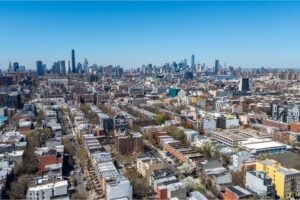
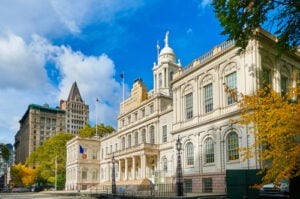
New York City Hall in Lower Manhattan, the historic seat of New York City’s mayoral government. Photo: Mikhail Leonov / Shutterstock.com
New York City has been governed by mayors for more than three and a half centuries, but the office did not begin with the powers, borders, or voting system familiar to New Yorkers today. Following the English takeover of New Amsterdam, Governor Richard Nicolls appointed Thomas Willett in 1665. Before that, Dutch New Amsterdam had been governed by burgomasters and other officials. The colonial mayor exercised judicial and administrative duties in a relatively small port settlement, not the executive authority of a government covering all five boroughs.
The route to an elected mayoralty was gradual. English colonial governors, followed by New York State governors, appointed early mayors; the Common Council assumed the selection role in 1820. Regular direct elections began in 1834, when Cornelius Van Wyck Lawrence won the office, although an exceptional election had occurred during Leisler’s Rebellion in 1689. Another transformation came in 1898, when Manhattan and the Bronx were joined with Brooklyn, Queens, and Staten Island in the consolidated City of Greater New York. From that point onward, the mayor’s responsibilities encompassed a much larger and more diverse population.
This complete chronological guide covers the 100 distinct individuals listed as mayors or acting mayors in the city’s conventional English-era succession from 1665 through the present, with each person appearing once even if they served multiple nonconsecutive terms. It also includes research corrections to the official chronology, notably Matthias Nicoll’s overlooked 1674–1675 term. The city calls its current mayor the 112th mayor because its historical ordinal system counts some separate terms more than once and ordinarily does not number acting mayors. Historic source lists are not entirely uniform, so the distinctions are explained in the notes near the end.
1. Thomas Willett
Served: 1665–1666; 1667–1668
New York connection: Early colonial New York; longtime ties to New England
Thomas Willett became New York’s first English-appointed mayor in 1665, following the English takeover of New Amsterdam in 1664. He was familiar with Dutch language and commercial life and had experience in the New England colonies, qualities that were useful as the new administration dealt with residents whose institutions and customs had developed under Dutch rule.
Willett served a second, nonconsecutive term in 1667–1668. The early mayor was not the modern chief executive familiar to New Yorkers today: he presided over a small colonial town and participated in the municipal court and council under authority granted by the governor. His terms mark the beginning of the city’s conventional English mayoral succession.
2. Thomas Delavall
Served: 1666–1667; 1671–1672; 1678–1679
New York connection: Colonial New York City merchant and official
Thomas Delavall held the mayoralty on three separate occasions in the early decades of English rule. A merchant and colonial official, he belonged to the narrow circle of residents whose business and government connections enabled them to serve in municipal office during a period of frequent turnover.
Delavall’s terms fell in 1666–1667, 1671–1672, and 1678–1679. Those return appointments reveal how the governor repeatedly drew on established merchants to administer the town. The office dealt with courts, trade, local regulation, and relations between authorities and the city’s Dutch- and English-speaking residents.
3. Cornelis Steenwyck
Served: 1668–1671; 1682–1684
New York connection: Dutch-born merchant in New Amsterdam and New York
Cornelis Steenwyck, often spelled Cornelius Steenwyck, was an important merchant of Dutch New Amsterdam who became mayor under English rule. His first administration began in 1668, and he returned to the office in the early 1680s, when the city’s harbor economy depended on Atlantic trade and shifting imperial policies.
Steenwyck had also served within the Dutch municipal system, demonstrating how political and commercial leaders sometimes continued in office despite changes in sovereignty. The city’s later official mayoral lists recognize his two separate periods of service, although older records vary in the way they spell his surname.
4. Matthias Nicoll
Served: 1672–1673; 1674–1675
New York connection: Early English colonial government in New York
Matthias Nicoll was a lawyer and colonial official who served as mayor in the early 1670s. He had helped prepare legal rules for the English-controlled province and was involved in the municipal administration as the former Dutch city adjusted to a different political system.
His name has an especially important place in the history of mayoral numbering. Municipal Archives research identified a second, overlooked term in 1674–1675 after English rule resumed following a temporary Dutch reconquest. The official numbered mayoral list long omitted this return appointment, even though contemporary records support it.
5. John Lawrence
Served: 1673–1674; 1691–1692
New York connection: Colonial New York City merchant and alderman
John Lawrence was a merchant and municipal official who first became mayor in 1673, shortly before Dutch forces temporarily recovered the city from the English. His first term thus occurred during one of the most unusual interruptions in New York’s colonial history.
He served again in 1691, after the turmoil surrounding Leisler’s Rebellion. His return reflects the importance of established colonial trading families and officials during political transitions. Municipal records and historians distinguish his two nonconsecutive mayoral periods.
6. William Dervall
Served: 1675–1676
New York connection: Colonial New York City mercantile community
William Dervall served after English control of New York was restored in the 1670s. The town was still recovering from changes in imperial administration, and its merchants faced the complicated task of maintaining commerce while competing European governments struggled for control of Atlantic trade.
Dervall was associated with the city’s merchant community. Like many early mayors, his duties included the practical administration of local courts and commercial affairs, rather than the extensive agencies, departments, and budget responsibilities of a modern New York City mayor.
7. Nicholas De Mayer
Served: 1676–1677
New York connection: Dutch colonial merchant in New York City
Nicholas De Mayer, also spelled Nicholas De Meyer, became mayor in 1676. A merchant associated with the Dutch community, he served as the town’s English and Dutch residents negotiated commercial and political life under the restored English government.
The surviving mayoral chronology provides a clear record of his appointment, but does not support attributing every later harbor improvement or market regulation to his individual administration. His role is best understood in the context of a port town governed by a small council and closely supervised by colonial authorities.
8. Stephanus van Cortlandt
Served: 1677–1678; 1686–1688
New York connection: Born in New Amsterdam; Van Cortlandt family
Stephanus van Cortlandt, born in New Amsterdam, became one of the city’s first native-born mayors. He served in 1677–1678 and returned in 1686–1688, while his family developed substantial commercial interests and landholdings.
His second term fell soon after the Dongan Charter of 1686, an important step in the organization of New York’s colonial government. The Van Cortlandt family later became associated with estates in the Hudson Valley and with the land now known as Van Cortlandt Park in the Bronx.
9. Francis Rombouts
Served: 1679–1680
New York connection: Colonial New York City and Dutchess County
Francis Rombouts was a merchant of Flemish background who served as mayor in 1679–1680. His appointment reflects the commercial and cultural diversity of the late-17th-century port, where traders with roots in different parts of Europe became important members of local government.
Rombouts is also remembered for his association with extensive Hudson Valley landholdings, including the Rombout Patent in present-day Dutchess County. His life connects municipal leadership in Manhattan with the expansion of European colonial property claims farther north, an expansion that affected Indigenous communities and land use.
10. William Dyre
Served: 1680–1682
New York connection: Colonial New York City and royal customs administration
William Dyre served as mayor in 1680–1682 and was connected to the enforcement of English colonial trade regulations. The port’s commercial activity made customs collection and imperial revenue especially contentious, and disputes over who could impose and collect duties brought political tension.
Dyre’s career is remembered for a confrontation over customs authority that led to legal proceedings. Rather than treating him simply as an unusually harsh tax official, his story illustrates the contested powers of provincial administrators and merchants before more stable municipal institutions developed.
11. Gabriel Minvielle
Served: 1684–1685
New York connection: French-born merchant in colonial New York City
Gabriel Minvielle was a French-born merchant and member of New York’s international trading community. He held the mayoralty in 1684–1685, shortly after the Dongan Charter provided a more durable framework for the city’s corporate government.
His tenure demonstrates the importance of commercial experience in choosing colonial mayors. As the harbor linked New York to Caribbean and European markets, merchants such as Minvielle occupied positions of influence that combined private business relationships with local civic responsibilities.
12. Nicholas Bayard
Served: 1685–1686
New York connection: New York City; Bayard and Stuyvesant families
Nicholas Bayard, a nephew of Peter Stuyvesant, served as mayor in 1685–1686. His family standing made him a visible member of the colonial establishment during the development of the city’s government under the Dongan Charter.
Bayard later became involved in the political controversies surrounding Leisler’s Rebellion. He was on the opposing side from Jacob Leisler’s supporters and faced prosecution and a death sentence in the early 1700s before receiving a pardon. The conflicts demonstrate how unstable political authority could remain under English rule.
13. Peter Delanoy
Served: 1689–1691
New York connection: New York City during Leisler’s Rebellion
Peter Delanoy served during the upheaval known as Leisler’s Rebellion, when factions in New York challenged the established colonial administration. He is notable as an exceptional early example of a mayor selected through an election during the rebellion, long before regular direct mayoral elections began in 1834.
Delanoy supported the movement associated with Jacob Leisler, whose rule divided New Yorkers by political, commercial, and religious allegiance. When royal authority was restored, his period in office ended. The episode makes the distinction between an exceptional 1689 election and the permanent electoral reform of 1834 particularly important.
14. Abraham de Peyster
Served: 1692–1694
New York connection: New York City; Dutch merchant family
Abraham de Peyster became mayor after the Leisler period, as royal authorities sought to reestablish order in a deeply divided city. A prosperous New York merchant, he represented the commercial families who played a central role in municipal government.
De Peyster’s term is usually dated 1692–1694 in the city’s official succession, although some secondary lists begin the period in 1691. The family remained important in city affairs, and its members were associated with public buildings and charities over subsequent generations.
15. Charles Lodwick
Served: 1694–1695
New York connection: Colonial New York City militia and commerce
Charles Lodwick served in 1694–1695 and belonged to New York’s merchant and militia community. His period in office coincided with King William’s War, when the Atlantic colonies remained vulnerable to the larger rivalry between England and France.
Lodwick has a special place in the history of the official mayoral list: municipal historians found that his term was omitted from some early numbered lists and restored to the city’s Green Book in 1937. That correction changed the numerical designation of later mayors and shows why a complete historical roster requires attention to the underlying records.
16. William Merritt
Served: 1695–1698
New York connection: Colonial New York City merchant
William Merritt held the mayoralty in the late 1690s, when the city’s economy centered on Atlantic shipping, commerce, and the activities of a relatively small group of merchants. His period in office followed the factional conflicts of Leisler’s Rebellion and the struggle to restore routine municipal government.
Merritt’s term is recorded in the city’s official mayoral chronology, though biographical information about early officeholders is much less extensive than the records for modern mayors. The office still combined local judicial duties with the regulation of markets and other municipal affairs.
17. Johannes de Peyster
Served: 1698–1699
New York connection: Born in New Amsterdam; de Peyster family
Johannes de Peyster served as mayor in 1698–1699 and belonged to a Dutch New York family that supplied several municipal officials. He succeeded William Merritt while the city’s merchants were negotiating the opportunities and restrictions of Atlantic colonial trade.
De Peyster’s term was short, but it illustrates the continuing role of established Dutch families in city government well after English control began. The municipal mayoral chronology distinguishes him from his relative Abraham de Peyster, who had previously held the office.
18. David Provost
Served: 1699–1700
New York connection: New York City mercantile community
David Provost held office from 1699 to 1700, at a time when New York merchants were adjusting to stricter imperial efforts to control trade and piracy. His administration belongs to a period in which local commercial interests and the authority of provincial governors often came into tension.
Provost was among the merchants who entered municipal public life under the appointed mayoral system. The surviving public roster establishes his tenure, but claims of specific financial reforms or private disputes require stronger contemporary evidence than the brief records commonly available.
19. Isaac De Riemer
Served: 1700–1701
New York connection: New York City and its Common Council
Isaac De Riemer served as mayor from 1700 to 1701, in a colonial city still divided by the political effects of Leisler’s Rebellion. Conflicts between factions and disputes over provincial appointments affected the Common Council and other local institutions.
De Riemer was associated with the mercantile and municipal circles of New York City. His brief tenure belongs to a succession of one-year mayors, before the office acquired the broad executive responsibilities familiar in later city government.
20. Thomas Noell
Served: 1701–1702
New York connection: Colonial New York City merchant
Thomas Noell served during 1701–1702, a period when colonial politics remained divided by competing economic and religious factions. The office was still held by appointment and combined local judicial responsibilities with representation of the colony’s mercantile interests.
Noell died while in office in 1702. An older Municipal Archives finding aid inserted Thomas Hood between Noell and Philip French, but later archival analysis questioned that entry as a transcription error. The city’s official Green Book proceeds directly to French; this article follows the documented succession and explains the discrepancy below.
21. Philip French
Served: 1702–1703
New York connection: Colonial New York City and its Common Council
Philip French succeeded Thomas Noell in 1702 and held office until 1703. His term coincided with the beginning of Queen Anne’s War, another European conflict whose consequences reached New York’s harbor and frontier.
As a merchant and municipal officer, French operated within a government where appointed officials and the Common Council shared responsibility for markets, trade, and civic regulation. Records of the era do not justify attributing broad economic changes to his brief individual administration.
22. William Peartree
Served: 1703–1707
New York connection: Colonial New York City merchant
William Peartree served from 1703 to 1707, during Queen Anne’s War, when the rivalry between Britain and France influenced colonial trade and frontier security. New York’s port was particularly exposed to the economic consequences of wider imperial conflict.
Peartree had a mercantile background and was part of the group of merchants and officials from which colonial governors often selected the mayor. His four-year tenure was relatively long compared with many of the appointments that preceded it.
23. Ebenezer Wilson
Served: 1707–1710
New York connection: New York City colonial government
Ebenezer Wilson became mayor in 1707 and remained in office until 1710, during a period when war and trade disruptions affected colonial commerce. The Common Council continued to oversee markets, local judicial matters, and other civic concerns.
Wilson had experience in municipal government before becoming mayor. His three-year tenure was part of a gradual transition toward more established institutions in a port city that was increasing in population and commercial importance.
24. Jacobus van Cortlandt
Served: 1710–1711; 1719–1720
New York connection: New York City and the Van Cortlandt estate
Jacobus van Cortlandt served two nonconsecutive mayoral terms, in 1710–1711 and 1719–1720. A member of a prominent Dutch New York family, he combined commercial interests and political influence at a time when the city’s economic importance was increasing.
The Van Cortlandt family’s substantial property holdings included land associated with the later Bronx park and historic house. His return to the mayoralty demonstrates the recurring reliance on a relatively small circle of prominent families in the colonial administration.
25. Caleb Heathcote
Served: 1711–1714
New York connection: New York City and Scarsdale, Westchester County
Caleb Heathcote became mayor in 1711 and served until 1714. A wealthy landowner and political figure associated with Scarsdale, he occupied the city’s highest municipal office while Queen Anne’s War continued to affect the region.
Heathcote was also associated with the Church of England and with colonial property development in Westchester County. His career connects the Manhattan municipal government with the broader network of landowners, church leaders, and officials who exercised authority in the province.
26. John Johnstone
Served: 1714–1719
New York connection: Colonial New York and New Jersey
John Johnstone served from 1714 to 1719 during the period following Queen Anne’s War. A physician and political figure with connections to New York and New Jersey, he took office as trade resumed and the colonial population continued to grow.
Johnstone’s career illustrates the close relationship between local government, landownership, and intercolonial politics in the early 18th century. His five-year administration was longer than many of the single-year mayoral terms of the preceding century.
27. Robert Walters
Served: 1720–1725
New York connection: New York City colonial judiciary and commerce
Robert Walters became mayor in 1720 and served until 1725. His tenure coincided with a period of continuing commercial growth in New York, whose waterfront and markets brought increasing numbers of residents and goods into the city.
Walters was connected with law and local administration. Although surviving mayoral lists firmly establish his service, individual claims about road paving or fiscal legislation should not be assigned to him without contemporaneous records.
28. Johannes Jansen
Served: 1725–1726
New York connection: New York City and the Dutch merchant community
Johannes Jansen held the mayoralty from 1725 to 1726, at a time when the city’s Dutch-descended merchant families remained important in public affairs. The colonial government continued to appoint mayors who were expected to supervise routine municipal and judicial business.
Jansen’s relatively brief term falls between those of Robert Walters and Robert Lurting. Less individual biographical material survives about him than about some longer-serving mayors, and the chronology itself is the firmest basis for documenting his place in the city’s history.
29. Robert Lurting
Served: 1726–1735
New York connection: New York City colonial government
Robert Lurting served from 1726 to 1735, one of the longer continuous colonial mayoralties of the early 18th century. His years in office coincided with the development of New York’s commercial waterfront and growing municipal responsibilities.
Lurting’s administration ended with his death in office. His long service contrasts with the frequent annual changes of the 17th century and reflects the increased continuity in the city’s appointed government.
30. Paul Richard
Served: 1735–1739
New York connection: New York City; Huguenot merchant community
Paul Richard served from 1735 to 1739, while the city confronted debates over the authority of the colonial governor and the political rights of printers and merchants. The 1735 trial of publisher John Peter Zenger became a famous episode in those debates.
Richard came from New York’s merchant community. Although the Zenger proceedings took place during his term, they were part of a wider confrontation over freedom of the press, colonial judicial authority, and popular opposition to Governor William Cosby.
31. John Cruger
Served: 1739–1744
New York connection: New York City mercantile and political life
John Cruger was a merchant and longtime public official whose term began in 1739. Colonial New York was experiencing growing tension involving imperial war, trade, and a society in which enslaved people formed a substantial portion of the population.
His administration included the 1741 New York conspiracy trials, in which panic over alleged plots produced severe punishments, including executions and deportations of enslaved and free people. Historians have questioned the allegations and evidence used in the proceedings. The events remain among the most disturbing episodes of the colonial city.
32. Stephen Bayard
Served: 1744–1747
New York connection: New York City; Bayard family
Stephen Bayard became mayor in 1744, during King George’s War, when conflict between Britain and France raised concerns about maritime trade and the security of New York’s harbor. His family held an established place in colonial commercial and political life.
Bayard’s term ended in 1747. The office retained its appointed and partly judicial character, and the mayor’s practical duties were shaped by the Common Council, local merchants, and the authority of the royal governor.
33. Edward Holland
Served: 1747–1757
New York connection: Albany and New York City
Edward Holland served from 1747 to 1757 after earlier public service in Albany. His career offers a notable connection between two of colonial New York’s principal centers of commerce and government.
Holland’s period in office bridged the end of King George’s War and the opening years of the French and Indian War. It was also an era of continued population and trade growth, as the city moved closer to the imperial conflicts that would precede the American Revolution.
34. John Cruger Jr.
Served: 1757–1766
New York connection: New York City merchant and representative
John Cruger Jr. took office in 1757, in the midst of the Seven Years’ War and a period of rising imperial taxation. As a merchant and colonial politician, he became a prominent spokesman for New York commercial interests as relations with Britain deteriorated.
Cruger helped lead the Stamp Act Congress, which met in New York in 1765 and opposed taxation without colonial representation. His decade in municipal leadership connected the city’s merchant community to the political movement that would eventually become the American Revolution.
35. Whitehead Hicks
Served: 1766–1776
New York connection: New York City colonial law and politics
Whitehead Hicks served from 1766 to 1776, as opposition to British taxation developed into organized resistance and eventually war. The mayor was still appointed under royal authority, limiting the options available to an officeholder as the colonial government faced growing challenges.
His tenure ended during the Revolutionary War, when New York became a central military objective. Hicks’s administration is a reminder that the city had a succession of colonial mayors before the United States existed and before the mayoralty became an elected position.
36. David Mathews
Served: 1776–1783
New York connection: New York City during the Revolutionary War
David Mathews, a Loyalist, held the mayoralty during the Revolutionary War and the British occupation of New York City. His term began amid the military emergency of 1776 and continued while the city served as the principal British base in North America.
Mathews was implicated in accusations of a plot against George Washington, but claims concerning his precise role should be treated carefully. He left the city as British forces evacuated in November 1783 and later settled in Canada. The restoration of American civil government brought a different mayoral era.
37. James Duane
Served: 1784–1789
New York connection: New York City; Continental Congress
James Duane became the first mayor of New York City after the British evacuation and the restoration of American government. The city had suffered fires, population displacement, and years of wartime occupation, leaving its leaders to rebuild civic institutions and commercial confidence.
Duane had been a delegate to the Continental Congress and was a leading New York legal figure. His administration overlapped with the early years of the United States under the Articles of Confederation. The former colonial port soon became the first seat of the new federal government under the Constitution.
38. Richard Varick
Served: 1789–1801
New York connection: New York City; born in New Jersey
Richard Varick served during a transformative period in the city’s history, including the inauguration of George Washington in New York and the opening of the first federal Congress. A Revolutionary War officer and former aide to Washington, he moved from military and legal work into city government.
His long administration faced growing population pressures, public-health emergencies, and questions about street expansion. When federal offices relocated from New York, the city continued to grow as a port and commercial center. Varick’s career connects the Revolutionary generation with the early republic.
39. Edward Livingston
Served: 1801–1803
New York connection: New York City; Livingston family of the Hudson Valley
Edward Livingston served as mayor in 1801–1803, while New York was confronting public-health problems and disputes about how the young republic should be governed. A member of the prominent Livingston family, he was also an important legal thinker and supporter of Thomas Jefferson.
Livingston resigned after a financial shortfall emerged in accounts for which he was responsible. He later moved to Louisiana, developed an influential legal career, and served as secretary of state under Andrew Jackson. His experience demonstrates how a municipal political reversal did not necessarily end a prominent national career.
40. DeWitt Clinton
Served: 1803–1807; 1808–1810; 1811–1815
New York connection: Born in Little Britain, Orange County; New York City politics
De Witt Clinton served three nonconsecutive periods as mayor between 1803 and 1815, while also taking part in state and national politics. His administrations overlapped with debates over public education, the expansion of Manhattan streets, and the need for improved inland transportation.
Clinton later became governor and the leading political champion of the Erie Canal, completed in 1825. The waterway strengthened New York City’s position as a commercial gateway to the interior. His broader accomplishments are explored in our history of the Erie Canal.
41. Marinus Willett
Served: 1807–1808
New York connection: New York City; Revolutionary War service
Marinus Willett held the mayoralty for a short period in 1807–1808. A veteran of the American Revolution and a well-known New York patriot, he entered office at a time when the United States faced worsening economic and diplomatic relations with Britain and France.
The embargo policies of Thomas Jefferson’s administration disrupted trade at New York’s busy port. Willett’s tenure was brief, but his military reputation and earlier public service gave him a particularly recognizable place among the city’s early republican mayors.
42. Jacob Radcliff
Served: 1810–1811; 1815–1818
New York connection: New York City judiciary and government
Jacob Radcliff served two nonconsecutive mayoral terms, in 1810–1811 and 1815–1818. A lawyer and former state judge, he governed as New York was expanding northward and facing contentious questions about street layout and civic improvements.
His years in office coincided with work on Manhattan’s Commissioners’ Plan of 1811 and the continuing transformation of the city’s geography. Large-scale developments, including the draining and filling of Collect Pond, took place over many years and under multiple administrations rather than resulting from one mayor’s actions alone.
43. John Ferguson
Served: 1815
New York connection: New York City; municipal and port official
John Ferguson briefly served as mayor in 1815, between the final term of De Witt Clinton and the return of Jacob Radcliff. His time in office lasted only a few months, making him easy to miss in accounts that emphasize longer administrations.
Ferguson was involved in municipal government and later served in a federal port position. The city’s official mayoral list explicitly includes his 1815 service. His short term belongs in the chronology because the office changed hands even though the broader political transition was brief.
44. Cadwallader D. Colden
Served: 1818–1821
New York connection: New York City law and politics
Cadwallader D. Colden was mayor from 1818 to 1821, following the War of 1812 and during the early development of the Erie Canal project. A lawyer and political figure associated with De Witt Clinton, he was interested in public improvements and the city’s growing economic connections.
Colden later served in Congress and continued writing and working on public affairs. His administration came just before the Common Council took a greater role in selecting mayors, part of the gradual shift toward the elected executive established in 1834.
45. Stephen Allen
Served: 1821–1824
New York connection: New York City merchant and politician
Stephen Allen served as mayor from 1821 to 1824, during an era of rapidly growing commerce and municipal spending. A businessman and political figure, he paid close attention to city finances and questions of administration.
Allen was also associated with Tammany Hall and later remained active in public and commercial life. He died in the 1852 fire aboard the Hudson River steamboat Henry Clay, an event that shocked New Yorkers decades after his mayoralty.
46. William Paulding Jr.
Served: 1825–1826; 1827–1829
New York connection: Tarrytown and New York City
William Paulding Jr. held two separate mayoral terms in the 1820s, a decade in which the opening of the Erie Canal helped accelerate New York’s expansion as a port and commercial center. The city faced rising demands for streets, buildings, markets, and municipal services.
Paulding’s career reflected the cautious approach of some early city officials to the scale and cost of public works. His two terms were separated by Philip Hone’s administration, and both took place before New Yorkers elected their mayor directly.
47. Philip Hone
Served: 1826–1827
New York connection: New York City merchant and diarist
Philip Hone served for one year, from 1826 to 1827, after establishing himself as a successful New York merchant and civic figure. His term came amid rapid growth and increasingly active discussions about public improvements and the city’s identity.
Hone is best remembered for his extensive diary, which records the social, commercial, and political life of 19th-century New York. For historians, those personal observations are among the distinctive sources that survive from the era of the appointed mayoralty.
48. Walter Bowne
Served: 1829–1833
New York connection: New York City and Flushing, Queens
Walter Bowne held the mayoralty from 1829 to 1833, a period in which the city was still being governed through an appointed or council-selected executive rather than a popular election. His administration faced the severe cholera epidemic of 1832 and the practical challenges of quarantine and disease prevention.
The epidemic exposed the limits of local sanitation, housing, and public-health systems in a rapidly expanding city. Bowne’s term came immediately before the final change to direct popular election of the mayor, a reform that permanently altered the relationship between city government and voters.
49. Gideon Lee
Served: 1833–1834
New York connection: New York City merchant; born in Massachusetts
Gideon Lee served from 1833 to 1834, just before New Yorkers gained the regular right to elect their mayor directly. A successful leather merchant, he represented a period of transition in which the city’s growing population demanded more accountable municipal government.
Lee’s administration faced urban unrest and recurring debates over policing, public order, and the proper responsibilities of city government. He was succeeded by Cornelius Van Wyck Lawrence, who won the first regular popular mayoral election in 1834.
50. Cornelius Van Wyck Lawrence
Served: 1834–1837
New York connection: Flushing, Queens; New York City business
Cornelius Van Wyck Lawrence became New York City’s first regularly elected mayor in 1834, defeating Gulian Verplanck after state legislation changed the selection process. The move represented a major shift from a mayor appointed through colonial or state-government institutions to an office responsible directly to the electorate.
His administration also faced the Great Fire of 1835, which destroyed a large portion of the Financial District and intensified demands for more reliable water and firefighting systems. The disaster was one of the defining emergencies of early 19th-century New York.
51. Aaron Clark
Served: 1837–1839
New York connection: New York City; born in Connecticut
Aaron Clark was elected mayor in 1837 as the country entered the Panic of 1837, a severe economic downturn that damaged businesses and employment in New York. A Whig, he won after the first regularly elected mayor, Cornelius Van Wyck Lawrence, had served three years.
Clark’s administration dealt with the consequences of commercial contraction and debates over municipal order. He was the city’s first Whig mayor, illustrating the growing competition between major national parties at the local level.
52. Isaac L. Varian
Served: 1839–1841
New York connection: New York City
Isaac L. Varian served as mayor from 1839 to 1841 amid intense competition between Whigs and Democrats. His administration overlapped with the continuing effort to develop a reliable municipal water system and with the social tensions of a rapidly expanding city.
Varian was a prominent Tammany Democrat. Plans for the Croton Aqueduct preceded and outlasted his term, but the project’s construction was already underway while he held office. The aqueduct began delivering water to New York in 1842.
53. Robert H. Morris
Served: 1841–1844
New York connection: New York City
Robert H. Morris became mayor in 1841 and served as New York confronted fast population growth and the continuing need for public services. His term included the arrival of water from the Croton Aqueduct in 1842, a breakthrough in the effort to provide a more dependable urban water supply.
The aqueduct had been planned and built across several administrations, and its completion should not be credited solely to Morris. Nevertheless, it was a defining event of his years in office, improving New York’s ability to supply residents, businesses, and firefighters with water.
54. James Harper
Served: 1844–1845
New York connection: New York City publishing industry
James Harper, cofounder of the publishing firm Harper & Brothers, was elected mayor in 1844 with the support of the nativist American Republican movement. His victory reflected a period when the city’s expanding immigrant population produced sharp political reactions and contested ideas about citizenship and religion.
Harper supported measures promoting public order, temperance, and changes in municipal administration. His publishing career ultimately proved more durable than his one-year mayoralty, but his election reveals the strength of anti-immigrant politics in mid-19th-century New York.
55. William F. Havemeyer
Served: 1845–1846; 1848–1849; 1873–1874
New York connection: New York City sugar refining and politics
William F. Havemeyer served three separate periods as mayor, first in the 1840s and again in 1873–1874 after the exposure of the Tweed Ring. A sugar refiner and public official, he maintained a long career in New York’s changing Democratic politics.
His final mayoral term took place amid demands for government reform and financial accountability. He died in office in 1874; the resulting vacancy was filled temporarily by Samuel B. H. Vance, an acting mayor omitted from many simplified lists.
56. Andrew H. Mickle
Served: 1846–1847
New York connection: New York City
Andrew H. Mickle served as mayor from 1846 to 1847, a period when immigration, commerce, and the city’s population were expanding. A businessman, he took part in municipal government as political parties and commercial interests competed to shape local policy.
Mickle’s administration was brief, and he returned to private pursuits afterward. His place in the record comes between the first and second mayoral terms of William F. Havemeyer, illustrating the frequent leadership changes of the mid-19th century.
57. William V. Brady
Served: 1847–1848
New York connection: New York City
William V. Brady served in 1847–1848 as immigration from Ireland increased dramatically during the Great Famine. The city faced urgent concerns about housing, employment, public assistance, and disease among newly arrived residents.
Brady came from a business background and was associated with the Whig Party. His term was only one year long, but it occurred during a demographic transformation whose effects shaped New York for generations.
58. Caleb Smith Woodhull
Served: 1849–1851
New York connection: Miller Place, Long Island
Caleb S. Woodhull became mayor in 1849, the year of the deadly Astor Place Riot. The confrontation involved competing theater audiences, questions of class and nationality, and the use of armed forces to restore order.
A Whig, Woodhull governed a city whose population and economic divisions were becoming increasingly visible. The violence demonstrated how deeply social conflict could affect public life, even during periods of commercial expansion.
59. Ambrose Kingsland
Served: 1851–1853
New York connection: New York City
Ambrose Kingsland was mayor in 1851–1853, as New York’s growing population pressed its leaders to plan public spaces and infrastructure beyond the already crowded lower wards. He advocated establishing a major public park, a proposal that became part of the movement resulting in Central Park.
Kingsland’s importance is connected to that early advocacy rather than to the park’s later construction, which occurred under subsequent administrations. Our history of Central Park follows the broader campaign and development of the landscape.
60. Jacob Aaron Westervelt
Served: 1853–1855
New York connection: New York City shipbuilding
Jacob A. Westervelt served from 1853 to 1855 and was widely known for his work in shipbuilding. He entered the mayoralty during a period when New York’s waterfront economy and international shipping remained central to the city’s prosperity.
Westervelt’s administration faced routine questions about police organization, street improvements, and the conduct of municipal agencies. He continued to be associated with maritime industry after his term, reflecting the close relationship between the harbor’s businesses and city politics.
61. Fernando Wood
Served: 1855–1858; 1860–1862
New York connection: New York City; born in Philadelphia
Fernando Wood served two nonconsecutive periods as mayor and became one of the city’s most controversial antebellum political figures. His terms featured bitter struggles involving city policing, rival political factions, and allegations of patronage and corruption.
In 1861, as the Civil War approached, Wood proposed that New York City consider declaring itself a free city separate from both the state and the Union. The proposal reflected the economic importance of southern cotton to New York commerce, but it did not become city policy. Wood later served for many years in Congress.
62. Daniel F. Tiemann
Served: 1858–1860
New York connection: New York City
Daniel F. Tiemann served from 1858 through 1860 after reform factions joined to defeat Fernando Wood. His election demonstrated growing public dissatisfaction with allegations of municipal corruption and disputes over the structure of the police force.
Tiemann was a paint manufacturer who supported more efficient administration. His term was sandwiched between Wood’s two mayoral periods, illustrating how reform alliances could win office yet struggle to remain united in New York’s competitive political environment.
63. George Opdyke
Served: 1862–1864
New York connection: New York City; born in New Jersey
George Opdyke became mayor in 1862 as the Civil War disrupted the city’s economy and political life. A Republican and opponent of slavery, he led the municipal government during the New York City Draft Riots of July 1863, when violent mobs attacked Black residents, property, and symbols of federal authority.
The riots required major military intervention and exposed deep divisions over conscription, race, and the Union war effort. Opdyke’s term stands as a stark example of how national conflict could erupt into a municipal crisis with devastating consequences.
64. Charles Godfrey Gunther
Served: 1864–1866
New York connection: New York City
Charles Godfrey Gunther became mayor in 1864 during the Civil War. A Democrat with conservative views, he governed a city that was divided over conscription, federal policy, and the conduct of the war.
The transition from volunteer fire companies to a paid fire department took place during this period, with legislative action in 1865. Gunther’s administration also faced the practical demands of managing a growing city amid wartime political conflict.
65. John T. Hoffman
Served: 1866–1868
New York connection: New York City political career
John T. Hoffman served as mayor in the late 1860s while the Tammany Hall organization and William M. Tweed grew in political influence. Municipal expansion and public works were increasingly entangled with patronage, questions of financial oversight, and rival claims about reform.
Hoffman’s reputation and degree of personal responsibility for the Tweed Ring’s abuses have been debated by historians; it is not accurate simply to equate his every action with the later proven frauds. He left the mayoralty after winning election as governor of New York.
66. Thomas Coman
Served: 1868 (acting)
New York connection: New York City; Irish-born
Thomas Coman served as acting mayor in 1868 after John T. Hoffman’s departure for the governorship. As president of the Board of Aldermen, he temporarily handled the duties of the executive office during a change of administration.
Because he served in an acting capacity, Coman is typically marked separately from the numbered mayors in the city’s Green Book. His inclusion in a complete list nevertheless matters: the authority of the office did not disappear between elected administrations.
67. A. Oakey Hall
Served: 1869–1872
New York connection: New York City; born in Albany
A. Oakey Hall became mayor in 1869 as the Tammany Hall organization and the Tweed Ring reached the height of their political influence. Municipal contracting and spending became the focus of investigations that exposed extensive financial abuses involving the construction of the county courthouse and other public works.
Hall faced legal scrutiny arising from the scandals, although criminal proceedings against him did not establish the same responsibility as that of other Tweed associates. His tenure is inseparable from the corruption investigations that transformed public expectations of city financial oversight.
68. Samuel B. H. Vance
Served: 1874 (acting)
New York connection: New York City municipal government
Samuel B. H. Vance became acting mayor in 1874 after the death of William F. Havemeyer. He served during the transition to the next elected administration as the city confronted continuing questions of municipal debt and the legacy of the Tweed Ring.
Vance’s name is separated from the numbered mayors in New York City’s official Green Book, which marks him as an acting mayor. His inclusion follows the same editorial rule applied to Thomas Coman, Ardolph L. Kline, and Joseph V. McKee: individuals who actually performed the mayor’s duties belong in a complete chronological roster.
69. William H. Wickham
Served: 1875–1876
New York connection: New York City merchant; born on Long Island
William H. Wickham entered office in 1875 after years of public outrage over the Tweed Ring and the cost of city government. A Democrat associated with reform, he sought to stabilize municipal finances and reduce the influence of patronage in city departments.
His administration illustrates the difficult work of repairing institutions after a major corruption scandal. Public pressure for savings and accountability remained strong, but reformers also encountered political resistance and the growing costs of running an expanding city.
70. Smith Ely Jr.
Served: 1877–1878
New York connection: New York City; born in New Jersey
Smith Ely Jr. was mayor from 1877 to 1878, when New York was still coping with the aftermath of the Tweed Ring scandals and the financial consequences of the Panic of 1873. His administration emphasized spending restraint and fiscal reform.
Ely belonged to a generation of mayors who faced demands for tighter control over municipal debt and patronage. His short term illustrates the difficult balance between maintaining public services and restoring trust in city finances.
71. Edward Cooper
Served: 1879–1880
New York connection: New York City
Edward Cooper, son of industrialist Peter Cooper, served as mayor in 1879–1880. Associated with reform Democrats, he took office amid continued public concern about corruption and the power of entrenched political organizations.
Cooper’s administration challenged aspects of Tammany Hall’s influence and emphasized the accountability of city departments. His family’s longstanding connections to industry and civic institutions gave him a distinctive place in New York public life.
72. William R. Grace
Served: 1881–1882; 1885–1886
New York connection: New York City; born in Ireland
William R. Grace, born in Ireland, served two nonconsecutive mayoral terms and is recognized as New York City’s first Irish Catholic mayor. A successful shipping businessman, he entered politics as the electorate increasingly reflected the city’s immigrant communities.
Grace supported changes in city contracting and administration and became known for a willingness to challenge entrenched interests. His victories demonstrated that Irish Catholic leadership had become a central part of New York political life, despite the nativist hostility that had marked earlier decades.
73. Franklin Edson
Served: 1883–1884
New York connection: New York City; born in Vermont
Franklin Edson served as mayor from 1883 to 1884 as New York continued its rapid industrial expansion. His business background and political alliances placed him within the competing Democratic factions that shaped city government.
During his administration, planning and land acquisition for new public parks in the northern part of the city gained momentum. Those efforts were part of a longer process that eventually created major Bronx parklands rather than an achievement confined to a single term.
74. Abram Hewitt
Served: 1887–1888
New York connection: New York City; born in Haverstraw
Abram S. Hewitt was elected mayor in 1886 after a three-way contest with Henry George and Theodore Roosevelt. A manufacturer and former congressman, Hewitt brought a strong interest in public administration and transportation to the office.
He is especially remembered for helping advance the municipal rapid-transit framework that eventually supported construction of the New York City subway. The first underground subway opened years after his mayoralty, but Hewitt’s role in shaping the legal and financial structure made him important to its history.
75. Hugh J. Grant
Served: 1889–1892
New York connection: New York City
Hugh J. Grant became mayor in 1889 and served through 1892, a period when New York faced intense public debate over electrical safety, public works, and Tammany Hall’s control of city politics.
Grant was the youngest person elected mayor up to that time and was closely associated with the Tammany organization. His tenure coincided with demands to move dangerous overhead wires and improve urban regulation as modern technology entered crowded streets.
76. Thomas F. Gilroy
Served: 1893–1894
New York connection: New York City; born in Ireland
Thomas F. Gilroy served as mayor from 1893 to 1894 and was aligned with Tammany Hall. His years in office overlapped with the national depression that began in 1893 and renewed demands for municipal police reform.
The Lexow Committee investigated police corruption during this period, intensifying public dissatisfaction with established political organizations. Gilroy’s administration was followed by the reform mayoralty of William L. Strong.
77. William L. Strong
Served: 1895–1897
New York connection: New York City; born in Ohio
William L. Strong was the final mayor of the preconsolidation City of New York, serving from 1895 through 1897. He won election as a reform candidate after investigations revealed police corruption and other abuses in city government.
Strong appointed Theodore Roosevelt president of the police board and supported improvements in street cleaning under Commissioner George E. Waring Jr. These reforms preceded the 1898 consolidation, when the mayor’s jurisdiction expanded to the five boroughs.
78. Robert A. Van Wyck
Served: 1898–1901
New York connection: New York City
Robert A. Van Wyck became the first mayor of the consolidated City of Greater New York on January 1, 1898. His administration faced the challenge of bringing together the existing City of New York with Brooklyn, Staten Island, and other communities in Queens and the Bronx under a single municipal government.
Van Wyck was aligned with Tammany Hall, and his administration became associated with a major scandal involving the American Ice Company. His term nevertheless occupies a defining point in municipal history: the five-borough city familiar to modern New Yorkers began under his watch. Read more in why New York City became five boroughs in 1898.
79. Seth Low
Served: 1902–1903
New York connection: Brooklyn and Manhattan
Seth Low, a former mayor of Brooklyn and president of Columbia University, served as mayor of the consolidated city in 1902–1903. A reform-minded Republican and fusion candidate, he advocated civil service improvements and more consistent municipal administration.
Low’s career was especially significant because it bridged Brooklyn’s former status as an independent city and the new five-borough government. His victory showed that reform coalitions could challenge Tammany Hall, even if holding those coalitions together proved difficult.
80. George B. McClellan Jr.
Served: 1904–1909
New York connection: New York City; born in Dresden, Germany
George B. McClellan Jr. became mayor in 1904, succeeding Seth Low. The first IRT subway opened later that year, the result of a major public-private construction effort that began before his administration and rapidly changed how New Yorkers traveled.
McClellan’s term also included the opening of major transportation works such as the Manhattan Bridge in 1909. His relations with the Tammany Hall organization became increasingly strained, and his mayoralty illustrates the political conflicts surrounding the city’s early 20th-century infrastructure expansion.
81. William J. Gaynor
Served: 1910–1913
New York connection: New York City and Brooklyn; born in Oriskany
William J. Gaynor, a former state judge, became mayor in 1910 and emphasized efficiency, police accountability, and the lawful exercise of municipal authority. His administration faced the practical problems of growth and urban transportation during the years before World War I.
In August 1910 a disgruntled former city employee shot Gaynor as he was boarding a ship; he survived but never fully recovered. He died in September 1913 while traveling aboard a steamship near Europe, not in a sudden heart attack at City Hall. His death brought the acting mayor Ardolph L. Kline into office.
82. Ardolph L. Kline
Served: 1913 (acting)
New York connection: New York City; born in New Jersey
Ardolph L. Kline became acting mayor in 1913 after the death of William J. Gaynor. As president of the Board of Aldermen, he took up the office under the city’s succession rules and served until the next administration began.
Kline’s short period of service is marked as acting rather than numbered in the city’s official Green Book. Including him makes the succession complete and clarifies how the government continued after the sudden death of an elected mayor.
83. John Purroy Mitchel
Served: 1914–1917
New York connection: New York City
John Purroy Mitchel took office in 1914 as a reform candidate and became known as the “Boy Mayor.” His administration emphasized administrative efficiency, police policy, public education, and an effort to separate municipal operations from party patronage.
Mitchel lost his reelection campaign in 1917, partly amid controversies over school policy and other reforms. He enlisted for military aviation training during World War I and was killed in an airplane accident in 1918, shortly after leaving office.
84. John F. Hylan
Served: 1918–1925
New York connection: New York City; born in Hunter, Greene County
John F. Hylan governed from 1918 through 1925, when subway fares and the power of private transit operators were major political issues. He defended the five-cent fare and promoted an independent, city-owned subway network as an alternative to the privately operated lines.
The city’s Independent Subway System was developed over a number of years, with construction beginning in the 1920s and service starting in 1932, after Hylan had left office. His advocacy helped make municipal operation of transit a defining part of New York politics.
85. Jimmy Walker
Served: 1926–1932
New York connection: New York City
James J. “Jimmy” Walker became mayor in 1926 and became closely identified with the nightlife, entertainment, and personal style of the Roaring Twenties. He remained in office as the economic collapse of 1929 brought unemployment and severe strain to city government.
The Seabury investigations uncovered widespread corruption within municipal institutions and raised serious questions about his administration. Walker resigned in September 1932 while under intense political pressure. His departure led to a brief acting administration under Joseph V. McKee.
86. Joseph V. McKee
Served: 1932 (acting)
New York connection: The Bronx, New York City
Joseph V. McKee served as acting mayor from September through December 1932 after Jimmy Walker resigned. A former Bronx political figure and president of the Board of Aldermen, he assumed control amid the Great Depression and severe municipal budget pressure.
McKee’s administration pursued spending restraint while the city prepared for the next regularly elected mayor. His place is recorded separately from the numbered mayors in the official Green Book, but he exercised the executive responsibilities of the office during those months.
87. John P. O’Brien
Served: 1933
New York connection: New York City; born in Massachusetts
John P. O’Brien served as mayor during 1933, as the city faced the economic emergency of the Great Depression. His administration was associated with Tammany Hall, whose influence had already been damaged by the Seabury investigations and the resignation of Jimmy Walker.
O’Brien struggled to establish political authority amid calls for reform and competition from other Democratic factions. He lost the election to Fiorello La Guardia, whose fusion campaign helped change the city’s political direction.
88. Fiorello La Guardia
Served: 1934–1945
New York connection: New York City
Fiorello H. La Guardia served three terms from 1934 through 1945. During the Great Depression he worked with federal New Deal agencies to direct money toward public housing, roads, airports, parks, and other city infrastructure.
Known as the Little Flower, La Guardia opposed the Tammany political machine and became a highly visible public communicator, especially through radio. His administration reshaped municipal institutions and helped establish the modern city-government model of coordinated planning, public services, and federal partnerships. See our profile of Fiorello La Guardia.
89. William O’Dwyer
Served: 1946–1950
New York connection: New York City; born in Ireland
William O’Dwyer became mayor in 1946 as New York adjusted to the postwar economy, population change, and increased demand for housing and public services. The city played an important role in the creation of a permanent headquarters for the United Nations, although the site and development involved many institutions beyond the mayor’s office.
O’Dwyer resigned in 1950 amid investigations and allegations concerning police corruption and organized crime. He was then appointed U.S. ambassador to Mexico. His departure temporarily placed Vincent R. Impellitteri in charge of city government.
90. Vincent R. Impellitteri
Served: 1950–1953
New York connection: New York City; born in Sicily
Vincent R. Impellitteri became acting mayor when William O’Dwyer resigned in September 1950. He then won a special election as an independent, defeating candidates supported by major party organizations.
Impellitteri governed through 1953, facing the ordinary demands of municipal finance, housing, services, and transportation in the postwar city. His path from acting mayor to elected mayor makes him a distinctive example of New York’s succession system.
91. Robert F. Wagner Jr.
Served: 1954–1965
New York connection: New York City
Robert F. Wagner Jr. served as mayor from 1954 through 1965, during the growth of postwar New York and the expansion of federal urban policy. His administration strengthened municipal labor relations, supported civil rights measures, and oversaw major changes to the city’s public institutions.
Wagner was important in the creation of the City University of New York in 1961 and in the development of collective bargaining arrangements with city employees. His long service included conflicts with Tammany leaders and represented a move toward more independent Democratic leadership. Read our Robert F. Wagner Jr. biography.
92. John V. Lindsay
Served: 1966–1973
New York connection: New York City
John V. Lindsay became mayor in 1966 during an era of civil rights struggles, rising municipal costs, and conflicts over public services. His eight years included major labor disputes, racial tension, and efforts to reorganize city agencies.
Lindsay’s visible presence in city neighborhoods became a defining feature of his public image. At the same time, his administration faced difficult criticism over spending, services, and the changing economic base of New York. The fiscal crisis that erupted after his departure had multiple causes extending across administrations.
93. Abraham Beame
Served: 1974–1977
New York connection: New York City; born in London
Abraham D. Beame became mayor in 1974, shortly before New York experienced one of the most serious financial crises in its history. A former budget director and comptroller, he confronted mounting debt, shrinking access to credit, and demands for deep reductions in municipal spending.
His administration negotiated with state and federal officials and accepted new fiscal oversight arrangements as the city struggled to avoid default. The 1977 blackout and the Son of Sam killings also marked the closing year of his term. Our Abraham Beame history explores the period in more detail.
94. Ed Koch
Served: 1978–1989
New York connection: New York City; born in the Bronx
Edward I. Koch served from 1978 through 1989, taking office as the city worked to recover from the fiscal crisis of the 1970s. His administration emphasized restoring financial stability and later undertook major housing-rehabilitation programs.
Koch’s blunt public manner and familiar question, “How’m I doin’?” made him one of the most recognizable mayors in modern city history. His administration also faced controversies over homelessness, AIDS, policing, and municipal corruption. Read our profile of Ed Koch.
95. David Dinkins
Served: 1990–1993
New York connection: New York City; born in New Jersey
David N. Dinkins became New York City’s first Black mayor in January 1990. His administration confronted a recession and public-safety concerns while proposing a vision of the city as a “gorgeous mosaic” of communities.
Dinkins supported the Safe Streets, Safe City initiative, which expanded police hiring and other services. His term was also marked by intense criticism of the city’s response to the 1991 Crown Heights unrest. The economic pressures and political conflicts of the period shaped his unsuccessful reelection campaign. Read our David Dinkins biography.
96. Rudy Giuliani
Served: 1994–2001
New York connection: New York City; born in Brooklyn
Rudolph W. Giuliani served as mayor from 1994 through 2001, emphasizing public safety, policing, and enforcement of city quality-of-life rules. Violent crime fell substantially during the 1990s, though researchers have debated the relative influence of policing strategies and wider economic and national crime trends.
Giuliani became internationally known for his public leadership after the September 11, 2001 terrorist attacks. His administration also attracted criticism over aggressive police practices and relations with minority communities. Our history of Giuliani’s mayoralty examines the period.
97. Michael Bloomberg
Served: 2002–2013
New York connection: New York City; born in Boston
Michael R. Bloomberg served three terms from 2002 through 2013, entering office shortly after the September 11 attacks. His administration pursued redevelopment, public-health regulations, school governance changes, and substantial rezoning across the five boroughs.
Bloomberg’s tenure included New York City’s indoor-smoking restrictions, expansion of cycling infrastructure, and the transfer of greater school-system authority to the mayor. His approach emphasized data and management, while policies such as stop-and-frisk and the extension of mayoral term limits generated significant public controversy. Read our Michael Bloomberg profile.
98. Bill de Blasio
Served: 2014–2021
New York connection: New York City; born in Manhattan
Bill de Blasio governed from 2014 through 2021, campaigning on economic inequality and promising changes to the city’s approach to policing. His administration introduced universal prekindergarten for four-year-olds and pursued programs intended to expand affordable housing.
His second term was dominated by the COVID-19 pandemic, which profoundly affected schools, transportation, public health, and municipal finances. Debates over policing, homelessness, and reopening policies remained central through the end of his administration.
99. Eric Adams
Served: 2022–2025
New York connection: Brooklyn and Queens, New York City
Eric L. Adams, a former police officer and Brooklyn borough president, served as mayor from January 2022 through December 2025. His administration emphasized public safety, economic recovery after the pandemic, and the city’s response to the arrival of large numbers of asylum seekers.
Adams’s tenure also faced investigations, a federal criminal indictment in 2024, and a controversial decision by the U.S. Department of Justice to seek dismissal of the charges in 2025. He did not seek a new term through the general election after withdrawing his reelection bid. His four years in office ended when Zohran Mamdani took office on January 1, 2026.
100. Zohran Mamdani
Served: 2026–present
New York connection: Astoria, Queens; born in Kampala, Uganda
Zohran Kwame Mamdani took office on January 1, 2026, after winning the 2025 mayoral election. Born in Uganda and raised in New York City, he previously represented a Queens district in the New York State Assembly. His election was historically significant: he became the city’s first Muslim, first South Asian, and first African-born mayor.
Mamdani campaigned on housing and affordability, including proposals concerning rent-stabilized housing, public transportation, and the cost of living. As with any serving mayor, proposals and completed measures should be distinguished rather than treated as interchangeable. His administration remains an evolving chapter in the history of New York City government.
Why New York City’s Mayoral Numbers Can Be Confusing
New York City’s historical number for a mayor is not the same thing as the number of different people who have held the office. The official Green Book numbers nonconsecutive administrations separately but lists several acting mayors without an ordinal number. It also historically omitted Matthias Nicoll’s second term in 1674–1675, which Municipal Archives researchers documented in a 2025 review. A May 2026 Municipal Archives account identifies Zohran Mamdani as the 112th mayor under the updated chronology. That designation should not be interpreted as meaning that 112 distinct individuals held the office.
The city’s Green Book also excludes the Dutch burgomasters who governed New Amsterdam before the English mayoralty began in 1665. An older Municipal Archives finding aid includes Thomas Hood as a mayor in 1702; subsequent municipal archival research identifies the entry as likely a transcription error involving Philip French. Because Hood’s actual service is disputed, he is not treated as a confirmed additional mayor in the numbered profiles. Readers interested in checking the succession can consult the New York City Green Book mayoral list and the Municipal Archives examination of mayoral numbering.
From Colonial New York to the Five-Borough City
Across these administrations, the mayoralty changed from an appointed colonial office into one of the largest and most consequential municipal executive positions in the United States. Some mayors oversaw short terms that are sparsely documented; others held office through wars, epidemics, financial crises, major infrastructure projects, social movements, and national emergencies. Together, their histories offer a portrait of how the city itself changed.
For more on the history behind these administrations, read Why New York City Became Five Boroughs in 1898, History of New York’s City Hall, and our individual profiles of Ed Koch, David Dinkins, and Robert F. Wagner Jr..