
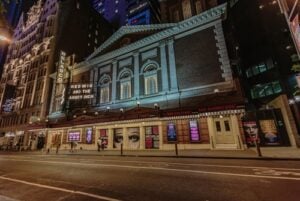
The Belasco Theatre on West 44th Street in Manhattan, long associated with the legend of Broadway impresario David Belasco’s ghost. Photo: Roy Harris / Shutterstock.com
New York City has accumulated ghost stories almost as quickly as it has accumulated buildings. Historic houses, Broadway theaters, churchyards, taverns, and abandoned institutions have inspired tales of apparitions, unexplained footsteps, cold spots, mysterious voices, and figures unwilling to leave the places they knew in life.
The stories below separate each location’s documented history from the legends that grew around it. The historical people, buildings, dates, and events are real; the supernatural claims remain folklore, eyewitness accounts, and urban legend.
1. Mark Twain and the “House of Death” in Greenwich Village
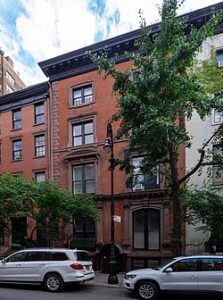
14 West 10th Street in Greenwich Village, known as the “House of Death.” Mark Twain lived in the townhouse from 1900 to 1901, and the building later became associated with one of New York City’s best-known ghost legends. Photo: Ajay Suresh from New York, NY, USA, CC BY 2.0, via Wikimedia Commons.
The Location: 14 West 10th Street, between Fifth and Sixth Avenues
The Legend: The Greek Revival townhouse at 14 West 10th Street has long carried the ominous nickname “House of Death.” Stories attached to the building describe unexplained footsteps, cold spots, shadowy figures, and multiple spirits. One of the most famous is said to be Mark Twain, sometimes described as appearing in a white suit inside the house.
The History: The townhouse was built in the 1850s. Mark Twain, whose real name was Samuel Clemens, lived there from 1900 to 1901. His brief residency became one of the best-known chapters in the building’s history and helped attach his name permanently to its later ghost lore. The house’s reputation grew further during the 20th century as stories of tragedy and paranormal encounters accumulated around the address.
The townhouse stands within the same historic neighborhood explored in our guide to Greenwich Village.
2. Gertrude Tredwell at the Merchant’s House Museum
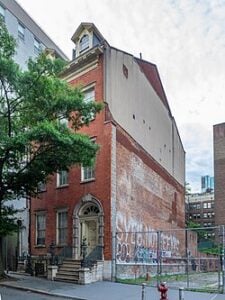
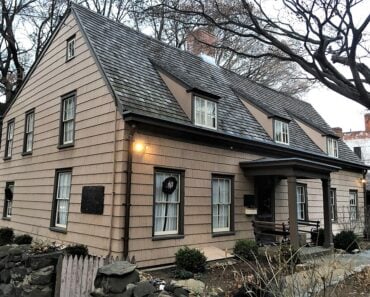
Ajay Suresh from New York, NY, USA, CC BY 2.0 <https://creativecommons.org/licenses/by/2.0>, via Wikimedia Commons
The Location: 29 East 4th Street, NoHo
The Legend: Staff members, volunteers, visitors, neighbors, and passersby have reported unusual sounds, sightings, and smells at the Merchant’s House for decades. The spirit most often associated with the building is Gertrude Tredwell, the last member of the family to live there.
The History: The house was built in 1832 and purchased by hardware merchant Seabury Tredwell in 1835. Gertrude, the youngest of the Tredwells’ eight children, was born in the house in 1840. She never married and remained there for the rest of her life, dying in an upstairs bedroom in 1933 at age 93. The house opened as a museum in 1936 and survives with thousands of original Tredwell family possessions, making it one of New York City’s most remarkable preserved 19th-century domestic interiors.
The Merchant’s House itself embraces its haunted reputation, documenting generations of reported phenomena while making clear that visitors must decide for themselves what they believe.
3. Olive Thomas at the New Amsterdam Theatre
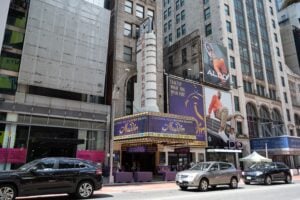
Photo: Anne Czichos / Shutterstock.com
The Location: 214 West 42nd Street, Times Square
The Legend: Olive Thomas is one of Broadway’s most enduring theater ghosts. Stagehands, security personnel, actors, and other employees have reported seeing a young woman in a green beaded Follies costume backstage at the New Amsterdam Theatre. Theater tradition became so strong that portraits of Thomas were placed backstage and employees became accustomed to greeting her when arriving and saying goodnight when leaving.
The History: Olive Thomas was a Ziegfeld Follies performer and silent-film actress whose career made her one of the recognizable young stars of the late 1910s. She died in Paris in 1920 at age 25. The New Amsterdam, where she had appeared as a Follies performer, subsequently became the center of stories claiming that she had returned to the theater after her death.
Unlike many New York ghost tales that survive only through anonymous retellings, the Olive Thomas legend has been repeated for decades by people who actually worked inside the New Amsterdam.
4. Alexander and Eliza Hamilton at Trinity Churchyard
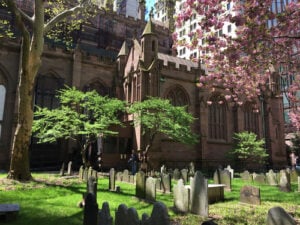
Michael John Maniurski / Shutterstock.com
The Location: Broadway at Wall Street, Lower Manhattan
The Legend: Trinity Churchyard has inspired generations of ghost stories simply because so much New York history is buried within its gates. Ghost-tour folklore has included reports of cold spots, shadowy figures, and unexplained movement among the graves, with some stories identifying a colonial-era figure near Alexander Hamilton’s monument.
The History: Alexander Hamilton died in 1804 after his duel with Aaron Burr and was buried in Trinity Churchyard. His white-marble monument was erected in 1806. His wife, Elizabeth Schuyler Hamilton, survived him by 50 years, devoted much of her widowhood to charitable work and preserving Hamilton’s papers, and helped found New York City’s first private orphanage. She died in 1854 at age 97 and is buried beside him.
The history is certain. The ghost stories are not. Trinity itself documents the Hamilton graves and the extraordinary lives behind them, while the paranormal tales remain part of the folklore surrounding one of Lower Manhattan’s oldest burial grounds.
5. Peter Stuyvesant at St. Mark’s Church in-the-Bowery
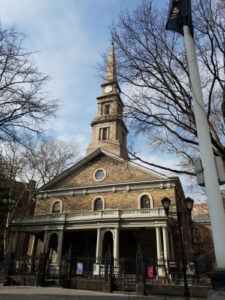
Photo by Jessica B. Kirk licensed from Shutterstock
The Location: 131 East 10th Street at Second Avenue, East Village
The Legend: Peter Stuyvesant’s ghost is traditionally associated with the sound of an uneven gait or peg leg moving through the church and surrounding neighborhood. Stories have also described mysterious bell ringing and sightings of a Dutch-period figure near the churchyard.
The History: In 1651, Peter Stuyvesant purchased the land for his farm, or Dutch bouwerij. By 1660 he had built a family chapel on the property, and when he died in 1672 he was buried beneath it. The Stuyvesant family sold the chapel site to the Episcopal Church in 1793. The cornerstone of the present church was laid in 1795, and St. Mark’s was consecrated in 1799.
Stuyvesant’s burial beneath the original chapel site gives the ghost story an unusually direct connection to where he lived, worshiped, and was laid to rest.
6. The Ghosts of the Campbell Apartment at Grand Central Terminal
The Location: 15 Vanderbilt Avenue, Grand Central Terminal
The Legend: Employees of the former Campbell Apartment have described unexplained drafts, taps or touches when no one was nearby, doors behaving strangely, and apparitions of a well-dressed couple in 1920s-style clothing on the mezzanine. Other accounts have described an older man associated with the upstairs rooms.
The History: Despite its famous name, the Campbell Apartment was never actually an apartment. Financier and New York Central Railroad director John W. Campbell leased the 3,500-square-foot space in Grand Central in 1923 as an office. Architect Augustus N. Allen transformed it into a spectacular Florentine-inspired room with a hand-painted ceiling, a large fireplace concealing Campbell’s safe, a Persian carpet, a piano, and a pipe organ. Campbell also used the room for private musical recitals and entertaining.
After Campbell died in 1957, the space passed through several railroad uses and eventually deteriorated before being restored as a cocktail lounge in 1999. Today it operates as The Campbell. For the larger history of the terminal, see Grand Central Terminal, A Postmodern Cathedral.
7. Eliza Jumel and Aaron Burr at the Morris-Jumel Mansion
The Location: 65 Jumel Terrace, Washington Heights
The Legend: The Morris-Jumel Mansion has one of New York’s longest-running haunted-house reputations. Eliza Jumel is the spirit most often associated with the mansion, while Aaron Burr and other former occupants have also become part of its paranormal lore. Reports have included apparitions, unexplained sounds, and unusual activity in rooms connected to the mansion’s former residents.
The History: Built in 1765–1766 for British officer Roger Morris and his wife, Mary Philipse Morris, the mansion is Manhattan’s oldest surviving house. George Washington used it as his headquarters during the 1776 campaign in upper Manhattan. French merchant Stephen Jumel purchased the property in 1810. After his death, his widow Eliza married former Vice President Aaron Burr in the mansion in 1833. Their marriage deteriorated quickly, and Eliza’s divorce from Burr was granted shortly before his death in 1836.
The mansion now openly acknowledges its paranormal reputation and even hosts historical paranormal investigations, allowing believers and skeptics alike to explore the stories attached to the house.
8. Dylan Thomas at the White Horse Tavern
The Location: 567 Hudson Street at West 11th Street, Greenwich Village
The Legend: The ghost most often associated with the White Horse Tavern is Welsh poet Dylan Thomas. Stories describe a figure resembling Thomas near his old corner, unexplained cold spots, footsteps, shifting glasses, and shadows that disappear when noticed.
The History: The White Horse Tavern dates to 1880 and originally served workers connected to the nearby Hudson River waterfront. By the 1950s it had become a celebrated gathering place for writers, poets, musicians, and other Greenwich Village figures. Dylan Thomas was one of its most famous patrons. His final days in New York in November 1953 became inseparable from the tavern’s legend, although the familiar stories about exactly how much he drank have been repeated and embellished over time.
The tavern itself now treats the ghost stories as part of its mythology, acknowledging that some patrons believe Thomas never completely left his favorite New York drinking place.
9. The Renwick Smallpox Hospital Ruin on Roosevelt Island
The Location: Southern Roosevelt Island, immediately north of Franklin D. Roosevelt Four Freedoms State Park
The Legend: The roofless Gothic ruin has inspired stories of voices, shadowy figures, lights, and other unexplained activity. Much of that paranormal reputation comes from the appearance of the building itself: pointed stone arches, empty windows, exposed walls, and a long history tied to disease and institutional life.
The History: Architect James Renwick Jr. designed the original Smallpox Hospital, which was constructed from 1854 to 1856 on what was then Blackwell’s Island. The hospital initially treated smallpox patients in isolation from the rest of the city. In 1875 it was renamed Riverside Hospital, and in 1886 smallpox patients were transferred to a new hospital on North Brother Island. The Renwick building then became a nurses’ residence and training-school facility, with later wings added in the early 20th century.
The building was abandoned in the 1950s and deteriorated into the dramatic shell seen today. It was listed on the National Register of Historic Places in 1972 and designated a New York City Landmark in 1976. The Landmarks Preservation Commission itself described it as a picturesque Gothic ruin capable of evoking the atmosphere of a 19th-century romance.
10. The Ghost of David Belasco at the Belasco Theatre
The Location: 111 West 44th Street, Manhattan
The Legend: Actors and backstage personnel have long claimed that Broadway impresario David Belasco still visits the theater that bears his name. He is most often described in the priestly clothing that made him famous as the “Bishop of Broadway,” sitting alone in an otherwise empty box on opening nights. Other stories describe unexplained footsteps and the sound of the chains from Belasco’s long-unused private elevator.
The History: David Belasco opened the theater as the Stuyvesant Theatre in October 1907 and renamed it the Belasco in 1910. Architect George Keister designed the playhouse, while artist Everett Shinn contributed murals and interior decoration. Belasco maintained an extraordinary Gothic-style duplex apartment above the theater filled with theatrical memorabilia, allowing him to live almost literally on top of his work.
Belasco died in 1931 at age 71. His ghost story became one of Broadway’s most famous theatrical legends, repeated by generations of performers and stage personnel. The theater remains active today, and the Shubert Organization itself acknowledges the longstanding haunting tradition in its official history. For a deeper look at the building, read our History of the Belasco Theatre on Broadway.
More New York Ghosts, Mysteries, and Dark History
For more stories where New York history and legend overlap, read Manhattan Well Murder, The Ghost Stories That Followed, Shanley Hotel History, Presidents, Mobsters, Madams and Ghosts, Ghosts and Good Times at the Carmel, New York Smalley Inn, and History of Willowbrook and the Terrifying Legend of Cropsey.
Sources
Village Preservation: The House of Death at 14 West 10th Street
Merchant’s House Museum: Our Ghosts
Merchant’s House Museum: The Tredwell Family
Playbill: Olive Thomas and the New Amsterdam Theatre Ghost
Trinity Church Wall Street: Alexander Hamilton and Trinity Church
National Park Service: Elizabeth Schuyler Hamilton Timeline
St. Mark’s Church in-the-Bowery: History
Village Preservation: Haunted Greenwich Village
Museum of the City of New York: The Campbell Apartment That Wasn’t
CBS New York: Reported Hauntings at the Campbell Apartment
Morris-Jumel Mansion: Paranormal Historical Investigations
New York City Landmarks Preservation Commission: Morris-Jumel Mansion Interior Designation Report
White Horse Tavern: Myth, Mystery & Ghosts at the White Horse
New York City Landmarks Preservation Commission: Smallpox Hospital Designation Report
Roosevelt Island Historical Society: Smallpox Hospital
Shubert Organization: Belasco Theatre History
Playbill: The Belasco Theatre and the Ghost of David Belasco
Updated August 21, 2026.





_(48072661566).jpg)
.jpg)