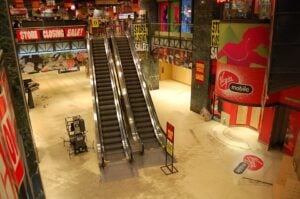
Virgin Megastore during its closing sale, marking the end of one of New York City’s major music-buying destinations. Photo: Rebecca Wilson, CC BY 2.0, via Wikimedia Commons.
Before streaming platforms, downloads, and online marketplaces changed the way people discovered music, buying records in New York City was an experience all its own. From Greenwich Village and the East Village to Times Square, Harlem, Park Row, and the record departments inside huge discount stores, New Yorkers spent hours flipping through bins, studying album covers, searching for imports, and finding records they had never heard before.
Some stores specialized in punk, garage rock, dance music, hip-hop, Broadway cast albums, or rare 45s. Others seemed to carry everything. There were tiny shops where the person behind the counter knew every record in the building and giant stores where an entire afternoon could disappear while you worked your way from one floor to another.
These 25 lost New York City record stores and record-buying destinations belonged to very different eras and neighborhoods, but they all shared one thing: they made buying music feel like an event.
1. Bleecker Bob’s Golden Oldies
- Years Active: 1967–2013
- Founder: Robert “Bleecker Bob” Plotnik
- NYC Locations: Began at 149 Bleecker Street, later moved to MacDougal Street, and eventually settled at 118 West 3rd Street
Bleecker Bob’s became one of the most famous record stores in Greenwich Village. Plotnik began the business as Village Oldies in 1967 before the store eventually became identified with the nickname that followed him for the rest of his life. By 1981, Bleecker Bob’s was operating at 118 West 3rd Street, where generations of musicians, collectors, tourists, and night owls searched through punk singles, rock albums, imports, oldies, and hard-to-find vinyl. The store was known almost as much for the personalities behind the counter as it was for the records in the bins. It survived until April 2013, ending one of the longest and most colorful runs in New York record-store history.
2. Vinylmania
- Years Active: 1978–2007
- Founder: Charlie Grappone
- NYC Location: Began at 30 Carmine Street and expanded to additional storefronts on the block
Vinylmania became one of the essential record stores of New York’s dance-music era. Charlie Grappone opened the original shop on Carmine Street in 1978, and the business eventually expanded into multiple adjoining and nearby storefronts devoted to different styles of music. Its location near the Paradise Garage made it especially important to DJs and clubgoers. Larry Levan and many of the city’s leading DJs came through the store looking for imports, promotional copies, 12-inch singles, and records that had not yet reached the mainstream. For nearly three decades, Vinylmania stood at the center of the relationship between New York record stores and New York nightlife.
3. Sounds
- Years Active: 1979–2015
- NYC Location: 20 St. Mark’s Place, East Village
Sounds was one of the great record-hunting stops on St. Mark’s Place. Opened in 1979, the upstairs shop became known for its enormous selection of records, tapes, and later CDs, along with used titles and inexpensive finds that rewarded anyone willing to spend time digging. Musicians and serious collectors mixed with neighborhood regulars and people who simply wandered in off St. Mark’s Place. Sounds survived long after many of the East Village record stores around it disappeared and finally closed in October 2015 after 36 years in business.
4. Venus Records
- Era: 1990s–early 2000s
- NYC Location: 13 St. Mark’s Place, East Village
Venus Records was part of the remarkable concentration of music shops that once made St. Mark’s Place such an important destination for record buyers. The store catered to listeners seeking rock, alternative music, imports, collectibles, and titles that weren’t always easy to find in the large chain stores. With Sounds, Mondo Kim’s, and other music retailers nearby, St. Mark’s became the kind of street where record collectors could move from shop to shop without leaving a few blocks. Venus is gone now, but it remains part of the memory of an East Village retail culture built around music.
5. Rocks in Your Head
- Years Active in SoHo: 1978–2006
- Founder: Charles Ball
- NYC Location: 157 Prince Street, SoHo
Rocks in Your Head occupied a special place in SoHo when the neighborhood still had a strong connection to artists, loft culture, and experimental music. The shop opened at 157 Prince Street in 1978 and became known for independent music, post-punk, No Wave, garage rock, and records that did not fit comfortably into mainstream retail categories. As SoHo changed and rents climbed, the economics that had made an independent record store possible became increasingly difficult. Rocks in Your Head left Prince Street in 2006, closing another chapter in the neighborhood’s transformation.
6. Other Music
- Years Active: 1995–2016
- Founders: Chris Vanderloo, Josh Madell, and Jeff Gibson
- NYC Location: 15 East 4th Street
Other Music opened in 1995 directly across from the massive Tower Records on Broadway and built its identity around being something completely different. The store championed independent, experimental, electronic, international, and hard-to-classify music, while its knowledgeable staff became famous for handwritten recommendations and a widely read email newsletter. Other Music also hosted in-store performances and helped connect listeners with artists who were still outside the mainstream. Tower disappeared first, but Other Music eventually faced the same pressures affecting physical music retail. Its final day was June 25, 2016.
7. Midnight Records
- Years Active as a Physical Store: 1984–2004
- Founder: J.D. Martignon
- NYC Location: West 23rd Street, Chelsea
Midnight Records was both a record store and an important independent label associated with the garage-rock revival of the 1980s. French-born record dealer J.D. Martignon opened the Chelsea shop in 1984, across from the Chelsea Hotel, after developing a mail-order record business. The store became a destination for garage rock, psychedelic music, reissues, punk, and obscure releases that serious collectors might not find elsewhere. Martignon’s Midnight label released music by several underground bands, making the store part retail operation and part engine of the scene it served. The physical shop closed in 2004.
8. Rebel Rebel Records
- Years Active: About 1988–2016
- Owner: David Shebiro
- NYC Location: 319 Bleecker Street, West Village
Rebel Rebel was one of those record stores that seemed perfectly matched to the West Village. For nearly three decades, the narrow Bleecker Street shop specialized in rock, alternative music, imports, new releases, and the kind of catalog knowledge that could turn a quick stop into an hour of browsing. It remained a real neighborhood record store even as Bleecker Street around it became increasingly dominated by higher-priced retail. Rising rent finally ended the run in June 2016, only days before Other Music also closed.
9. 99 Records
- Era: Late 1970s–mid-1980s
- Key Figures: Gina Franklyn and Ed Bahlman
- NYC Location: 99 MacDougal Street, Greenwich Village
99 began as a small punk-fashion shop run by British designer Gina Franklyn, but records gradually took over as Ed Bahlman began selling imported punk and independent singles from the space. The shop became an important stop for listeners interested in post-punk, dub, funk, reggae, and emerging downtown sounds. Bahlman then turned the store’s identity into the 99 Records label, which released influential records by artists including ESG, Liquid Liquid, and the Bush Tetras. For a brief period, one tiny MacDougal Street storefront sat at the center of a hugely influential New York music scene.
10. Fat Beats
- NYC Store Era: 1994–2010
- NYC Location: Best remembered at 406 Sixth Avenue, Greenwich Village
For hip-hop fans, DJs, producers, and MCs, Fat Beats was far more than a place to buy records. The New York store became a meeting point for underground hip-hop culture at a time when independent 12-inch singles, DJ records, mixtapes, and small-label releases were central to the music. Customers climbed to the second-floor Sixth Avenue shop to dig through vinyl and encounter artists, DJs, and other people immersed in the scene. The New York brick-and-mortar store closed on September 4, 2010, but the Fat Beats name continued through other parts of the music business.
11. Downstairs Records
- Opened: 1972
- Founders: John Kulish and Nick deKrechewo
- NYC Locations: Began in a subway arcade near 42nd Street and Sixth Avenue and later moved above ground in Midtown
Downstairs Records earned its name honestly. The store began in a small Manhattan subway arcade and built its business around oldies, hard-to-find 45s, and eventually the new singles that DJs could not find elsewhere. By the early 1980s, Downstairs had become an important stop for collectors and working DJs, including people searching for breakbeats, disco singles, funk, and unusual 45s. A 1984 Billboard profile described how the business grew from its underground beginnings and moved to a larger space at 35 West 43rd Street. The store’s connection to DJ culture made it one of the most distinctive record shops of its era.
12. Record Mart
- Years Active: 1958–2020
- Founders: Jesse Moskowitz and Bob Stack
- NYC Locations: Began in the Union Square subway station and later became a longtime fixture in the Times Square subway complex
Record Mart was proof that one of New York’s great record stores could exist underground in the middle of the subway system. Founded in 1958, the store developed an especially strong reputation for Latin music while also carrying jazz, classical, Caribbean music, and popular releases. Its Times Square location became familiar to generations of commuters who passed the storefront while changing trains. By the time it closed in 2020, Record Mart was widely described as Manhattan’s oldest operating record store. The pandemic prevented the shop from reopening, ending a 62-year run.
13. Colony Records
- Years Active: 1948–2012
- Founders: Sidney Turk and Harold “Nappy” Grossbardt
- NYC Location: Began at 52nd Street and Broadway; later spent more than four decades at the Brill Building at Broadway and 49th Street
Colony was one of Midtown’s great music institutions. Founded in 1948, it catered to jazz musicians and theater people before becoming famous for its enormous inventory of sheet music, Broadway cast recordings, pop records, vocal scores, and music-related collectibles. The store eventually moved into the Brill Building, placing it in the middle of one of the most important songwriting districts in American popular music history. Musicians and performers relied on employees who seemed capable of locating nearly anything. Colony closed in September 2012 after 64 years.
14. Footlight Records
- Era: About three decades, ending in 2005
- NYC Location: 113 East 12th Street
Footlight Records was a specialist’s dream. The East 12th Street store became famous for Broadway and Off-Broadway cast recordings, movie soundtracks, cabaret, vocal music, and obscure theatrical releases. For collectors trying to find an out-of-print cast album or a recording from a forgotten show, Footlight was the kind of place where knowledgeable employees actually understood what the customer was asking for. In 2005, after roughly 30 years in business, Footlight closed its physical shop and shifted to an Internet-only operation.
15. Kim’s Video & Music
- NYC Era: 1980s–2014
- Founder: Yongman Kim
- Notable NYC Locations: Avenue A, 6 St. Mark’s Place, Bleecker Street, Broadway, and First Avenue
Kim’s became one of the defining independent media retailers of downtown Manhattan. Although the stores were famous for hard-to-find films, music was equally important to the Kim’s identity, especially at branches such as Mondo Kim’s on St. Mark’s Place. Customers came for experimental music, punk, indie rock, imports, vinyl, CDs, cult films, and selections that mainstream retailers rarely carried. At its height, Kim’s operated several Manhattan locations. The final Kim’s Video & Music store on First Avenue closed in 2014, bringing an end to a retail institution that had helped define downtown music and film culture.
16. Bobby’s Happy House
- Years Active: 1946–2008
- Founder: Bobby Robinson
- NYC Location: Harlem, best remembered at 125th Street and Frederick Douglass Boulevard
Bobby Robinson opened his record shop in Harlem in 1946, when there were very few Black-owned businesses on 125th Street. Originally known as Bobby’s Record Shop and later as Bobby’s Happy House, it became far more than a retail store. Robinson used the shop as a base for a remarkable career as an independent producer and label owner, working with R&B, doo-wop, soul, and later early hip-hop artists. The store remained a neighborhood landmark for more than six decades. It finally closed in January 2008 when the building was slated for demolition.
17. House of Oldies on Carmine Street
- Founded: 1968
- Founder: Bob Abramson
- NYC Location: 35 Carmine Street, after an earlier location on Bleecker Street
- Status: The physical shop has closed; the business continues online
House of Oldies was a Greenwich Village destination for serious collectors of original 45s, early rock and roll, doo-wop, R&B, soul, and 1960s pop. Bob Abramson built an enormous inventory over more than half a century, and the Carmine Street storefront became the kind of place where collectors arrived with specific titles, pressings, and labels in mind. The business survived dramatic changes in the record industry, but the physical shop has now closed and the inventory has moved online. The storefront is gone, but the House of Oldies name and collection continue.
18. Tower Records
- NYC Era: 1983–2006
- Major NYC Locations: 692 Broadway at East 4th Street and 1961 Broadway at West 66th Street
Tower Records brought the scale of a music superstore to New York without completely removing the sense of discovery that made record shopping fun. The Broadway flagship, which opened in 1983, became a downtown landmark filled with new releases, imports, magazines, rock, jazz, classical music, and later CDs spread across a huge retail space. The Lincoln Center store became equally important to classical, jazz, Broadway, and pop customers on the Upper West Side. Tower’s American retail operation collapsed in 2006, and the Lincoln Center location was among the last U.S. stores to close that December.
19. J&R Music World
- Years Active: 1971–2014
- Founders: Joseph and Rachelle Friedman
- NYC Location: Park Row, across from City Hall
J&R began in 1971 as a small electronics business and grew into a Lower Manhattan institution that seemed to occupy half of Park Row. Music was a major part of the operation, with departments devoted to records and CDs alongside stereo equipment, computers, cameras, and other electronics. For generations of New Yorkers, J&R was the kind of place where you could compare audio equipment and then walk into another department to buy the records you wanted to hear on it. The main Park Row retail complex closed in April 2014 after 43 years.
20. Virgin Megastore
- NYC Era: 1996–2009
- Major NYC Locations: Times Square and Union Square
When Virgin Megastore opened in Times Square in April 1996, it was promoted as the world’s largest record store. The enormous space offered music, movies, books, listening stations, artist appearances, and the kind of late-night browsing experience that fit perfectly into the newly transformed Times Square. A second major Manhattan location operated at Union Square. For a while, Virgin represented the peak of big-box music retail, but the rise of digital music and changing economics caught up with even the largest stores. Both New York locations were gone by 2009.
21. HMV
- NYC Era: 1990–early 2000s
- Major NYC Locations: Lexington Avenue at East 86th Street and Herald Square
The British HMV chain brought a sleek, modern style of music retail to Manhattan in the 1990s. Its flagship at Lexington Avenue and East 86th Street opened in 1990 and offered a large selection of CDs, records, cassettes, and imports. HMV also operated a prominent Herald Square store at Broadway and West 34th Street. For New Yorkers who came of age during the CD boom, the stores were major browsing destinations. The East 86th Street location closed in 2002, and HMV’s Manhattan presence disappeared during the early years of the digital-music transition.
22. Sam Goody
- New York Roots: Record sales beginning in 1938; flagship era beginning in the early 1950s
- Founder: Sam Goody, born Samuel Gutowitz
- Famous NYC Location: 235 West 49th Street
Long before Sam Goody became a familiar name in shopping malls across America, it was a New York record business built by Samuel Gutowitz. He began selling records in 1938 and became an important pioneer of discount record retailing as LPs took off after World War II. His West 49th Street flagship attracted thousands of customers and carried tens of thousands of records, making it one of the great record-buying destinations near Times Square. The company eventually grew into a national chain under later ownership, but the name began with a real New York record merchant and a Midtown store that helped change how Americans bought albums.
23. E.J. Korvettes Record Department
- Store Chain Era: 1948–1980
- Founder: Eugene Ferkauf
- NYC Connection: Major Manhattan and borough locations, including Herald Square and the Bronx
For many New Yorkers, record shopping did not always mean going to a small independent shop. E.J. Korvettes turned records and stereo equipment into a major part of the discount-department-store experience. Its record and audio operation became significant enough that the chain was one of Manhattan’s major record discounters during the 1960s. Billboard reported that Korvettes generated $20 million in record sales in 1964. The combination of large inventories and aggressive pricing made Korvettes a favorite place for families and young music fans to buy new LPs. For more on the chain, see our history of New York’s Korvettes department stores.
24. Alexander’s Record Department
- Store Chain Era: 1928–1992
- Founder: George Farkas
- NYC Connection: Major stores in Manhattan, the Bronx, Brooklyn, and Queens
Alexander’s record departments competed directly with specialty record discounters during the height of the LP era. When the chain opened its huge Lexington Avenue store in 1965, Billboard reported that the fifth-floor record department carried inventory in considerable depth and was designed to compete head-on with E.J. Korvettes and Sam Goody. That gives a sense of how important records had become inside New York department stores. For countless families, buying an album at Alexander’s was simply part of a Saturday shopping trip. Read more in our history and tales of Alexander’s department stores.
25. Times Square Stores Record Department
- Store Chain Era: 1929–1989
- NYC Connection: Large TSS discount stores across Brooklyn, Queens, and other parts of the New York metropolitan area
Times Square Stores, better known to generations of shoppers simply as TSS, belonged to an era when a trip to a discount department store could include browsing records along with clothing, appliances, toys, and household goods. The record departments gave New Yorkers another place to pick up current albums and singles without making a separate trip to a specialty music shop. For families who regularly shopped at TSS, buying a record could become part of the weekly routine. The chain disappeared in 1989, taking another familiar New York record-buying destination with it. Read more in our history of Times Square Stores.
For more on New York retail history, revisit our stories on E.J. Korvettes, Alexander’s, and Times Square Stores, or continue with 25 Lost Electronics Stores New York City Shoppers Remember.
Sources
- CBS New York — Bleecker Bob’s Closes Shop After 45 Years in Business
- Red Bull Music Academy Daily — Vinylmania: An Oral History
- EV Grieve — East Village Record Store Archive
- Trouser Press — Rock and Roll Ghosts: Lost New York Record Stores
- Other Music — Official History
- The New Yorker — The Stores That Matter: Rebel Rebel and Three Lives & Company
- The Vinyl Factory — The Complete 99 Records Story
- Time Out New York — Fat Beats
- Billboard — Downstairs Records Profile, June 16, 1984
- NY1 — Record Mart in Times Square Subway Closing
- Playbill — Colony Records Closing
- Playbill — Footlight Records Store Closing
- The Guardian — Bobby Robinson Obituary
- House of Oldies — Official Site
- UPI — Virgin Megastore Opens in Times Square
- Los Angeles Times — Sam Goody, Founder of Record Store Chain
- Billboard — Alexander’s Manhattan Record Department, September 11, 1965
Published September 8, 2026.