Feature Photo: Kyle Rieker / Shutterstock.com
New York City has been the setting for some of the most famous heists and robberies in American history. Banks, luxury hotels, museums, airport cargo terminals, armored-car depots, and safe-deposit vaults have all been targeted by criminals who believed they had found a way around the city’s security.
Some of these crimes became famous because of the enormous amounts stolen. Others became part of New York folklore because of the people involved, the audacity of the plan, or the way the robbery exposed weaknesses that no one thought could be exploited. From a Wall Street bank burglary in 1831 to thieves cutting through the roof of a Queens bank more than 180 years later, these ten crimes represent different eras of New York City crime history.
1. The City Bank of New York Burglary of 1831
Date: March 20, 1831
Location: City Bank of New York, Wall Street
The Take: Approximately $245,000 in bank notes and coins
One of the earliest great bank burglaries in New York City history took place in 1831, when James Honeyman and William J. Murray entered the City Bank of New York with keys made from impressions of the bank’s locks. They escaped with approximately $245,000, an extraordinary amount of money at the time.
Newspapers initially celebrated the crime as America’s first bank robbery, although historians later identified an earlier major bank theft in Philadelphia in 1798. What remains certain is that the City Bank crime was one of the earliest enormous bank burglaries in New York history.
The thieves did not remain free for long. New York High Constable Jacob Hays followed the trail, and investigators recovered much of the stolen money after searching trunks connected to Honeyman. Both men were eventually convicted and sentenced to Sing Sing Prison.
2. The Manhattan Savings Institution Heist of 1878
Date: October 27, 1878
Location: Broadway and Bleecker Street, Manhattan
The Take: $2,747,700 in cash and securities
The Manhattan Savings Institution robbery became one of the great criminal stories of Gilded Age New York. Architect-turned-bank burglar George Leonidas Leslie spent years planning the crime. His architectural knowledge allowed him to study bank construction in extraordinary detail, and accounts of the plot describe a replica of the bank being built in a Brooklyn warehouse so the crew could rehearse.
There was one extraordinary twist: Leslie never lived to take part in the robbery. He was murdered months before the job was carried out, and his body was found near Yonkers in June 1878. His former associates went ahead with the plan without him.
On October 27, the gang entered the Manhattan Savings Institution and escaped with approximately $2.75 million in cash and securities. Most of the haul consisted of securities that proved difficult to negotiate, and much of the stolen property was eventually recovered. The size of the theft nevertheless made it one of the most sensational bank burglaries of the nineteenth century.
3. Willie Sutton and the J. Rosenthal & Sons Jewelry Robbery
Date: October 28, 1930
Location: Manhattan
The Take: Approximately $129,000 in jewelry
Brooklyn-born Willie Sutton became one of America’s most famous professional robbers, known for using disguises and carefully chosen identities to get close to his targets. In 1930, Sutton and an accomplice targeted J. Rosenthal & Sons, a Manhattan jewelry business.
Sutton reportedly arrived disguised as a telegraph messenger. Once inside, the robbers produced weapons, restrained the employees, and escaped with approximately $129,000 in jewelry. The FBI’s history of Sutton confirms his reputation for using disguises including messenger, policeman, and maintenance-worker outfits and specifically notes his brazen Broadway jewelry-store robbery.
Sutton’s career eventually made him one of the FBI’s first Ten Most Wanted fugitives. He was captured in New York in 1952 after a young man recognized him from a wanted poster while riding the subway.
4. The Star of India Theft at the American Museum of Natural History
Date: October 29, 1964
Location: American Museum of Natural History, Manhattan
The Take: 22 items, including the Star of India, Midnight Star, DeLong Star Ruby, and Eagle Diamond
The 1964 burglary of the American Museum of Natural History sounds almost too cinematic to be true. Jack Roland Murphy, better known as “Murph the Surf,” Allan Kuhn, and Roger Clark targeted the museum’s Morgan Memorial Hall of Gems.
The museum’s own history records that the thieves stole 22 items, including the Star of India, the Midnight Star, the DeLong Star Ruby, and the Eagle Diamond. Murphy and an accomplice reached the gem hall through an open window after descending from an upper floor. Security was shockingly weak, and the alarm protecting the Star of India had a dead battery.
The three men were arrested soon afterward. Many of the most famous gems were recovered, including the Star of India. The Eagle Diamond and some other stolen material were never returned. The museum subsequently strengthened security in the gem hall and elsewhere.
5. The 1967 Air France Theft at JFK Airport
Date: April 1967
Location: Air France cargo terminal, John F. Kennedy International Airport
The Take: Approximately $420,000
Long before the Lufthansa robbery made JFK Airport synonymous with mob-connected cargo theft, another famous score took place at the same airport. In April 1967, associates connected with the crew later portrayed in Goodfellas stole approximately $420,000 from an Air France cargo facility.
The theft relied on information about cash shipments arriving at the airport and access to the room where the money was being stored. Henry Hill later described the Air France score as an important moment in his rise within the criminal world around him.
The crime also foreshadowed a much larger robbery at John F. Kennedy International Airport eleven years later. By then, organized theft from airport cargo facilities had become a serious and very expensive problem.
6. The Pierre Hotel Robbery of 1972
Date: January 2, 1972
Location: The Pierre, Fifth Avenue at 61st Street
Reported Take: Approximately $3 million, with some later estimates much higher
In the early morning hours of January 2, 1972, armed robbers entered the Pierre Hotel, one of Manhattan’s most prestigious luxury hotels. The operation had been organized around the hotel’s safe-deposit boxes, which held money, jewelry, and other valuables belonging to wealthy guests.
The robbers took employees and guests hostage and spent hours opening the boxes. Approximately $3 million was reported stolen, although later accounts have argued that the true total was considerably higher because some victims may not have disclosed the full value of what they lost.
Samuel Nalo, Robert “Bobby” Comfort, and organized-crime associates became linked to the operation. The Pierre robbery eventually earned a reputation as one of the largest hotel heists ever carried out, and its mixture of luxury, organized crime, and enormous unreported wealth helped make the story part of New York criminal folklore.
7. The Lufthansa Heist at JFK Airport
Date: December 11, 1978
Location: Lufthansa cargo terminal, JFK Airport
The Take: Approximately $5 million in cash and $875,000 in jewelry
The Lufthansa heist remains one of the most famous robberies in American history. On December 11, 1978, an armed crew entered Lufthansa’s cargo operation at JFK Airport and stole approximately $5 million in cash along with hundreds of thousands of dollars in jewelry.
The robbery depended heavily on inside information about the airline’s high-value shipments. James “Jimmy the Gent” Burke, a Lucchese crime family associate, became one of the figures most closely associated with planning and dividing the proceeds. Federal prosecutors later described the Lufthansa robbery as one of the most notorious heists in organized-crime history.
The aftermath became almost as famous as the theft itself. A number of people connected with the robbery were later murdered or disappeared, while most of the stolen money was never recovered. The crime became known to an even larger audience through Martin Scorsese’s Goodfellas.
8. The Sentry Armored Courier Heist of 1982
Date: December 12, 1982
Location: Sentry Armored Courier Corporation, the Bronx
The Take: More than $11 million in currency and valuables
Four years after Lufthansa, New York witnessed an even larger cash theft. More than $11 million in currency and valuables disappeared from the Sentry Armored Courier Corporation in the Bronx on the night of December 12, 1982.
Christos Potamitis, the guard on duty, initially appeared to have been a victim. He was found handcuffed to a stair railing and told investigators that masked gunmen had overpowered him. The government’s case eventually showed something very different: Potamitis and Eddie Argitakos had staged the robbery with accomplices while Potamitis was the only guard working.
The enormous theft generated an intensive federal investigation. Potamitis, Eddie Argitakos, and others were convicted of crimes connected with the heist. Court records later noted that only a fraction of the stolen money had been recovered, leaving millions unaccounted for.
9. The Hudson Armored Car Robbery of 1992
Date: December 27, 1992
Location: Hudson Armored Car Courier Service, Brooklyn
The Take: Approximately $8.27 million
Ten years after the Sentry robbery, another armored-car company became the scene of one of New York City’s largest cash thefts. A lone guard at Hudson Armored Car Courier Service in Brooklyn reported being surprised by armed men, bound, and left while the robbers emptied the facility.
Shipping records showed that $8,268,680.07 had been taken. Most of the money consisted of new $100 bills with sequential serial numbers, creating a major problem for the thieves because the cash was extraordinarily difficult to spend without attracting attention.
Investigators quickly suspected an inside job, and that suspicion proved correct. By February 1993, authorities had recovered almost all of the money from a Brooklyn apartment and arrested suspects. The enormous score had lasted only a matter of weeks before the bulk of it was back in law-enforcement hands.
10. The 2016 Maspeth Federal Savings Roof Heist
Date: May 2016
Location: Maspeth Federal Savings Bank, Rego Park, Queens
The Take: Approximately $296,000 in bank cash and $4.3 million in customer valuables
Even in the era of surveillance cameras and electronic alarms, an old-fashioned physical burglary could still work. In May 2016, a crew targeted a Maspeth Federal Savings Bank branch on Woodhaven Boulevard in Queens.
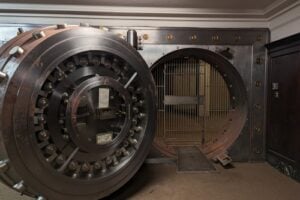
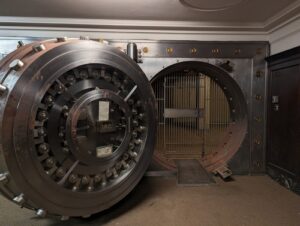
The burglars reached the bank from the roof and cut into the vault area, where they broke open customer safe-deposit boxes and removed cash and valuables. Federal prosecutors later placed the Maspeth loss at approximately $296,000 in bank cash and $4.3 million in valuables from the safe-deposit boxes.
The same crew had carried out a similar burglary at an HSBC branch in Brooklyn the previous month. Federal prosecutors ultimately said the two burglaries together produced more than $600,000 in bank cash and more than $20 million in valuables from safe-deposit boxes. Michael Mazzara, Charles Kerrigan, Anthony Mascuzzio, and Christopher Kerrigan pleaded guilty and received federal prison sentences.
The 2016 burglaries provided a modern ending to a story that had begun with copied keys in 1831. Technology had changed enormously, but New York’s banks and vaults were still confronting the same fundamental problem: determined thieves searching for the overlooked way inside.
Comparison of 10 Famous New York City Heists and Robberies
| Year | Heist or Robbery | Location | Reported Take |
|---|---|---|---|
| 1831 | City Bank of New York | Wall Street | About $245,000 |
| 1878 | Manhattan Savings Institution | Broadway & Bleecker Street | $2.75 million in cash and securities |
| 1930 | J. Rosenthal & Sons | Manhattan | About $129,000 in jewelry |
| 1964 | American Museum of Natural History | Upper West Side | 22 gems and other items |
| 1967 | Air France Cargo Theft | JFK Airport | About $420,000 |
| 1972 | Pierre Hotel | Upper East Side | About $3 million reported |
| 1978 | Lufthansa Heist | JFK Airport | About $5.9 million |
| 1982 | Sentry Armored Courier | The Bronx | More than $11 million |
| 1992 | Hudson Armored Car | Brooklyn | About $8.27 million |
| 2016 | Maspeth Federal Savings | Queens | About $4.6 million in cash and valuables |
Readers interested in more New York stories involving crime, mystery, and the places where these events unfolded can explore the history of the American Museum of Natural History, the history of JFK Airport, the history of Rikers Island, and our look at 10 unsolved New York City mysteries.
Sources
The Saturday Evening Post — America’s (Not Quite) First Bank Robbery
CultureNOW — Manhattan Savings Institution Robbery
Federal Bureau of Investigation — Willie Sutton
Pinkerton — Willie Sutton and the J. Rosenthal & Sons Robbery
American Museum of Natural History — Murph the Surf and the Great Jewel Robbery
Biography — Henry Hill, the Air France Theft, and the Lufthansa Heist
The Mob Museum — Pierre Hotel and Lufthansa Heists
U.S. Department of Justice — 1978 Lufthansa Heist
United States District Court via Justia — Sentry Armored Courier Theft
Los Angeles Times — Hudson Armored Car Robbery
U.S. Department of Justice — 2016 New York Bank Burglaries