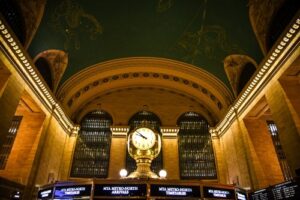
Feature Photo: Grand Central Terminal information booth clock in New York City. Pedro Costa Simeao / Shutterstock.com
New York City has always run on the clock. Long before smartphones put the exact time in every pocket, New Yorkers looked to train terminals, office towers, jewelry stores, bank buildings, and sidewalk clocks to keep the city moving.
Many of those clocks became more than practical timepieces. They became meeting places, neighborhood landmarks, architectural ornaments, and familiar pieces of the skyline. Some are enormous enough to be seen from blocks away, while one of the most unusual sits directly beneath the feet of pedestrians in Lower Manhattan.
These 10 clocks stand out for their history, design, location, and place in New York life. Together, they tell a story of a city that has always been intensely conscious of time.
1. The Grand Central Main Concourse Information Booth Clock
M_Makarov / Shutterstock.com
Location: Main Concourse, Grand Central Terminal
Installed: 1913
Clock system: Self Winding Clock Company, with Seth Thomas movements
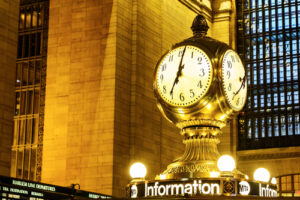
No New York clock is more closely associated with meeting someone than the four-faced clock above the information booth at Grand Central Terminal. Since the terminal opened in 1913, the clock has stood at the center of the Main Concourse, where generations of travelers have agreed to meet “under the clock.”
The clock’s four faces are made of opal glass and are surrounded by brass. Grand Central says the clock is synchronized to the master clock at the U.S. Naval Observatory in Washington, D.C. The terminal also notes that the famous timepiece has been valued at $20 million or more.
More than a century after the terminal opened, the information booth clock remains one of New York City’s great meeting places and one of the most recognizable clocks in the world.
2. Grand Central Terminal’s 42nd Street Facade Clock
Victoria Lipov / Shutterstock.com
Location: South facade of Grand Central Terminal, facing 42nd Street
Completed: 1913–1914
Associated artwork: Jules-Félix Coutan’s Glory of Commerce
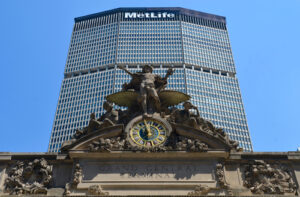
Grand Central has another extraordinary clock outside the terminal. The 13-foot clock on the 42nd Street facade sits beneath Jules-Félix Coutan’s monumental Glory of Commerce, the 48-foot sculptural group featuring Minerva, Hercules, and Mercury.
The clock is commonly known as Grand Central’s Tiffany Clock, and Grand Central itself uses that name. Its glass face has long been attributed to Tiffany, although the clock is unsigned and researchers have questioned whether the Tiffany attribution can be documented conclusively. What is certain is its enormous scale and its commanding position on one of New York’s most famous facades.
The Roman numeral VI at the bottom of the clock conceals an access panel used for maintenance. Seen from 42nd Street, the clock and sculpture together form one of the great architectural compositions in Midtown Manhattan.
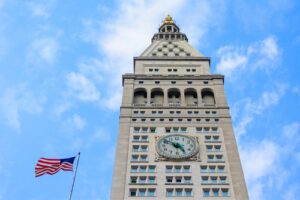
3. The Metropolitan Life Insurance Company Tower Clock
M_Makarov / Shutterstock.com
Location: 5 Madison Avenue at East 24th Street
Completed: 1909
Architect: Napoleon LeBrun & Sons
When the Metropolitan Life Insurance Company Tower was completed in 1909, its 700-foot height made it the tallest building in the world, a title it held until the Woolworth Building surpassed it in 1913.
Each of the tower’s four clock faces measures approximately 26.5 feet in diameter. The numerals are about four feet high, while each 17-foot minute hand weighs roughly 1,000 pounds. The clock faces were among the largest in the world when they were installed and remain one of the defining features of the Madison Square skyline.
The tower also had a famous set of chimes. Rather than the Cambridge Quarters, the bells played a phrase from Handel’s “I Know That My Redeemer Liveth” at quarter-hour intervals. Above the clock faces, the illuminated lantern became associated with Metropolitan Life’s advertising phrase “The Light That Never Fails.”
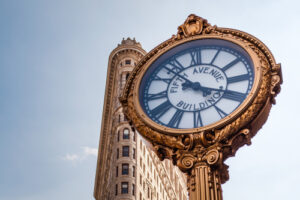
4. The Fifth Avenue Sidewalk Clock at 200 Fifth Avenue
Maya K. Photography / Shutterstock.com
Location: 200 Fifth Avenue at West 23rd Street
Installed: 1909
Manufacturer: Hecla Iron Works
Standing across from the Flatiron Building, the ornate sidewalk clock at 200 Fifth Avenue is one of the finest survivors of a type of street fixture that was once common in New York.
The gilded cast-iron clock was manufactured by Brooklyn’s Hecla Iron Works and installed when the Fifth Avenue Building opened in 1909 on the former site of the Fifth Avenue Hotel. Its fluted column, classical ornament, Roman-numeral faces, and elaborate crest made the clock both a practical public timepiece and an advertisement for the building.
New York City designated the clock an individual landmark in 1981. Today it remains a rare survivor from the era when jewelers, hotels, banks, and commercial buildings used elaborate sidewalk clocks to attract the attention of passing pedestrians.
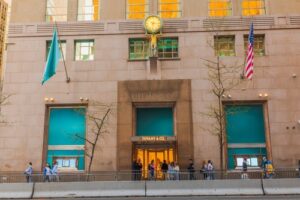
5. The Tiffany & Co. Atlas Clock
Mulevich / Shutterstock.com
Location: Tiffany & Co. flagship, Fifth Avenue and East 57th Street
Created: 1853
Sculptor: Henry Frederick Metzler
The Atlas Clock is one of the oldest and most recognizable commercial landmarks in New York. In 1853, Charles Lewis Tiffany commissioned Henry Frederick Metzler, a carver known for ship figureheads, to create the wooden figure of Atlas holding a clock above Tiffany’s store at 550 Broadway.
The figure was painted to resemble weathered bronze and became so closely identified with Tiffany & Co. that it moved uptown with the company. It appeared at later Tiffany locations before reaching the present Fifth Avenue flagship in 1940.
Tiffany describes the Atlas Clock as the oldest public clock in New York City. The approximately nine-foot Atlas figure supports a clock about four feet in diameter, and the landmark later inspired Tiffany’s Atlas watch and jewelry collections.
6. The William Barthman Sidewalk Clock
Location: Broadway and Maiden Lane, Lower Manhattan
First installed: 1899
Creators: F. William Barthman and Frank Homm
Most public clocks require people to look up. The William Barthman clock requires them to look down.
Jeweler F. William Barthman conceived the unusual sidewalk clock in 1896 with employee Frank Homm, but the first version was installed in 1899 outside the firm’s store at Broadway and Maiden Lane. The original was a three-window jump clock that illuminated at night and was designed to attract customers in what was then the heart of Lower Manhattan’s jewelry district.
That original mechanism proved difficult to maintain after Homm died in 1917, and the clock was eventually replaced by a more conventional round dial during the 20th century. The timepiece has been repaired and restored several times, including a complete restoration in 2024, but it remains embedded at the same famous corner more than 125 years after the first clock was installed there.
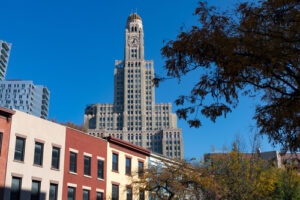
7. The Williamsburgh Savings Bank Tower Clock
James Andrews1 / Shutterstock.com
Location: 1 Hanson Place, Brooklyn
Completed: 1929
Architects: Halsey, McCormack & Helmer
The former Williamsburgh Savings Bank Tower at 1 Hanson Place is one of Brooklyn’s great skyline landmarks. Near the top of the tower are four enormous clock faces, each measuring approximately 27 feet across.
The New York City Landmarks Preservation Commission described the building as having one of the world’s largest four-faced dial clocks. The faces were originally illuminated with bright red neon, making the tower visible across large sections of Brooklyn after dark.
For decades the 512-foot building dominated Brooklyn’s skyline and served as an unmistakable visual marker near the Atlantic Avenue transportation hub. Although taller buildings have since risen around it, the clock tower remains one of the borough’s most recognizable architectural features.
8. The Paramount Building Clock and Globe
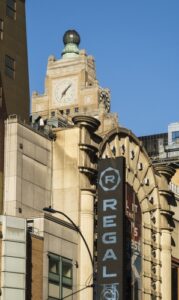
Brian Logan Photography / Shutterstock.com
Location: 1501 Broadway, Times Square
Completed: 1926–1927
Architects: Rapp & Rapp
The Paramount Building was designed as both an office tower and a giant advertisement for the motion-picture company whose name it carried. Rising above Times Square, the tower is crowned by four huge clock faces and an illuminated glass globe.
Instead of ordinary numerals, the clocks use illuminated five-pointed stars to mark the hours, echoing the ring of stars in the Paramount Pictures logo. The original lighting scheme made the stepped building, clock hands, stars, and globe part of a single nighttime display.
The clocks were equipped with chimes, and the globe was synchronized with them to flash a time signal after dark. The Landmarks Preservation Commission noted that the globe represented the worldwide activities of Paramount. The combination of clocks, stars, and glowing globe helped turn the building into one of the great visual landmarks of the old Times Square theater district.
9. The Delacorte Musical Clock
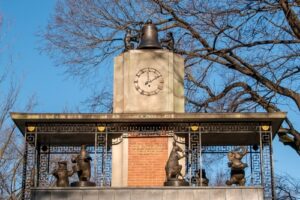
Lena Chert / Shutterstock.com
Location: Between the Central Park Zoo and Tisch Children’s Zoo
Unveiled: 1965
Animal sculptures: Andrea Spadini
The Delacorte Clock brings a completely different kind of timekeeping to Central Park. Publisher and philanthropist George T. Delacorte was inspired by the animated clocks he saw in European town squares and funded a New York version designed especially to delight children visiting the zoo.
Six bronze animal musicians rotate around the clock every half hour: a goat plays a horn, a hippopotamus a violin, an elephant an accordion, a penguin drums, a bear plays a tambourine, and a kangaroo plays a French horn. Two bronze monkeys above them strike a bell.
Spanish designer Fernando Texidor and architect Edward Coe Embury created the arcade that houses the clock, while Italian sculptor Andrea Spadini created the animals. The clock’s electrical system was updated in 2017, and its seasonal music is now digitally controlled. The mechanical procession continues every half hour between 8 a.m. and 6 p.m.
10. The Consolidated Edison Tower of Light Clock
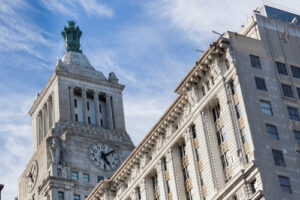
DW labs Incorporated / Shutterstock.com
Location: 4 Irving Place at East 14th Street
Tower completed: 1928–1929
Architects: Warren & Wetmore
The Consolidated Edison Building near Union Square is crowned by one of Manhattan’s most distinctive clock towers. Warren & Wetmore, the architectural firm also associated with Grand Central Terminal, designed the 1920s additions that created the building’s monumental 26-story corner tower.
Four illuminated clock faces sit below a colonnaded bell chamber and an enormous bronze-and-glass lantern. The upper tower was designed partly as a corporate symbol of electric power and partly as a memorial to company employees who died in World War I.
The elaborate nighttime lighting program was inaugurated in 1929. The original equipment has since been modernized, but the tower continues to be illuminated, preserving the idea behind the building’s enduring nickname: the “Tower of Light.”
Quick Comparison of 10 Iconic New York City Clocks
| Clock | Location | Date | What Makes It Stand Out |
|---|---|---|---|
| Grand Central Information Booth | Grand Central Terminal | 1913 | Four-faced opal-glass meeting-place clock |
| Grand Central Facade | 42nd Street | 1913–1914 | 13-foot clock beneath Glory of Commerce |
| Metropolitan Life Tower | Madison Avenue & 24th Street | 1909 | 26.5-foot faces and 17-foot minute hands |
| 200 Fifth Avenue | Fifth Avenue & 23rd Street | 1909 | Landmarked cast-iron sidewalk clock |
| Tiffany Atlas | Fifth Avenue & 57th Street | 1853 | Historic Atlas sculpture carrying a clock |
| William Barthman | Broadway & Maiden Lane | 1899 | Clock embedded directly in the sidewalk |
| Williamsburgh Savings Bank | 1 Hanson Place, Brooklyn | 1929 | Four 27-foot clock faces |
| Paramount Building | 1501 Broadway | 1926–1927 | Star hour markers and illuminated globe |
| Delacorte Clock | Central Park | 1965 | Animated bronze animal musicians |
| Con Edison Tower of Light | 4 Irving Place | 1928–1929 | Clock tower, bells, and illuminated memorial lantern |
Readers who enjoy exploring New York landmarks can learn more about Grand Central Terminal, the Flatiron Building, the history of Times Square, and the history of Central Park.
Sources
Grand Central Terminal — What to See
CultureNOW — Glory of Commerce and Grand Central Facade Clock
New York City Landmarks Preservation Commission — Metropolitan Life Insurance Company Tower
New York City Landmarks Preservation Commission — Sidewalk Clock at 200 Fifth Avenue
Tiffany & Co. — Heritage Timeline and Atlas Clock
Smithsonian American Art Museum — Atlas Clock Sculpture Record
William Barthman Jeweler — History of the Sidewalk Clock
New York City Landmarks Preservation Commission — Williamsburgh Savings Bank
New York City Landmarks Preservation Commission — Paramount Building
Central Park Conservancy — Delacorte Clock
New York City Landmarks Preservation Commission — Consolidated Edison Building
Published September 1, 2026.