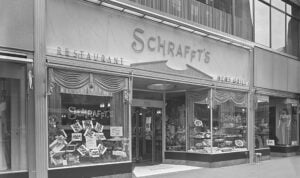
Schrafft’s Restaurant at 625 Madison Avenue in Manhattan, December 1, 1940. Photograph by Gottscho-Schleisner, Inc. / Library of Congress.
Imagine walking along Madison Avenue in 1940 and stopping in front of Schrafft’s. Above the entrance, the restaurant’s name stretched across the facade in large letters. The display windows were filled with boxes of candy and carefully arranged gifts. Inside, a customer could order lunch, sit at a soda fountain, or finish an afternoon with an ice cream sundae. There was a restaurant entrance and, as the old photograph shows, a separate sign for a Men’s Grill. It was a New York institution that could serve several different purposes in the course of a single day.
For generations of New Yorkers, Schrafft’s was the place to meet a friend after shopping, take a child for a special dessert, or enjoy a meal without the formality and expense of a grand hotel dining room. Its carefully furnished restaurants became part of the rhythm of the city. People remembered the food, but they also remembered the waitresses, the candy counters, the atmosphere, and the feeling of being somewhere familiar.
So whatever happened to Schrafft’s Restaurants? The chain grew from a candy business into one of the best-known restaurant operations in the Northeast, then lost much of its identity amid changing dining habits, corporate ownership, and repeated efforts to reinvent its image. Locations closed through the 1960s and 1970s; the final longstanding New York restaurant is generally dated to 1980. The separate candy business also disappeared in 1981. The historic chain has not returned as a network of dining rooms, although a group associated with the Schrafft’s name has announced plans for a New York revival.
The full story is more interesting than a simple account of a restaurant that went out of business. It begins with candy made in Boston, takes an unexpected turn in Syracuse, and reveals something about how women helped change the experience of eating out in New York City.
Schrafft’s Began With Candy, Not Restaurants
The Schrafft’s name dates to a confectionery business established in Boston in 1861 by William F. Schrafft. Long before customers associated the name with chicken salad, coffee, and sundaes, it was connected to candy and chocolates. That distinction matters because the familiar restaurant chain developed through the work of another family, the Shattucks, who recognized the possibilities of selling more than sweets.
Frank G. Shattuck came from the Upstate New York community of Durhamville in Oneida County and worked as a traveling salesman for the candy business. In 1898, he opened a Schrafft’s candy store near Broadway and West 36th Street in Manhattan. New Yorkers could buy confections there, but the store was not yet the full-service restaurant people would later remember. Its future changed when the family began experimenting with food that customers could enjoy on the premises.
Shattuck’s sister Jane deserves a central place in this history. Contemporary accounts credit her with developing the ice cream and luncheon service that turned a candy shop into a hospitality business. It is tempting to tell the story as one man’s retail triumph, but Jane helped define what Schrafft’s actually became. Another sister, Katherine, was also connected to the family enterprise. By building on the Schrafft’s name while developing their own restaurant operation, the Shattucks created something far larger than the original candy shop.
Why Syracuse, New York, Was So Important to Schrafft’s
One of the most surprising details in the company’s history is that its breakthrough as a restaurant happened in Upstate New York. On July 9, 1906, Frank G. Shattuck opened a Schrafft’s store at South Salina and East Fayette Streets in Syracuse. According to the Onondaga Historical Association, this was the first Schrafft’s location to serve meals. Its dining area was promoted as a Japanese Tea Room, and the addition of prepared food helped establish the successful formula the company would repeat elsewhere.
This gave Syracuse an important role in a story usually remembered as part of Manhattan history. The idea was straightforward but effective: customers who arrived for candy or a refreshment might stay for lunch, while those who came to eat could leave with a box of chocolates. Under Jane Shattuck’s influence, meals were added to the company’s New York City operations, including the West 23rd Street store in the Ladies’ Mile shopping district by 1909.
The Syracuse restaurant also developed a remarkably loyal following of its own. It later operated on South Warren Street, and in 1946 the founder’s son, Frank M. Shattuck, described a chain serving approximately 100,000 customers daily. When the company announced plans to close the Syracuse restaurant in the 1960s, residents actually organized a campaign to try to save it. The restaurant closed on January 5, 1965. That local effort says something important about Schrafft’s: customers did not necessarily think of it as an interchangeable chain outlet. They regarded a particular dining room, and the people working there, as part of their community.
The Restaurant Where Women Could Dine on Their Own
Schrafft’s made its reputation at a time when many public dining spaces were organized around assumptions about who belonged there. A woman entering certain restaurants by herself could face unwelcome attention or social judgment. Schrafft’s offered a different experience: an orderly, welcoming setting where women could meet, shop, eat, and socialize without needing a male companion.
Its popularity included shoppers, office workers, mothers, friends meeting for lunch, and women who simply wanted an affordable meal in comfortable surroundings. The carefully arranged tables, familiar American dishes, and attentive service created the atmosphere of a respectable middle-class dining room. Schrafft’s was not the only place to serve women, but it developed that audience on an unusual scale. Historian Paul Freedman considered the chain important enough to include in his book Ten Restaurants That Changed America, emphasizing the part it played in making dining out more accessible and socially acceptable for women.
Women also helped run Schrafft’s. They worked not only as servers but as cooks, supervisors, and managers, positions not always open to women in the restaurant trade of the time. That does not make Schrafft’s a modern workplace by today’s standards, nor does it mean every woman experienced the restaurants equally. But the role of women as both customers and employees was fundamental to its success, not a minor detail in the story.
What Was It Like to Eat at Schrafft’s?
For all its reputation for propriety, Schrafft’s knew how to make ordinary American food feel like a treat. Diners might order an egg-salad sandwich, a salad plate, vegetables prepared with a cream sauce, chicken, or a more substantial dinner. Ice cream, fountain drinks, chocolates, cakes, and pastries made the restaurant as much a destination for dessert as for lunch. Writer and food authority James Beard later remembered the exceptional neatness of its egg-salad sandwiches, a small detail that captured the chain’s attention to presentation.
Its menus are wonderful records of how New Yorkers once ate. A 1937 Syracuse menu, described in research preserved by the Onondaga Historical Association, listed a lamb-chop dinner with potatoes, peas, coffee, and a bacon-pineapple rice fritter for $1.25. There was also a toasted chicken-giblet-and-bacon sandwich for 35 cents. Those offerings may seem unusual now, but they show a restaurant whose appeal rested on familiar ingredients presented with a little ceremony.
Schrafft’s was also known for its attention to the surroundings. Some larger branches had distinct dining rooms, candy departments, soda fountains, and separate spaces intended for different types of customers. A 1928 account in The New Yorker described Frank Shattuck’s almost obsessive inspections of cleanliness and service. His standards could be severe, but the consistency they produced was part of what customers came to expect, whether they were eating in Manhattan or Upstate New York.
There is an important detail visible in the 1940 photograph of the Madison Avenue restaurant: alongside the main entrance is the sign Men’s Grill. Men were never entirely absent from Schrafft’s, and male-oriented rooms existed well before the late-1960s modernization campaigns. The chain’s identity, however, remained especially closely associated with women and the culture of shopping and lunching in the city.
How Schrafft’s Became Part of New York’s Neighborhoods
As the operation expanded, Schrafft’s developed a presence across Manhattan, Brooklyn, and other New York communities. In 1915 there were already nine Manhattan stores, one in Brooklyn, and the Syracuse location, according to the Onondaga Historical Association. The network continued to grow through the following decades, reaching more than forty locations by the mid-1930s and approximately fifty-five by the late 1960s, according to contemporary reporting.
Schrafft’s was by no means limited to one type of location. Its restaurants appeared near busy shopping districts, theaters, offices, and residential neighborhoods. In Brooklyn, a location opened on Flatbush Avenue near Erasmus Hall High School, and another became part of the commercial landscape around Fulton and Smith Streets. The chain also reached communities including White Plains and New Rochelle, as well as cities outside New York State.
What distinguished these places was that people built routines around them. A customer might remember a particular booth, a counter stool, or an employee who knew the usual order. Someone else remembered a shopping trip that always ended with a sundae. The restaurants offered a familiar environment in an enormous city whose streets and stores were constantly changing. Readers interested in another influential form of old New York dining can also explore our history of Horn & Hardart Automats, which tells a very different story of how New Yorkers once ate away from home.
Schrafft’s in Popular Culture, From Society Columns to Andy Warhol
Schrafft’s belonged to New York popular culture in ways that extended far beyond the menu. Writers used it as a setting because readers immediately understood what the name suggested: a particular kind of city restaurant, respectable but not grand, familiar but still a little special. Stories about its patrons included fashionable shoppers, working women, actors, and people who found comfort in its orderly dining rooms. Journalist Liz Smith recalled the chain with affection, while Helen Gurley Brown regarded a meal there as one of the quintessential New York experiences.
Then came a surprising collaboration. In 1968, the company commissioned Andy Warhol to create a television advertisement centered on a chocolate sundae. The short film, known as Underground Sundae, used the visual language of Warhol’s experimental work rather than looking like a conventional restaurant commercial. Time reported on the campaign that October, describing the company’s effort to attract a younger, more fashionable audience. It was an extraordinary contrast: a restaurant identified with quiet lunches and neatly served desserts turning to one of the country’s most provocative pop artists.
That advertising experiment has since become an interesting part of both restaurant history and the history of television art. It also illustrates the dilemma Schrafft’s faced. The chain knew it needed to attract new customers, but the question was whether changing its image would bring in a new generation or weaken the familiarity that kept older patrons returning.
Why Schrafft’s Tried to Reinvent Itself
By the 1960s, the world in which Schrafft’s had prospered was changing. Shopping patterns, neighborhood businesses, and expectations about restaurants were evolving. More women worked outside the home and had a widening choice of places to eat. The carefully furnished, traditional dining room that once made Schrafft’s distinctive did not appeal to every new customer, and maintaining a large network of restaurants presented its own financial and managerial challenges.
In the late 1960s, the Shattuck company merged with the food conglomerate Pet, Inc. The new corporate structure brought ambitions to modernize the restaurants and attract a broader audience. Some branches were redesigned with more prominent bars, darker interiors, and a less traditional atmosphere. At a Fifth Avenue location, a male-oriented space called the Male Animal became an especially memorable example of the makeover. But the goal was not merely to admit men; the chain had offered men’s dining areas decades earlier. The larger effort was to change what people thought the Schrafft’s name stood for.
That distinction matters when explaining the decline. The chain’s fortunes cannot be reduced to one eccentric dining-room redesign or a single corporate decision. It was caught between a loyal audience that valued its familiar identity and a marketplace increasingly full of other ways to eat. The renovations did not reverse the long-term contraction, while changes in ownership made it harder to preserve a consistent restaurant concept.
When Did Schrafft’s Restaurants Close?
The disappearance happened gradually, not on one dramatic final day. The Syracuse closing in 1965 was an early sign of the chain’s retreat from some communities. Other branches disappeared in the 1970s as the restaurant business passed through further corporate changes. In 1973, Pet moved toward selling its Schrafft’s restaurants to the Riese restaurant organization, which operated and acquired multiple New York dining brands. Some locations were converted to other concepts or closed altogether.
The old name became increasingly difficult to find as the decade went on. The Onondaga Historical Association identifies the Schrafft’s restaurant at Madison Avenue and 58th Street as the final location, closing in 1980. Other accounts describe the chain’s disappearance more broadly as occurring around the early 1980s, reflecting the complicated history of its remaining businesses and ownership. The separate Schrafft’s candy operation ceased in 1981.
For customers who had spent years visiting the restaurants, the loss was more than the departure of another retail sign. It was the disappearance of familiar surroundings and of a particular experience: a place where lunch could become a small occasion without having to be a major expense. The evolution of Chock Full o’Nuts coffee shops and lunch counters offers another perspective on how New York’s everyday restaurant culture changed during the twentieth century.
Is Schrafft’s Coming Back to New York?
The brand has attracted renewed interest, and a group connected to the Schrafft’s name has announced plans to bring it back. In December 2023, Eater New York reported that the revival team, led by James Byrne III, was pursuing a new Midtown Manhattan restaurant inspired by the original chain. The concept combined a full-service restaurant with familiar sweets and baked goods, while updating the experience for modern diners.
The brand’s website also describes a proposed flagship restaurant and a Dreamery Bar featuring ice-cream-based cocktails and desserts. That is an intriguing idea, particularly for a name associated with the soda fountain and the ice cream sundae. But a website describing future menus is not proof that a restaurant has opened. As of November 2026, the sources reviewed for this article did not establish a verified operating New York flagship with a confirmed address and opening date. For now, the revival should be described as a plan rather than the return of the old restaurant chain.
That difference is central to answering the question in our headline. The historic Schrafft’s dining rooms are gone. The name has survived in memories, archives, old menus, photographs, and efforts to relaunch it, but the company that once operated those neighborhood restaurants has not been restored in its original form.
Why New Yorkers Still Remember Schrafft’s
In the end, Schrafft’s tells us something larger about New York. A restaurant does not have to serve extravagant food to become part of a city’s history. Sometimes what people remember is being able to take a seat, order something familiar, and feel entirely at ease. Schrafft’s made that experience available on a large scale, particularly to women whose presence in public dining rooms was not always taken for granted.
Its story also belongs to several places at once: Boston, where the candy was first made; Manhattan, where the name became a household word; Brooklyn and the suburbs, where neighborhood branches developed their own followings; and Syracuse, where serving actual meals helped transform the enterprise. It is a history of changing customs, family ambition, restaurant design, and the complicated business of keeping an old institution relevant.
That is why a photograph of a Schrafft’s storefront can still command attention. The lettering and display windows tell us what the company sold, but they also invite us to imagine the people walking through the door. The restaurants are gone, yet their place in New York’s everyday history remains.
For more stories about the city’s vanished dining institutions, read our features on 10 Classic New York Restaurants We Miss the Most, Whatever Happened to Howard Johnson’s Restaurants?, and Whatever Happened to Tad’s Steaks?.