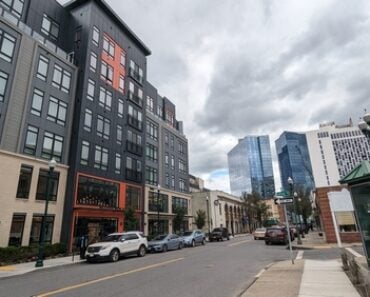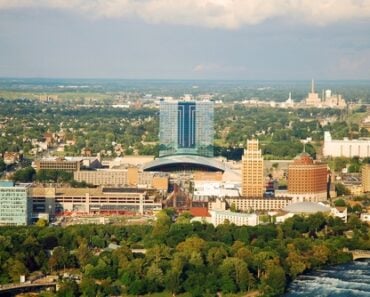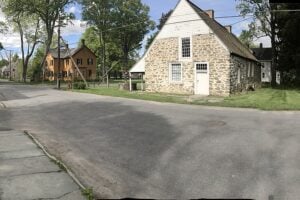
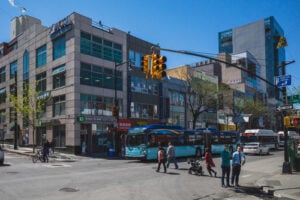
Pedestrians cross Main Street in downtown Flushing, Queens, in April 2019. Photo: Mark Zhu / Shutterstock.com.
Flushing has given New York some remarkable stories, and not all of them begin with the modern neighborhood most people know today. Before Main Street became one of Queens’ busiest commercial corridors, Flushing was a colonial settlement where residents challenged religious persecution. During the 19th century, its nurseries supplied plants to customers across the country. Later generations brought filmmakers, musicians, actors, artists, scientists, and public officials whose accomplishments reached well beyond New York City.
There is a geographical distinction worth making in an article like this. Historic Flushing covered a larger area than the present-day neighborhood, and people sometimes use the name broadly for surrounding communities. Kew Gardens Hills, Forest Hills, Bayside, and Little Neck have their own identities. Where someone was born in Flushing but raised elsewhere, or grew up in nearby Kew Gardens Hills, the individual profiles make that clear rather than claiming a childhood spent on streets they never lived on. You can learn more about the area’s changing geography in our history of how Queens neighborhoods got their names.
That distinction makes the range of people here even more interesting. Some were born in Flushing and left as children. Others spent decades in the community, made it their home, or did their most important early work there. A few are connected to the wider historical Flushing area rather than the neighborhood’s present boundaries. The common thread is a specific, documented connection, not simply the fact that somebody once lived somewhere in Queens.
Here are 25 people whose histories intersect with Flushing, from the 17th-century fight for religious liberty to the development of electronic music, Hollywood filmmaking, New York hip-hop, and public life. For a borough-wide companion, see our 25 famous people from Queens article.
1. Martin Scorsese
Martin Scorsese was born in Flushing in 1942, a detail that surprises people who associate him almost entirely with Manhattan’s Little Italy. His family moved to Little Italy when he was young, and that neighborhood, not Flushing, provided much of the street-level experience that later shaped his filmmaking. As a child with severe asthma, Scorsese spent long stretches indoors and developed a fascination with films, television, and the Catholic religious imagery around him. His Flushing birthplace and Manhattan upbringing are both parts of his New York story.
Scorsese went on to direct Mean Streets, Taxi Driver, Raging Bull, Goodfellas, and The Departed, among many other films. His work regularly returns to questions of loyalty, violence, guilt, and the neighborhoods that form people’s identities. He won the Academy Award for Best Director for The Departed. Although his films made Little Italy internationally familiar, the director’s life began in Queens, a fact documented by PBS’s American Masters and other film biographies.
2. John Williams
Before movie audiences knew the opening music of Star Wars or the ominous theme from Jaws, John Williams was a boy in Flushing. Born there in 1932, he grew up in a musical household. His father was a professional percussionist, and Williams studied piano and other instruments while still young. The family moved to Los Angeles in 1948, when he was a teenager, so his earliest musical education belonged to the New York years rather than the Hollywood career that would make him famous.
Williams became one of the defining film composers of the modern era, creating music for Star Wars, Jaws, E.T. the Extra-Terrestrial, Jurassic Park, and the Indiana Jones films. He also maintained an important career as a concert composer and conductor, including his long association with the Boston Pops. His gift for creating melodies audiences recognize within a few notes has made him an unusual sort of household name: a composer whose music is often more instantly familiar than his face.
3. Jon Favreau
Jon Favreau was born in Flushing in 1966, although he has identified Forest Hills as the Queens neighborhood where he spent much of his childhood. Both of his parents worked in education. He graduated from the Bronx High School of Science and attended Queens College, where he initially considered an engineering-oriented education. Favreau has spoken about how his campus activities exposed him to organizing events and working with people, skills that became useful when he entered the entertainment business. He left college without completing a degree.
After working in comedy and acting, Favreau wrote and starred in Swingers, directed Elf, and helped establish the Marvel Cinematic Universe as director of Iron Man in 2008. He later developed the Star Wars series The Mandalorian and continued working as an actor, producer, and director. His path from a Queens public-school education and Queens College to major film and television projects demonstrates how an ordinary neighborhood upbringing can lead into an extraordinary entertainment career.
4. Judd Apatow
Judd Apatow was born in Flushing in 1967, according to accounts including a Sports Illustrated interview tied to his documentary about the New York Mets. His childhood, however, was spent chiefly in Syosset on Long Island, and some biographical databases identify Syosset rather than Flushing as his birthplace. That distinction matters: Apatow should not be described as having grown up on Flushing streets. His formative fascination with comedy developed on Long Island, where he began interviewing established comedians while still a high school student.
Apatow became a major writer, director, and producer of American screen comedy. He directed The 40-Year-Old Virgin and Knocked Up, helped bring Freaks and Geeks to television, and produced or developed a number of successful comedy projects. He also co-directed the documentary Doc & Darryl about Mets stars Dwight Gooden and Darryl Strawberry, a particularly fitting connection for someone whose reported birthplace was only a short distance from Shea Stadium in Flushing Meadows.
5. David Schwimmer
David Schwimmer was born in Flushing in 1966, but his family’s move to Los Angeles when he was very young meant that most of his childhood took place in California. That is quite a contrast with his best-known fictional role: Ross Geller, the New Yorker he portrayed throughout the long run of Friends. Schwimmer studied theater at Northwestern University and helped establish the Lookingglass Theatre Company in Chicago, building a serious stage background before becoming a television star.
As Ross on Friends, Schwimmer became recognizable to viewers around the world. He subsequently directed films, returned to stage work, and played Robert Kardashian in The People v. O. J. Simpson: American Crime Story. The Flushing connection is a birthplace, not a claim about the neighborhood shaping his acting education. Yet it adds an unexpected real-life Queens detail to the career of an actor so closely identified with a television version of Manhattan.
6. Fran Drescher
Fran Drescher was born in Flushing in 1957 and grew up in nearby Kew Gardens Hills, a neighborhood with a distinct identity of its own. She attended local public schools, including Parsons Junior High School and Hillcrest High School. Her unmistakable Queens voice became one of her greatest artistic assets. In interviews, she has recalled being urged early in her career to change her accent and discovering that attempts to suppress it took away much of her personality as a performer.
Drescher co-created and starred in The Nanny, turning the voice, humor, and energy of her Queens upbringing into an internationally recognized television character. She later became active in health advocacy and served as president of the actors’ union SAG-AFTRA from 2021 to 2025, including during the 2023 actors’ strike. Her career has two important New York connections: her Flushing birthplace and the Kew Gardens Hills childhood that helped develop a style she never abandoned.
7. Paul Simon
Paul Simon was born in New Jersey in 1941 and raised in Kew Gardens Hills, near Flushing, rather than in the present-day Flushing neighborhood itself. The distinction is worth preserving, especially because so much of his early story is tied to particular Queens schools and streets. He attended P.S. 164 and later Parsons Junior High School, where he came to know Art Garfunkel. Simon also attended Queens College, earning an English degree in 1963. His earliest performances and musical partnership grew from those school and neighborhood connections.
Simon became one of America’s most prominent songwriters, first through Simon & Garfunkel and later through a solo career that ranged from There Goes Rhymin’ Simon to Graceland. His writing drew on folk, gospel, rock, and other musical traditions while keeping a distinctive ear for conversational detail. His inclusion here reflects the broader historic Flushing-area community, not a misleading claim that he was born in downtown Flushing. Queens College’s own alumni materials document his Kew Gardens Hills upbringing.
8. Art Garfunkel
Art Garfunkel was born in Forest Hills in 1941 and grew up in Kew Gardens Hills, where his family lived on Jewel Avenue. Like Paul Simon, he belongs to the wider Flushing-area story rather than being presented as a native of the neighborhood around Main Street. The two met as schoolchildren at P.S. 164 and began performing together when they were young. Their early partnership grew out of school productions, shared enthusiasm for harmony, and the ambitions of two teenagers growing up in Queens.
Garfunkel’s tenor became one of the defining elements of Simon & Garfunkel recordings such as “The Sound of Silence,” “Scarborough Fair,” and “Bridge Over Troubled Water.” He also developed a solo recording career and appeared in films including Carnal Knowledge. His official biography identifies both his Forest Hills birthplace and Kew Gardens Hills upbringing, details that tell the local story more accurately than treating all of northeastern Queens as one interchangeable neighborhood.
9. Robert Moog
Robert “Bob” Moog was born in Flushing in 1934 and attended P.S. 24 there. His father, an electrical engineer, encouraged his interest in experimenting with circuitry and building electronic devices. Moog took piano lessons, but he was equally fascinated by the machinery behind sound. As a teenager he built a theremin and continued experimenting while attending the Bronx High School of Science. His early scientific and musical interests were already intertwined long before the invention that would make his name familiar to musicians.
Moog studied at Queens College and Columbia University, later completing a doctorate at Cornell. Working with musicians and engineers in the 1960s, he developed the Moog synthesizer, helping bring electronic sound into popular music, rock, and experimental composition. Instruments bearing his name became important to progressive rock, funk, film scores, and countless other styles. The Bob Moog Foundation’s timeline preserves detailed evidence of his Flushing childhood, including his earliest school and electronics projects.
10. Lewis Latimer
Lewis Howard Latimer was born in Chelsea, Massachusetts, in 1848, not in Flushing. His connection to Queens belongs to the final 25 years of his life. In 1903 he moved with his family to a house on Holly Avenue in what is now East Flushing, remaining there until his death in 1928. That home survives as the Lewis Latimer House Museum, giving the neighborhood a physical link to one of America’s notable Black inventors and technical draftsmen.
Latimer helped prepare the patent drawings connected with Alexander Graham Bell’s telephone and contributed to improvements in electric-light technology, including carbon filaments. He worked in a period when engineering advances were transforming American homes, streets, and industry. His later residence in Flushing makes him a genuine member of the community’s history even though his major professional work began elsewhere. The museum’s research and exhibits preserve both his technical achievements and his family story.
11. Joseph Cornell
Joseph Cornell was born in Nyack, New York, in 1903, but Flushing became his long-term home and a central part of his artistic life. In 1929 his family moved to a house on Utopia Parkway, where he lived until his death in 1972. Cornell traveled into Manhattan to visit bookstores, movie houses, antique shops, and galleries, collecting the printed images and small objects that would become materials for his work. Much of that material returned to his quiet Queens home.
Cornell became especially known for carefully composed assemblage boxes that placed photographs, maps, glassware, toys, and found objects into dreamlike arrangements. His work is represented in major museum collections, including the Museum of Modern Art. MoMA’s archives explicitly identify his Utopia Parkway home in Flushing and document his film and art interests. His story illustrates the surprising relationship between an ordinary Queens residence and the development of a highly original modern artistic language.
12. John Bowne
John Bowne settled in Flushing during the Dutch colonial period and built the house that still bears his name around 1661. He allowed Quakers to meet there at a time when Director-General Peter Stuyvesant’s administration sought to restrict religious gatherings outside the Dutch Reformed Church. Bowne was arrested in 1662, sent away from the colony, and traveled to the Netherlands to appeal his treatment to the Dutch West India Company. His story belongs to the very foundations of Flushing’s historical identity.
The company directed colonial authorities to permit peaceful religious observance, an important early episode in the struggle for liberty of conscience. Bowne should not be confused with the signers of the earlier 1657 Flushing Remonstrance; his arrest and appeal occurred several years afterward. His house remains a major historic landmark in Queens, and the broader story is explored in our article on the Flushing Remonstrance and religious freedom.
13. George Tenet
George Tenet was born in Flushing in 1953 and raised in Little Neck, in northeastern Queens. His parents were immigrants of Greek background who operated a family diner, and Tenet worked there while growing up. He attended New York City public schools and graduated from Benjamin N. Cardozo High School in Bayside. His biography is a reminder that a Flushing birthplace can be part of a larger Queens childhood without every stage of that childhood occurring in Flushing proper.
Tenet eventually rose through congressional and national-security work to become director of central intelligence, serving from 1997 to 2004 under Presidents Bill Clinton and George W. Bush. His tenure included the September 11 attacks and the intelligence controversies surrounding the Iraq War, which made his leadership the subject of intense public examination. Accounts of Tenet’s early life, including material from his former high school, connect that later national role to his family’s experience in Queens.
14. Amy Ryan
Actress Amy Ryan grew up in Flushing in a house that had also been her father’s childhood home. In a radio interview, she described family roots that extended through multiple generations of the neighborhood: her grandparents lived only a few blocks away. Her father worked in the trucking business and her mother was a nurse. Ryan later attended New York’s High School of Performing Arts, developing a career in theater before attracting a wider audience through film and television.
Ryan earned an Academy Award nomination for Gone Baby Gone and became familiar to television viewers through The Wire, The Office, and Only Murders in the Building. She has continued working on stage as well as on screen. Unlike performers whose Flushing connection consists of a birthplace followed by an early move away, Ryan has described a substantial family and neighborhood history there. That makes her an especially strong addition to a list devoted specifically to Flushing.
15. Action Bronson
Action Bronson, born Ariyan Arslani, grew up in Flushing in a family where food played an important part of everyday life. His father’s restaurant business introduced him to professional kitchens, and he trained and worked as a cook before making music his principal career. In interviews he has spoken about the cooking, family traditions, and immigrant influences that surrounded him as a child. Those experiences gave his later songs an unusually detailed vocabulary of ingredients, dishes, markets, and restaurants.
Bronson established himself as a rapper with releases including Dr. Lecter and Blue Chips, then brought his culinary enthusiasm to television through F*ck, That’s Delicious. He has frequently used Queens locations and food references in his lyrics and public appearances. His career is rooted in two overlapping Flushing stories: the neighborhood’s lively restaurant culture and its contribution to the development of New York hip-hop. That combination makes his connection particularly distinctive.
16. Large Professor
Large Professor, born William Paul Mitchell, was born in Harlem and raised in Flushing. He developed his interest in hip-hop while the music and its production techniques were changing rapidly in New York. Records, sampling equipment, drum machines, and neighborhood rap performances provided an informal education that became just as important to him as conventional schooling. He emerged as both a rapper and a producer, with a careful ear for the sounds that could make a hip-hop recording immediately recognizable.
He became known through the group Main Source and its influential album Breaking Atoms. As a producer, he helped shape the early recording career of Nas, notably through work connected with Illmatic, and contributed to other major East Coast rap projects. In a lengthy interview about his life, Large Professor identified Flushing as the place where he grew up. His local roots connect the neighborhood to a formative generation of hip-hop recording and production.
17. Mic Geronimo
Mic Geronimo, born Michael McDermon, came out of Flushing’s 1990s hip-hop scene. He grew up listening to the rap artists who established the music’s New York vocabulary and developed his own performing style while the city was producing an extraordinary number of local records and independent labels. His connection to Flushing is documented in music biographies, and his rise reflects the importance of neighborhood networks at a time when a promising single could draw attention from producers and record companies.
After attracting notice from producer Irv Gotti, Mic Geronimo released The Natural in 1995, featuring tracks such as “Masta I.C.” He later recorded Vendetta and collaborated with other artists working in New York rap. Although he did not achieve the household-name recognition of some contemporaries, his music has remained part of discussions about mid-1990s East Coast hip-hop. His inclusion represents a specific local musical scene rather than fame alone.
18. Royal Flush
Rapper Royal Flush, born Ramel Govantes, came out of Flushing and became associated with the Queens hip-hop network that included Mic Geronimo. In interviews, he has spoken directly about growing up in the neighborhood and about the complicated rivalries and friendships between artists from different parts of Queens. His stage name itself refers to Flushing, making the local identification unusually clear.
His 1997 debut album, Ghetto Millionaire, included production and guest appearances that connected him to prominent East Coast rap artists. Royal Flush later continued releasing music and appearing in interviews about the Queens rap scene. Although his work was less commercially dominant than that of some New York stars, his recordings document a period when distinct neighborhood identities were central to the city’s hip-hop culture.
19. John Liu
John Liu immigrated to the United States from Taiwan as a child and grew up in Queens, eventually establishing his home and political base in Flushing. He attended New York City public schools, including the Bronx High School of Science, and earned a degree at Binghamton University. Before holding elected office he worked in the financial sector as an actuary, experience that informed his later involvement in government budgets, public contracts, and financial oversight.
Liu became the first Asian American elected to the New York City Council in 2001 and later the first Asian American elected to a citywide office when he became comptroller in 2010. He went on to serve in the New York State Senate, continuing to represent communities in northeastern Queens. His official Senate biography describes Flushing as his hometown, making his connection both personal and political. Liu’s career also reflects the changing representation of Asian American communities in New York government.
20. Grace Meng
Grace Meng was born in Elmhurst and raised in several Queens neighborhoods, including Flushing and Bayside. She attended Stuyvesant High School, the University of Michigan, and the Benjamin N. Cardozo School of Law. Her family and professional life remained closely connected to Queens, where she worked as a lawyer and later entered elected office. Her official congressional biography specifies the different neighborhoods that formed her upbringing, avoiding the mistake of calling Flushing her birthplace.
Meng served in the New York State Assembly before being elected to the U.S. House of Representatives in 2012. She became the first Asian American woman to represent New York in Congress and has advocated on issues involving immigration, education, community resources, and civil rights. Her district includes Flushing, a neighborhood whose Asian American population and businesses have become central to the borough’s contemporary identity. Her career links that local community to national legislation.
21. Gary Ackerman
Gary Ackerman was born in Brooklyn in 1942 but moved to Flushing’s Pomonok Houses as a child, according to the Gary Ackerman Papers held by Queens College. He graduated from the college in 1965 and became a public-school teacher. Ackerman later helped establish the Flushing Tribune, the newspaper that grew into the Queens Tribune. Those experiences created an unusually close connection between local journalism, education, and the political life he eventually entered.
After serving in the New York State Senate, Ackerman was elected to the U.S. House of Representatives in 1983 and served until 2013. He became involved in foreign affairs and other congressional work while continuing to represent parts of Queens and, for some periods, nearby Long Island communities. His own papers document the importance of his Flushing childhood and Queens College years, so the neighborhood connection is not merely an assumption based on the district he represented.
22. Bill Viola
Bill Viola was born in Queens in 1951 and grew up in Flushing, where his early interests included drawing and music. He later studied at Syracuse University and began exploring video at a time when the technology was still unfamiliar as a medium for serious artistic work. His childhood neighborhood forms part of a story that eventually took him to museums and galleries around the world. The Museum of Modern Art’s writings on his work explicitly identify Flushing as the place where he grew up.
Viola became one of the major pioneers of video installation art, creating large-scale projected images and immersive sound environments concerned with memory, perception, spirituality, and human experience. His work appeared at major institutions, and he represented the United States at the Venice Biennale in 1995. He died in 2024. Including Viola also broadens the Flushing story beyond popular entertainment: his career helped establish moving-image technology as a lasting part of contemporary fine art.
23. Cadwallader D. Colden
Cadwallader David Colden was born in 1769 at the Colden family’s Spring Hill estate near Flushing, then part of colonial Long Island. He was the grandson of a prominent colonial official of the same family name and grew up during the turbulent years surrounding the American Revolution. His formal education and legal training took him beyond Flushing, but the family estate gives him a clearly documented local origin, recorded in historical biographies and accounts of the old town.
Colden went on to a substantial public career as a lawyer, New York City mayor, member of Congress, and New York state senator. He wrote about Robert Fulton and supported transportation improvements, including the Erie Canal. His association with Flushing belongs chiefly to his birth and family background rather than to a lifetime spent there. His story connects the rural colonial outskirts of today’s Queens with the development of New York’s early republican institutions.
24. William Prince
William Prince, the horticulturist born in Flushing in 1766, belonged to a family whose nurseries helped establish the community as an important center of American plant cultivation. This William Prince should not be confused with his father of the same name or his son, William Robert Prince, who also worked in horticulture. The younger William, sometimes called William Prince Jr., expanded the family enterprise and developed the Linnaean Botanic Garden and Nurseries in Flushing.
The Prince nurseries supplied fruit trees, ornamental plants, and botanical material to gardeners and agricultural customers throughout the country. The family also produced influential horticultural publications and exchanged plant material with other nurserymen and researchers. Records held by the Smithsonian, Library of Congress, and National Agricultural Library document their work. At a time when Flushing was still surrounded by farms and gardens, Prince helped establish a reputation for horticultural innovation that long preceded the neighborhood’s modern urban landscape.
25. Nancy Reagan
Nancy Reagan was born Anne Frances Robbins in Manhattan in 1921, but her earliest home was in Flushing. Her family lived at 149-40 Roosevelt Avenue during approximately the first two years of her life before she moved to relatives in Maryland. This is a short but unusually specific connection, supported by reporting on the house and its history. She should not be described as having grown up in Flushing throughout childhood; the neighborhood was the setting of her earliest infancy.
Reagan later became an actress and married Ronald Reagan, serving as first lady of the United States from 1981 to 1989. She was closely associated with the administration’s public image and the “Just Say No” antidrug campaign. Most accounts of her life focus on Hollywood, California politics, and Washington, making her brief Queens beginning an especially surprising detail. The former family house on Roosevelt Avenue offers a tangible reminder that an internationally familiar political life once intersected with an ordinary Flushing street.
Flushing’s Remarkable Range of People and Histories
One reason this list is so interesting is that the local connections are not all the same. Robert Moog’s childhood workshop and John Bowne’s 17th-century house belong to Flushing itself. Joseph Cornell and Lewis Latimer made homes in the community. Scorsese, Williams, and Schwimmer were born there before becoming associated with other places. Simon and Garfunkel grew up in neighboring Kew Gardens Hills, part of the larger northeastern Queens story, rather than the modern Flushing neighborhood. Distinguishing these histories makes the article more useful, not less.
For more local history, explore our articles on the Flushing Remonstrance, how Queens neighborhoods got their names, and the history of Shea Stadium in Flushing Meadows. Our borough-wide Famous People From Queens list covers additional communities and figures from across Queens.