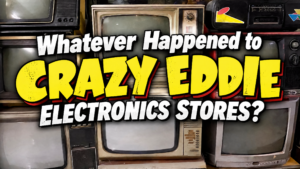
Feature Photo: asysyifarg/ Shutterstock.com
For New Yorkers who watched television during the 1970s and 1980s, Crazy Eddie was almost impossible to miss. A fast-talking salesman waved his arms in front of walls of stereos and televisions, promising electronics bargains with a slogan that became part of the region’s popular culture: “His prices are insane!” The commercials ran constantly, and their spokesman was so convincing that many viewers thought they were watching the real Crazy Eddie.
They weren’t. The man on the screen was radio personality Jerry Carroll. The actual Eddie was Eddie Antar, a Brooklyn businessman who helped turn a small stereo shop into a chain of 43 stores across the Northeast. At a time when New Yorkers were buying color televisions, receivers, turntables, VCRs, and other expensive home electronics, Crazy Eddie offered the excitement of a bargain and made itself a familiar name in the metropolitan area.
So what happened to Crazy Eddie electronics stores? The chain collapsed in 1989 after years of accounting fraud came to light, ownership changed hands, sales weakened, and suppliers lost confidence in the business. The original stores closed, and Eddie Antar eventually pleaded guilty to a federal racketeering-conspiracy charge. There were later attempts to bring back the name, but they never recreated the company New Yorkers remembered. The story begins on Kings Highway in Brooklyn, well before the company’s finances became a national scandal.
The Brooklyn Beginnings of Crazy Eddie
In 1969, Eddie Antar, his father Sam M. Antar, and a family partner opened a store called Sights and Sounds on Kings Highway in Brooklyn. It was a modest beginning, with an emphasis on audio equipment at a time when home stereos were becoming increasingly desirable purchases. Federal court records identify Sights and Sounds as the predecessor of the Crazy Eddie chain. Those records also show that the early company struggled financially and ceased operating in its original form by the end of 1972.
Rather than abandoning the electronics business, the family continued through a reorganized operation. By the middle of the 1970s, the Crazy Eddie name was established, and the enterprise began expanding beyond its Brooklyn base. A store opened in Syosset on Long Island, and another followed in Manhattan in 1975. These weren’t incidental locations. They put Crazy Eddie in front of different New York customers and gave the growing business a foothold in the wider metropolitan area.
The basic selling proposition was easy to understand. The stores carried familiar brand-name electronics and competed aggressively on price. Buyers looking for a stereo system or a television were encouraged to compare offers and return if Crazy Eddie could beat them. The sales approach could be intense, but it fit a competitive retail environment where customers often shopped between independent dealers to find the best deal.
As the business expanded, so did its selection of equipment. Cassette decks, receivers, speakers, televisions, video recorders, and recordings became the kinds of products customers associated with the chain. These were major purchases for many households, and the prospect of saving money on them gave Crazy Eddie a substantial audience.
Jerry Carroll and the Commercials New Yorkers Remember
The retailer’s biggest cultural breakthrough came from advertising. Jerry Carroll, a New York radio disc jockey known as Doctor Jerry, brought an unusually loud, playful delivery to a Crazy Eddie radio advertisement. Eddie Antar liked the approach and encouraged it. When Carroll became the face of the television campaign during the mid-1970s, the exaggerated salesman became one of the most recognizable figures in local advertising.
Carroll wore jackets or suits, spoke at a frantic pace, and treated every sale as if the entire city needed to hear about it immediately. He shouted the famous slogan so often that viewers could recognize the commercial without looking at the screen. The advertising appeared throughout the New York television market, and the chain promoted events such as its memorable Christmas in August sales. Some commercials were intentionally ridiculous, but that was part of the appeal.
The spots even entered popular culture beyond electronics retailing. Saturday Night Live parodied the approach with Dan Aykroyd as Crazy Ernie, while the ads were familiar enough to be referenced in other entertainment. There was an important distinction, however, between the television character and the store’s founder. Jerry Carroll was performing a role. Eddie Antar was the businessman making the decisions behind the chain.
For better or worse, the commercials helped give Crazy Eddie an identity that outlasted the stores themselves. Many former customers remember the voice, the gestures, and the slogan more clearly than any particular purchase they made there.
How Crazy Eddie Became a Regional Electronics Empire
Crazy Eddie grew rapidly during the late 1970s and early 1980s. Consumer electronics was changing, and the business was positioned to benefit. Home video recorders became increasingly popular, stereo systems were important purchases for music fans, and families were replacing older televisions with new models. The chain expanded through New York, New Jersey, Connecticut, and Pennsylvania, eventually reaching 43 stores.
The growth also reflected Eddie Antar’s ambition. He and relatives occupied senior positions throughout the company, and the business operated with the intensity of a family enterprise even as it became large enough to attract outside investors. Crazy Eddie became a publicly traded company in 1984, offering shares at $8 apiece. It reported sales of more than $350 million during its peak years, figures that made it appear to be a remarkably successful regional retailer.
For customers, the expansion meant more stores, familiar advertising, and access to electronics at advertised discount prices. For investors, it appeared to be a fast-growing company riding a profitable consumer trend. But the reported financial picture was increasingly disconnected from what was happening inside the business. Much of that difference would become visible only after the Antar family’s control came to an end.
The Financial Fraud Behind the Storefronts
One of the most disturbing parts of the Crazy Eddie story is that the fraud did not begin only after the company went public. Federal court findings describe the skimming of cash from retail receipts before the 1984 stock offering. Money was removed from the business without being fully reported, allowing insiders to conceal income while the operation was still closely held.
Once Crazy Eddie was publicly traded, the incentives changed. Investors and analysts expected strong growth, and the company needed to produce convincing sales and earnings figures. The scheme evolved to make the financial statements look better than the underlying business. Records were altered to inflate inventory, increase reported sales, and reduce amounts the company appeared to owe suppliers. Cash that had previously been skimmed was also used in ways designed to improve reported comparable-store sales.
These weren’t merely accusations made after the company failed. In a later federal proceeding, Eddie Antar acknowledged directing schemes to falsify company books and records, including inventory counts and sales figures. The Securities and Exchange Commission also pursued civil charges against former Crazy Eddie officials. Court records provide a much clearer account than the simplified idea that somebody just invented merchandise on a spreadsheet.
The fraudulent practices mattered because they distorted how shareholders and creditors evaluated the company. A retailer can have real customers, real merchandise, and very successful advertising while still reporting misleading financial results. Crazy Eddie had all three realities at once: a recognizable business, genuine sales, and accounting figures that concealed serious problems.
The 1987 Takeover and the Missing Inventory
By 1986 and 1987, signs of trouble were becoming harder to ignore. Sales performance deteriorated, the stock price declined, and investors became concerned about how the business was being run. Eddie Antar had stepped away from the company’s presidency, but the family remained closely associated with its management. An investor group led by Elias Zinn, working with the Oppenheimer-Palmieri Fund, challenged that control.
On November 6, 1987, dissident shareholders succeeded in electing a new board of directors. A physical inventory under the new management uncovered an estimated $45 million shortfall between the merchandise shown in the company’s records and what could be accounted for. Further accounting adjustments produced an even larger write-down. The discoveries made it impossible to treat Crazy Eddie’s financial troubles as simply a temporary slowdown in electronics sales.
Those discoveries also triggered years of lawsuits and investigations. Shareholders alleged that the company had been presented as much healthier than it really was, and federal investigators examined what the former executives had done. The name that had once stood for discount televisions and frantic commercials now appeared in headlines about inventory manipulation and securities fraud.
Why Did Crazy Eddie Stores Go Out of Business?
The company’s collapse had several causes, and they reinforced one another. The exposure of accounting fraud destroyed confidence in the financial statements. New management inherited a business whose true position was worse than investors had been led to believe. Sales were already weakening, and the stores still faced competition from other electronics retailers offering similar products.
Suppliers became a particularly serious problem. Electronics stores depend on receiving merchandise from manufacturers and distributors, often on credit. When vendors fear they may not be paid, they can demand cash before sending new products. A store that cannot replenish televisions, stereos, and other popular items becomes less attractive to customers, which makes its cash position worse. Contemporary accounts of Crazy Eddie’s final months identified the inability to obtain adequate supplier credit as an important reason the business could no longer continue.
Creditors sought bankruptcy proceedings in June 1989, and the chain was operating under bankruptcy protection that summer. Stores had already been closed as management tried to reduce losses. On October 3, 1989, Crazy Eddie announced that it would liquidate its remaining business. Going-out-of-business sales followed, and the liquidation of assets continued into 1990.
That is the clearest answer to what happened to the original Crazy Eddie stores. They weren’t quietly replaced by a new chain, and they didn’t disappear only because shoppers moved to another retailer. A heavily damaged business could no longer maintain the confidence and merchandise supply needed to operate.
What Happened to Eddie Antar?
The collapse of the stores did not end the legal story. Eddie Antar moved assets overseas and fled to Israel in 1990 as investigators pursued the financial fraud. Israeli authorities arrested him in June 1992, and he returned to the United States in early 1993 to stand trial. His former chief financial officer and cousin, Sam E. Antar, became an important government witness.
A federal jury convicted Eddie Antar in 1993 on racketeering and fraud-related charges, and he received a lengthy prison sentence in 1994. But that was not the final legal result. In 1995, a federal appeals court overturned the convictions of Eddie and his brother Mitchell because of problems involving the trial judge and ordered a new trial. Leaving out that reversal would give an incomplete account of the case.
Instead of going through another trial, Eddie pleaded guilty to racketeering conspiracy in May 1996. In February 1997, he was sentenced to 82 months in prison. The plea established his responsibility for schemes that falsified the retailer’s books and misled investors. He ultimately spent years in federal custody. Eddie Antar died on September 10, 2016, at age 68.
The lasting irony of the case is that Crazy Eddie’s public image was built around a seemingly outrageous promise of low prices, while the most damaging deception was taking place far from the sales floor. Many New Yorkers remembered an entertaining television salesman; investigators were examining the conduct of the people who actually owned and controlled the stores.
Did Crazy Eddie Ever Come Back?
The Crazy Eddie name was too well known to disappear without anyone trying to use it again. After the original liquidation, different parties explored revivals, and a limited effort opened in New Jersey during the late 1990s. There were also attempts to sell consumer electronics through the Crazy Eddie name online during the early 2000s.
Those efforts should not be confused with a return of the original chain. The online business associated with the name closed in the early 2000s, and a 2004 electronics-industry report described how the Crazy Eddie website was directing visitors to another retailer. None of the subsequent ventures restored the large network of neighborhood electronics stores or the combination of local advertising and discount retailing that had made Crazy Eddie famous.
Today, Crazy Eddie is remembered primarily as a vanished electronics chain, an unusually successful regional advertising campaign, and a notorious accounting-fraud case. The name occasionally resurfaces in discussions of New York retail history, but the original stores are gone.
Why New Yorkers Still Remember Crazy Eddie
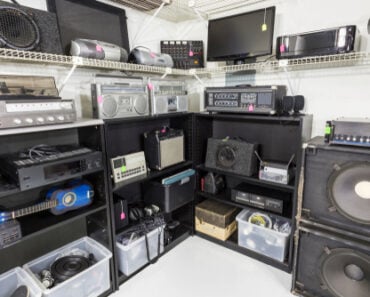
Crazy Eddie belonged to a particular period of New York shopping. Buying a major piece of electronics often meant visiting several stores, comparing prices, asking questions about equipment, and deciding whether to spend a substantial amount of money on something that might last for years. The storefronts were filled with television screens, audio components, and merchandise that now looks unmistakably tied to the era.
The company’s collapse also makes this a different story from the ordinary closing of a neighborhood retailer. The stores had real appeal and a marketing identity few competitors could match, but their success could not survive the dishonesty of the people managing their finances. Customers lost a familiar place to shop, employees lost jobs, and investors faced the consequences of misleading corporate reports.
For more New York retail memories, readers can explore our articles on 25 Lost Electronics Stores New York City Shoppers Remember, 20 Legendary Long Island Electronics, Stereo & Appliance Stores We Miss, and 25 Lost NYC Record Stores and Vinyl Shops We Still Miss. They recall a time when shopping for music, stereos, and electronics was an experience built around actual stores and the people inside them.