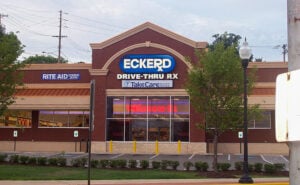
An Eckerd drug store in Rochester, Pennsylvania, displaying a “Rite Aid Coming Soon” sign in 2007. Photo: Jgera5 / Wikimedia Commons / Public Domain.
For a relatively brief stretch from the late 1990s through the mid-2000s, the familiar Eckerd signs seemed to appear on commercial corners all over New York State. From shopping plazas in Syracuse, Rochester, and Buffalo to neighborhood intersections across Queens, Brooklyn, and Long Island, New Yorkers picked up prescriptions, dropped off rolls of film, and shopped for everything from shampoo to greeting cards under the Eckerd banner.
Then, almost as suddenly as it had arrived, the century-old pharmacy name began disappearing from Empire State storefronts following its acquisition by Rite Aid in 2007. Yet Eckerd’s rise and fall in New York is far more than a simple buyout story. It connects the disappearance of two of New York’s most familiar homegrown drugstore chains, Upstate’s Fay’s Drug and Downstate’s Genovese Drug Stores, with the expansion and eventual collapse of Rite Aid’s nationwide chain of pharmacies.
From Erie Cut-Rate Medicine to a Southern Powerhouse
Long before Eckerd became a familiar sight across New York State, the business had its beginnings in neighboring Pennsylvania. In 1898, Joseph Milton Eckerd opened a drugstore in Erie with his business partner, Z. Tatom. Known as the Erie Cut-Rate Medicine Store, the business emphasized affordable prices, an approach that would remain central to the Eckerd name for generations.
The family expanded its business to Wilmington, Delaware, in 1912. Joseph Milton’s son, Jack Eckerd, worked in the family’s drugstore business before striking out on his own. In 1952, he purchased three struggling drugstores in the Tampa Bay area of Florida. From those modest beginnings, he built an extensive Southern pharmacy chain, expanding through new store openings and acquisitions. By the early 1980s, the Clearwater-based company ranked among the largest drugstore chains in the United States.
Although the Eckerd family had earlier business connections to New York, the Southern chain that Jack built was not yet the everyday presence across the Empire State that it would become in the late 1990s. That transformation came through the ambitions of a company better known to New Yorkers for selling clothing, furniture, and household merchandise: J.C. Penney.
How Eckerd Expanded Across New York Through Fay’s and Genovese
J.C. Penney already operated the Thrift Drug pharmacy chain when it began a major expansion of its drugstore business in the mid-1990s. It purchased Fay’s Incorporated in 1996 and completed its acquisition of Eckerd Corporation in 1997 for approximately $3.3 billion. Penney subsequently brought several of its pharmacy operations together under the Eckerd name. For New Yorkers, the changes arrived in two particularly significant waves.
Fay’s Drug: The Upstate New York Connection
In 1958, father-and-son pharmacists Henry A. Panasci Sr. and Henry A. Panasci Jr. opened their first Fay’s Drug store in Fairmount, just outside Syracuse. The business was named for Henry Jr.’s wife, Faye. According to the family, they omitted the final letter of her name to save space and money on the store signs. What began as a single drugstore grew into an extensive regional chain with a substantial presence around Syracuse, Albany, Rochester, and Buffalo.
Fay’s expanded through acquisitions as well as new store openings, including its purchase of the Rome-based Carl’s Drug chain in 1991. By the time J.C. Penney acquired Fay’s in 1996, the company operated 272 drugstores, primarily in New York and other Northeastern states. The subsequent conversion of Fay’s stores to Eckerd in 1997 brought the Eckerd name to many Upstate communities where customers had been shopping at Fay’s for years. In numerous cases, the neighborhood pharmacy continued doing business in the same building, but under a different name.
Genovese Drug Stores: The New York City and Long Island Connection
J.C. Penney turned its attention to another long-established New York pharmacy business in November 1998, announcing its agreement to acquire Genovese Drug Stores. The chain traced its origins to a pharmacy opened by Joseph Genovese in Astoria, Queens, in 1924. Over the following decades, Genovese developed a substantial presence on Long Island and in the New York metropolitan area, eventually establishing its corporate headquarters in Melville.
The acquisition closed on March 1, 1999, bringing 141 Genovese drugstores in New York, New Jersey, and Connecticut into J.C. Penney’s pharmacy operation. Unlike the relatively rapid conversion of Fay’s stores, the Genovese name remained in use for several years. By 2003, the surviving Genovese-branded stores were being brought under the Eckerd identity. For many Long Islanders, the change marked the loss of a familiar neighborhood institution. The earlier history of that business is explored in our article Whatever Happened to Genovese Drug Stores?
By the time J.C. Penney decided to sell its pharmacy business, Eckerd operated approximately 2,800 stores. One of the more unusual experiments during the Penney years involved placing catalog-order desks inside selected drugstores. The idea was to give shoppers another way to purchase and collect J.C. Penney merchandise without having to visit a department store. The experiment did not develop into the sweeping integration of the two businesses that executives had envisioned.
The 2004 Breakup: Enter Quebec’s Jean Coutu Group
Despite Eckerd’s enormous retail network, J.C. Penney found it difficult to achieve the returns it had hoped for from its drugstore business. Integrating several formerly independent chains was a complicated undertaking, and competition from other national pharmacy operators remained intense. By the end of its 2003 fiscal year, Penney had decided to sell the operation and refocus on its department stores and catalog business.
In April 2004, J.C. Penney announced two transactions with a combined initial value of $4.525 billion. CVS agreed to pay $2.15 billion for roughly 1,260 Eckerd stores concentrated in the Southern and Southwestern United States, together with other pharmacy assets. The Canadian pharmacy company Jean Coutu Group agreed to pay $2.375 billion, before subsequent adjustments, for the remaining Eckerd business.
When Jean Coutu completed its purchase on July 31, 2004, it acquired 1,549 Eckerd drugstores across 13 states. Of those, 365 were in New York, according to the company’s contemporary financial disclosures. It also acquired the Eckerd trade name and the company’s headquarters in Largo, Florida. Jean Coutu already operated the Brooks Pharmacy chain, with its American operations headquartered in Warwick, Rhode Island. The acquisition brought Eckerd and Brooks together while retaining their separate retail names.
For customers in New York, the immediate result was less dramatic than the changes taking place in the South, where many Eckerd stores became CVS pharmacies. New Yorkers continued to shop at Eckerd even though the company had changed hands again. The next acquisition, however, would bring the Eckerd name’s long history in American drugstore retailing to an end.
The Rite Aid Takeover and the End of the Eckerd Name
Jean Coutu’s ownership of Eckerd lasted just under three years. In August 2006, the Canadian company announced an agreement to sell its American drugstore operation to Rite Aid. The transaction involved cash, Rite Aid stock, and the assumption of debt, and gave Jean Coutu a substantial ownership interest in the enlarged American pharmacy company.
The acquisition closed on June 4, 2007, after an antitrust review that required the divestiture of certain stores. Rite Aid acquired 1,854 Brooks and Eckerd locations, including 1,516 Eckerd drugstores, along with six distribution centers. The purchase expanded Rite Aid’s network to more than 5,000 stores and gave it a considerably larger presence in the New York metropolitan area and throughout the eastern United States.
Rite Aid set about converting the acquired stores to its own identity. The changes involved more than replacing the signs outside the buildings. Pharmacy computer systems, merchandise distribution, store layouts, and management structures also had to be integrated. The conversion program continued through 2008, bringing an end to the Eckerd name on the New York retail landscape.
For a customer in Syracuse or on Long Island, it was not necessarily the end of the neighborhood pharmacy itself. Many continued visiting the same buildings, sometimes dealing with the same employees, under yet another name. A store that had once been Fay’s or Genovese, and then Eckerd, was now Rite Aid.
What Happened to the Former Eckerd Stores After Rite Aid?
The sign changes were far from over. Rite Aid faced a combination of financial challenges in the years following the Brooks and Eckerd acquisition, including substantial debt, competition, and pressure on pharmacy reimbursement. The company eventually agreed to sell a large portion of its stores to Walgreens after abandoning an earlier plan for a full merger.
The Walgreens transaction, announced in its final form in September 2017, was completed in March 2018 with the transfer of 1,932 Rite Aid stores nationwide. Some former Eckerd locations in New York consequently entered another phase of their retail histories under the Walgreens name.
Rite Aid filed for Chapter 11 bankruptcy protection in October 2023. Burdened by debt, operating losses, and litigation related to opioid prescriptions, the company closed hundreds of locations during its restructuring. It emerged from bankruptcy in September 2024, only to file for Chapter 11 again on May 5, 2025. This time, the original company’s remaining chain of retail pharmacies was dismantled. At the time of the second filing, reports identified 178 remaining New York locations slated for sale or closure.
By early October 2025, Rite Aid had announced the closure of all its remaining stores nationwide. CVS, Walgreens, and other pharmacy operators acquired prescription records or selected pharmacy assets. Although a new team subsequently began reviving the Rite Aid name online, that development was separate from the nationwide chain of physical drugstores that closed in 2025.
Across New York State, the physical legacy of Eckerd is still recognizable in some of the buildings that housed its pharmacies. Depending on the location, former stores have been occupied by other pharmacies, discount retailers, or entirely different businesses. Others have stood vacant or been redeveloped. The disappearance of Eckerd was part of a much longer transformation of the neighborhood drugstore, in which generations of regional businesses gave way to national chains and, in some communities, the loss of a local pharmacy altogether.
For more stories about the familiar businesses that disappeared from New York’s shopping landscape, explore our articles on 25 Lost Department Stores Upstate New Yorkers Still Remember, lost supermarkets of Upstate New York, and Whatever Happened to Finast Supermarkets?