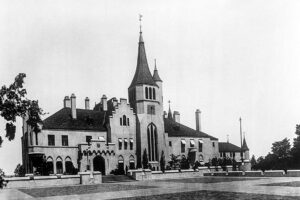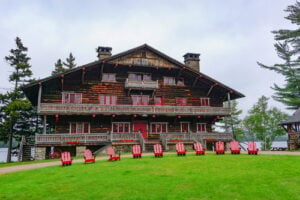
Photo: Martin Lewison, CC BY-SA 2.0, via Wikimedia Commons. Cropped from original.
There was a time when a family vacation in Upstate New York meant a stop at Frontier Town, an afternoon feeding animals at the Catskill Game Farm, or an evening watching the performers at Gaslight Village. For families who lived upstate, the local amusement park might have been just a short drive or trolley ride from home. You didn’t have to travel to Florida to spend a day riding a roller coaster, watching a show, or getting soaked on a water ride.
Some of these parks were built by railroad companies that wanted to encourage people to ride their trolleys on weekends. Others were the creations of families and entrepreneurs who saw opportunity along the highways leading to the Adirondacks, Catskills and Finger Lakes. As automobile travel changed and larger theme parks emerged, many of the smaller attractions struggled to survive. Fires, floods, financial troubles and rising real estate values also took their toll.
Fortunately, not everything disappeared. Some of the old carousels were rescued and still carry children today. Other amusement grounds became public parks, while a few found entirely new uses. Here are 25 lost amusement parks and related family attractions from across Upstate New York, including the Hudson Valley. The list celebrates their original amusement operations, even where pieces of those attractions live on elsewhere.
1. Frontier Town – North Hudson
Arthur Bensen opened Frontier Town on July 4, 1952, in the Adirondack town of North Hudson. Visitors stepped into an imagined Old West complete with a railroad, stagecoaches, saloons, a blacksmith shop and a rodeo arena. Staged robberies and gunfights were part of the entertainment, and children could experience a Western adventure without leaving New York State.
The park closed in 1985, reopened in 1989 under different ownership and shut down permanently in 1998. Its contents were auctioned in 2004. A portion of the former property now accommodates the state’s Frontier Town Campground, Equestrian and Day Use Area. We explore its remarkable story in greater detail in our history of Frontier Town. The Town of North Hudson’s history also documents the attraction.
2. Catskill Game Farm – Catskill
Roland Lindemann established the Catskill Game Farm in 1933, initially with a small collection of deer. The operation grew into an enormous privately owned zoo that attracted generations of vacationing families. Visitors encountered animals from around the world, but for many children the highlight was the opportunity to feed the animals in the special petting area.
Declining attendance and financial difficulties brought the attraction’s 73-year run to an end on October 9, 2006. The animals were dispersed and the property stood unused for years. Its former giraffe barn was subsequently converted into the Long Neck Inn, which opened in 2019. The zoo itself is gone, although the Old Game Farm preserves portions of the property and its history.
3. Gaslight Village – Lake George
Charles R. Wood opened Gaslight Village in 1959. Instead of building the park around a single giant roller coaster, Wood created a nostalgic theatrical village inspired by the entertainment of the late 19th century. Its performers included comedians, magicians, musicians and ice skaters. The midway offered rides and refreshments, while the Opera House provided live entertainment.
Gaslight Village lasted until the late 1980s and briefly returned under a different name, Lake George Action Park. Its distinctive buildings were eventually demolished, beginning in 2010. The property was redeveloped as Charles R. Wood Park, including an outdoor festival space and restored wetlands. See the history of the Festival Commons for the site’s subsequent transformation.
4. Time Town – Bolton Landing
I remember going here as a little kid and being blown away by a water fountain that I could ask for a drink verbally, and it would turn the water on. It was mind-blowing. It was also the 1960s. Time Town grew out of an unusual hobby. Albany businessman Ted Yund acquired a large telescope and wanted a suitable location for observing the night sky. He found one in the hills above Lake George and built a theme park around his interest in astronomy. Opening in 1970, Time Town combined futuristic attractions with a miniature railroad and displays representing earlier periods of history.
The park’s geodesic domes and sculptures of astronauts reflected the excitement surrounding the American space program. Rocket engineer Wernher von Braun even visited to dedicate an astronaut sculpture. The remote location, fuel shortages and financial difficulties contributed to its demise around 1980 or 1981. The land was subsequently subdivided for homes. Adirondack Life’s interviews with the Yund family preserve the story of this unusual attraction.
5. Land of Makebelieve – Upper Jay
Artist and designer Arto Monaco opened the Land of Makebelieve in 1954, a year before Disneyland welcomed its first visitors. His Adirondack park was conceived on a child’s scale. It featured a castle, fairy-tale buildings, a miniature Western town, a small train and a paddle-wheel boat. Much of the appeal lay in allowing children to explore the imaginary world themselves.
The property’s proximity to the Ausable River proved disastrous. Repeated floods damaged the park, and Monaco finally closed it in 1979. Some structures were relocated to Storytown in Queensbury. Tropical Storm Irene destroyed much of what remained at the original site in 2011. Monaco’s creativity survives in the memories of visitors and in the recorded interviews preserved by North Country Public Radio.
6. Water Slide World – Lake George
Water Slide World opened in 1979 on property that had previously accommodated a drive-in movie theater. Gary Koncikowski developed the attraction at the southern entrance to Lake George village, where generations of motorists passed its brightly colored slides. A wave pool added in 1984 helped establish it as a major summertime destination.
After Koncikowski died in 2018, the park did not reopen for that season. Its property was sold to a developer in 2022, and demolition followed. The closure was a particularly poignant loss for vacationers who had watched the park grow over nearly four decades. The Glens Falls Business Journal documented the sale and plans for redevelopment.
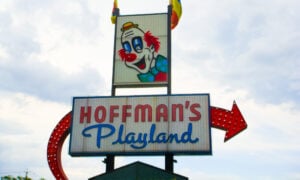
7. The Original Hoffman’s Playland – Latham
Bill Hoffman developed a children’s amusement park on his family’s property in the early 1950s. What began with a handful of attractions expanded to include a carousel, miniature train, Ferris wheel, roller coaster and other family rides. For decades, the familiar Playland sign along Route 9 welcomed children from throughout the Capital Region.
Dave and Ruth Hoffman retired after the 2014 season, closing the original Latham location. Fortunately, the rides were acquired by Huck Finn’s Warehouse and reopened in Albany in 2015 as Huck Finn’s Playland. The original grounds are lost as an amusement park, but this is one of the rare stories in which the attractions themselves were saved together. The Albany Institute of History & Art preserves the history of the original park.
8. Kaydeross Park – Saratoga Lake
Kaydeross Park was one of the recreational destinations that developed along Saratoga Lake in the early 20th century. Over the decades, it offered swimming, amusement rides, picnic grounds and dancing. Its carousel, with horses carved by Marcus Illions in 1910, became one of its most treasured attractions.
When the property was sold for residential development in 1987, local residents organized to keep the carousel from being dismantled and sold. The effort succeeded. The carousel was ultimately installed in Congress Park in Saratoga Springs, where it continues to operate. The city’s carousel history tells the story of the preservation campaign.
9. Electric Park – Kinderhook Lake
Opened in 1901 by the company operating the electric railway between Albany and Hudson, Electric Park was designed to attract passengers to Kinderhook Lake. Electric illumination, mechanical rides, live entertainment and waterfront amusements gave visitors reasons to make the trip. At a time when electricity was still a novelty in many homes, the park’s lights were an attraction in themselves.
World War I brought restrictions that interrupted operations. The park struggled after the war and had effectively closed by 1920, according to the Columbia County Historical Society. Its history illustrates how closely the fortunes of the early amusement parks were tied to the transportation companies that built them.
10. Al-Tro Park – Menands
The name Al-Tro combined Albany and Troy, the two cities whose residents were the park’s principal audience. Opening in 1906 on former island land near Menands, the park could be reached by steamboat or streetcar. Its attractions included a roller coaster, skating rink, dance hall, miniature railway and elaborate evening lighting.
The original Al-Tro name disappeared within a few years, although subsequent amusement businesses used the site under the names Maple Beach Park and Midway Beach Park. The geography itself changed substantially when waterways were filled during construction of Interstate 787. A historical marker along the Empire State Trail commemorates the amusement grounds.
11. Rensselaer Park – Lansingburgh, Troy
Rensselaer Park opened in 1867 as a private recreation ground, with facilities for picnics, races, sporting events and community gatherings. In 1906 the Troy Driving and Speedway Association expanded its activities into amusement park entertainment. The grounds were situated in Lansingburgh, now the northern part of Troy.
The Lansingburgh Historical Society identifies 1918 as the final year of the park, when it hosted the county fair. Much of the property was subsequently acquired for housing development associated with anticipated industrial growth on nearby Green Island. The old recreation grounds gave way to the changing needs of an industrial city.
12. Luna Park and Rexford Park – Rexford
Rexford had its own version of Luna Park on the banks of the Mohawk River. The amusement park opened in 1906, drawing visitors traveling by trolley from Schenectady. Its attractions included roller coasters, a carousel, a swing ride, fun houses and a water ride. Fred Dolle acquired the property in 1911, and the park operated under several names during its history.
The last season was 1933. As the Depression deepened and travel habits changed, the rides were removed and the land gradually returned to other uses. The Saratoga County Historian preserves photographs of the park during its years as a popular Mohawk Valley attraction.
13. Roseland Park – Canandaigua
William Muar opened Roseland Park in 1925 on the northern shore of Canandaigua Lake. Originally known as Lakeside Park, it grew into one of the Finger Lakes’ best-known summer attractions. The park offered a dance hall, a wooden roller coaster, a carousel and a sky ride that extended over part of the lake. Local children also benefited from an annual event that provided free rides and refreshments.
Roseland closed on Labor Day in 1985. Its wooden roller coaster was relocated to Pennsylvania, while its historic carousel eventually found a new home in Syracuse’s Carousel Center, now Destiny USA. The present Roseland Waterpark is a separate attraction, not the original amusement park. Finger Lakes Visitors Connection documents efforts to commemorate Roseland’s legacy.
14. Suburban Park – Manlius
Suburban Park developed around the turn of the 20th century in conjunction with the electric trolley system serving the Syracuse area. Situated just outside Manlius, the park offered a dance pavilion, picnic grounds, bumper cars and a roller coaster. It was a place for school outings, social events and weekend excursions.
The park survived long after the trolley service that helped establish it, finally closing in 1973. Its land was subsequently developed for housing. The Village of Manlius remembers Suburban Park as a significant part of the community’s history, spanning the years when a trolley trip to the country gradually gave way to automobile travel.
15. Long Branch Amusement Park – Onondaga Lake
Brothers Ben and George Maurer developed Long Branch Park in 1882. Overlooking Onondaga Lake near Liverpool, it offered a variety of recreation ranging from boating and baseball to dancing and mechanical rides. Its picnic grounds made it a popular destination for groups traveling from Syracuse and surrounding communities.
The amusement operation ended in 1938, and the land became part of the county’s park system. The carousel went to Roseland Park in 1941 and eventually returned to the Syracuse area at Carousel Center. The Onondaga Historical Association traces the journey of this remarkable surviving ride.
16. Long Point Amusements – Geneseo
Long Point on the western shore of Conesus Lake became a popular recreation destination in the 19th century. Its amusements grew from lakeside gatherings and dancing into a more elaborate collection of rides and concessions. The LaGrou family eventually added attractions including miniature golf and roller skating.
A major fire in 1988 brought the amusement business to an end. In 1990 the family donated the land to the Town of Geneseo for public use. Today, Long Point remains a lakeside park, but the commercial midway that once occupied the grounds is gone. The history is preserved by Explore Genesee Valley and local preservation efforts.
17. Enna Jettick Park – Owasco Lake
The Auburn City Railway Company established Lakeside Park on Owasco Lake in 1891. Fred L. Emerson acquired it in 1930 and renamed it after the Enna Jettick shoe brand associated with his Auburn business. The park provided rides and waterfront recreation in an area that also supported the separate Island Park across the outlet channel.
The former Enna Jettick property became Cayuga County’s Emerson Park in 1944. The county later acquired Deauville Island, incorporating the separate amusement grounds into the larger public park. Visitors today can still enjoy the lake, and the old carousel pavilion houses a theater. The Cayuga County historical timeline documents the transformation.
18. Olympic Park – Rochester Area
Located on Scottsville Road near Rochester’s airport, Olympic Park provided amusement rides for families in the western suburbs. Its attractions included roller coasters and a go-kart track. The complex also offered bowling and other activities, giving it a different character from the older amusement parks on Lake Ontario.
The park was under new management in 1981, but efforts to revive the amusement operation failed. The main park was closed by 1982, although some other recreational businesses continued for years. The opening of larger attractions such as Darien Lake added to the competition. The Roller Coaster DataBase records the park’s former coasters and its 1982 auction.
19. The Original Ontario Beach Amusement Park – Rochester
In the late 19th century, Rochester’s Charlotte neighborhood became a summer resort at the mouth of the Genesee River. Ontario Beach Park acquired hotels, amusement rides, a boardwalk and live entertainment. Visitors came by rail and other means of transportation to enjoy the attractions along Lake Ontario, earning the area comparisons to Coney Island.
The amusement complex was converted to public parkland following the 1919 season, and most of its rides disappeared. One particularly important exception is the 1905 Dentzel carousel, which has remained at the site for more than a century. Monroe County continues to operate the carousel seasonally. Ontario Beach Park itself is very much alive; it is the original commercial amusement complex that is lost.
20. Sherman’s Amusement Park – Caroga Lake
Frank Sherman opened his amusement park on West Caroga Lake in 1921. Its dance pavilion attracted prominent musicians, including Duke Ellington and Louis Armstrong, while swimming, a carousel and other rides entertained families. The park became a social center for the southern Adirondack community as well as a vacation attraction.
The town identifies 2009 as the year the amusement park closed. The property later became a home for the Caroga Arts Collective, which presents concerts and other cultural events. The organization has also worked to preserve the historic rides, including the Ferris wheel. The Caroga Museum’s postcard history and the Caroga Arts Collective document the site’s different eras.
21. Renwick Park – Ithaca
Renwick Park opened in 1894 at the southern end of Cayuga Lake. Developed in conjunction with the local electric railway, it featured a carousel, a small zoo, a dance pavilion and waterfront amusements. Boat excursions and trolley rides helped make the park accessible to Ithaca residents.
As the trolley park declined, filmmakers Theodore and Leopold Wharton leased the grounds for their silent movie studio. The original amusement operation closed in 1915, and the City of Ithaca purchased the property in 1921. It reopened as Stewart Park, named for Mayor Edwin C. Stewart. The city’s official history describes its journey from amusement park to film studio to public park.
22. Celoron Park – Celoron
Opened in 1894 on Chautauqua Lake, Celoron Park featured rides, swimming, live performances and sporting events. The park’s baseball grounds hosted professional players, and Babe Ruth famously hit a ball into the lake during an exhibition visit in 1921. The young Lucille Ball also worked at the park before she became one of America’s most celebrated entertainers.
The park’s fortunes declined after World War II, and a tornado in 1959 damaged many of its attractions. It closed in 1962, after which rides and structures were removed. Today, Lucille Ball Memorial Park occupies part of the former amusement grounds. A William G. Pomeroy Foundation historical marker preserves the memory of the park.
23. Luna Park – Olcott Beach
Olcott Beach was a thriving Lake Ontario vacation destination in the years when excursion boats and electric railways brought visitors to the shore. Luna Park, also associated with the Dreamland Dance Hall, offered music, food, amusement rides and access to the beach. The resort’s hotels and dance halls attracted visitors from throughout Western New York.
A devastating fire swept through Cooper Street in 1927, destroying Luna Park and several neighboring businesses. Its attractions were never rebuilt in their original form. Other amusement ventures subsequently opened in Olcott, and the community now has a small carousel park of its own. The Newfane Historical Society records the fire and the earlier resort era.
24. Carnival Court – Buffalo
Long before Darien Lake became a major regional destination, Buffalo residents could visit an amusement park within their own city. Carnival Court, also known as Athletic Park during its history, was situated at Main Street and Jefferson Avenue. Its location made it accessible by streetcar, offering city residents a convenient alternative to traveling to the lake resorts.
Fire damaged the old amusement grounds, and by 1920 the buildings were gone. The property was later developed for a Sears department store, whose building survives as part of Canisius University’s campus. Western New York Heritage preserves an image of the park near the end of its existence.
25. Indian Point Amusement Park – Buchanan
In 1923, the Hudson River Day Line established an amusement destination on the river in northern Westchester County. Steamboats carried passengers from New York City for day trips that included swimming, dancing, picnic grounds, games and rides. The park was an important part of the Hudson River excursion business.
The Day Line ceased operating the park in 1948, but it reopened under different ownership in 1950. By the mid-1950s the amusement business was gone. Consolidated Edison acquired the property for the Indian Point nuclear power plant, a transformation that would have been difficult for the park’s early visitors to imagine. The Village of Buchanan’s history documents this unusual change in land use.
For more memories of New York’s vanished attractions and vacation destinations, check out our articles on 10 Lost Amusement Parks New Yorkers Once Loved, 10 Lost Catskills & Adirondacks Hotels and Resorts, 25 Lost Ski Areas of Upstate New York, Restoring America’s Carousels: The Work of William Finkenstein, and 25 Upstate New York Roadside Attractions Worth Pulling Over For.