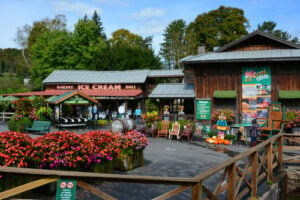
Fly Creek Cider Mill and Orchard in Fly Creek, New York. Photo: Steve Cukrov / Shutterstock.com.
Modern apple cider can be produced with everything from traditional rack-and-cloth presses to high-capacity commercial equipment, and today’s food-safety rules often add ultraviolet treatment or pasteurization after the apples are pressed. What has become rare is something much more visible: a working cider operation where machinery from the nineteenth or early twentieth century is still doing the actual job it was built to do.
New York still has a handful of places where that history is not sitting behind museum glass. Some are old cider mills, while others are family farms that acquired and preserved antique presses from earlier operations. In several cases, visitors can watch the gears, belts, racks, cloths, and hydraulic mechanisms turn fresh New York apples into sweet cider much as earlier generations did.
To qualify for this list, the operation had to be currently pressing cider with genuinely antique or historically old equipment that could be documented. That distinction eliminates several well-known cider businesses that now use modern presses and brings in others where the old machinery is still very much alive.
1. Fly Creek Cider Mill & Orchard (Fly Creek, Otsego County)
Fly Creek Cider Mill is the clearest example of living cider-making history in New York. The mill dates to 1856, and its centerpiece is an 1889 Boomer & Boschert cider press powered through an 1872 Lesner water turbine. Water from the millpond turns the turbine, which drives the machinery that creates hydraulic pressure for the press.
The press still uses the traditional rack-and-cloth method. Apples are washed, ground into pomace, layered into cloth and racks to form what cider makers call a “cheese,” and then squeezed under the old press. Fly Creek says the press can generate roughly 50 to 60 tons of force and produce about 100 gallons from a fully prepared pressing stack. The cider is then treated with ultraviolet light for food safety.
Visitors can look down on the operation from the Cider Gallery and Learning Center. Pressing schedules depend on cider demand, but the mill continues to advertise working press days during the 2026 harvest season. Few places in New York offer such a direct look at nineteenth-century machinery still earning its keep.
2. Wager’s Cider Mill (Penn Yan, Yates County)
Wager’s Cider Mill in Penn Yan operates one of the oldest documented cider-pressing systems still working in New York. Its cider press and hammermill were built in 1883. The equipment was originally used at a cider mill in Geneva before being moved to Penn Yan.
The building has served as a cider mill and juice plant since 1929, with the present family operating the business since 1977. Wager’s still uses the traditional rack-and-cloth method: apples are washed and ground, the pomace is layered between cloth and racks, and pressure extracts the cider from the stacked fruit.
The mill uses apples grown on the family’s farms and runs the finished cider through ultraviolet treatment rather than heat pasteurization. Wager’s is a particularly valuable survivor because both the antique press and its hammermill remain part of the working production process rather than simply serving as decoration.
3. Critz Farms (Cazenovia, Madison County)
Critz Farms may have been established as a modern family farm in 1985, but the machinery at the heart of its cider operation reaches back to the 1890s. The farm uses a 48-by-48-inch Boomer & Boschert four-screw press manufactured in Syracuse and originally operated at a water-powered cider mill in Pennsylvania.
Critz acquired the press in 2006 and restored it for active use. The machinery is line-shaft driven today by an electric motor, but the fundamental nineteenth-century mechanical system remains intact. Apples move through washing and grinding before the pomace is spread into the press. Critz says the machine can process more than 1,000 gallons of cider in a day.
The press is not hidden from customers. During the farm’s Fall Harvest Celebration, visitors can watch cider-pressing demonstrations and see the belts, gears, conveyors, and restored four-screw press operating together. The sweet cider is made from the farm’s own apples and treated with ultraviolet light rather than preservatives.
4. Hubbell Family Farm (Margaretville, Delaware County)
Hubbell Family Farm brings the story into the Catskills. The Hubbell family has farmed since 1848, and the farm says most of the equipment in its cider mill dates from between 1870 and 1910. Unlike a display assembled for visitors, the machinery is still used for seasonal custom pressing.
During October, customers can make appointments to bring their own apples to the farm. Hubbell requires a minimum quantity for custom pressing, and visitors are welcome to watch when the mill is operating. The farm estimates that five bushels of apples will commonly yield about 15 gallons of fresh cider, although actual output depends on the apples.
That custom-pressing tradition is one of the most historically authentic experiences on this list. Long before bottled cider became a supermarket product, local mills existed partly because individual farmers and families needed a place to bring their own apples. Hubbell still operates in that older tradition with equipment from the same broad era.
5. Smith’s Orchard Cider Mill (Pendleton, Niagara County)
Smith’s Orchard Cider Mill in Pendleton is a small family farm with a cider press that the farm describes as more than 100 years old. When the press is running, visitors can watch fresh cider flow from the machinery and may even be able to sample it directly from the pressing operation.
The orchard blends different apple varieties for its cider rather than relying on a single cultivar. The fresh cider also becomes the base for the farm’s cider slushies and cider donuts, giving the antique press a central role in several of its best-known fall products.
Smith’s is less elaborate than some of New York’s large agritourism destinations, which is part of its appeal. The orchard emphasizes straightforward apple picking, a working cider mill, and the ability to see an old press still being used for its original purpose.
6. Golden Harvest Farms (Valatie, Columbia County)
Golden Harvest Farms has operated along Route 9 in Columbia County since 1957, but its cider press was already considered old when the farm installed it in 1960. The 32-inch vertical rack-and-cloth press had originally been built for another local farmer and has remained at the center of Golden Harvest’s cider production for more than half a century.
The process still requires hands-on construction of the pressing stack. Ground apples are pumped onto cloth laid over a square frame. The cloth is folded around each layer of pomace, separators are added, and the stack is built upward before being rolled beneath the hydraulic press. Golden Harvest says the machine applies about 2,300 pounds of hydraulic pressure and can produce as much as 2,000 gallons on a busy day.
Golden Harvest presses cider throughout the year and increases production during the fall. The finished cider is ultraviolet treated rather than heat pasteurized. The same cider also feeds the farm’s broader apple business, including Harvest Spirits, which turns fermented cider into apple-based spirits.
7. Dressel Farms (New Paltz, Ulster County)
Dressel Farms rounds out the list in the Hudson Valley. Fred Dressel purchased the New Paltz farm in 1957 after working there as foreman for more than 25 years, and the operation has remained in the Dressel family. Today, the farm grows more than 300 acres of apple trees representing more than twenty varieties.
The family’s fresh cider is still produced on what Dressel Farms describes as an authentic antique rack-and-cloth cider press. Only Dressel-grown apples go into the cider, with no added preservatives, colors, or flavors. After pressing, the cider is treated with ultraviolet light for food safety.
Unlike many seasonal cider operations, Dressel presses throughout the year. The farm says it normally presses at least weekly and may run the antique equipment daily during the busy fall season. That makes the old press less of a ceremonial artifact and more of a working piece of agricultural machinery that remains central to a large modern apple farm.
Why Rack-and-Cloth Presses Survived
Rack-and-cloth pressing is mechanically simple but labor intensive. Apples are first ground into pomace. The pomace is spread inside a cloth, folded into a flat layer, and separated from the next layer by a rigid rack. Several layers are stacked together to form the “cheese.” Pressure is then applied to the entire stack, forcing juice through the cloth and out along the channels created by the racks.
The power source can vary enormously. Historic presses were driven by hand screws, water power, steam engines, line shafts, or hydraulic pumps. Some of the surviving New York presses now use electric motors to drive equipment that was originally powered by water or belts. What makes them historically significant is not that every part of the modern operation is nineteenth century, but that the old pressing mechanism itself is still doing real production work.
Modern food-safety equipment can sit right beside the antique machinery. Several of the mills and farms on this list use ultraviolet treatment after pressing. That combination allows an old rack-and-cloth press to remain part of a contemporary food operation without pretending that nothing has changed since the 1800s.
How an Antique Rack-and-Cloth Cider Press Works
| Component | What It Does |
|---|---|
| Apple Washer | Cleans dirt and debris from the apples before they enter the grinding equipment. |
| Grinder or Hammermill | Breaks whole apples into a coarse pulp called pomace so the juice can be extracted efficiently. |
| Press Cloth | Holds a layer of pomace while allowing cider to escape through the fabric. |
| Rack | Separates each cloth-wrapped layer and provides channels through which the expressed cider can drain. |
| Cheese | The complete stack of alternating pomace-filled cloths and racks prepared for pressing. |
| Screw or Hydraulic Press | Applies mechanical force to the stacked cheese. The exact pressure and drive system vary from one historic press to another. |
| Pomace Cake | The compressed apple solids left after most of the juice has been removed. Historically, spent pomace was often fed to livestock or returned to agricultural use. |
For more on New York’s agricultural and food traditions, see New York’s Vineyards and Wine Making History, 20 Foods That Were Invented in Upstate New York, and 10 Historic Small Towns in Upstate New York Worth Visiting.
Sources
Fly Creek Cider Mill & Orchard — Cider Mill Tours and 1889 Press
Fly Creek Cider Mill & Orchard — 1872 Lesner Water Turbine
Yates County Chamber of Commerce — Wager’s Cider Mill
Critz Farms — Historic Cider Press
Hubbell Family Farm — Cider Pressing
Smith’s Orchard Cider Mill — 100-Plus-Year-Old Cider Press
Golden Harvest Farms — Cider Mill and Rack-and-Cloth Press
Harvest Spirits — Golden Harvest Farms History
Dressel Farms — Farm History and Antique Cider Press
Updated September 23, 2026.