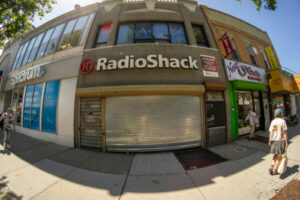
Feature Photo: Former RadioShack store on Steinway Street in Astoria, Queens. rblfmr / Shutterstock.com
New York City once had an electronics-store culture all its own. Before online shopping and national big-box chains came to dominate the market, New Yorkers bought televisions, stereos, radios, cameras, appliances, computers, turntables, speakers, and electronic parts from stores whose names became part of everyday city life.
Some of these businesses were noisy discount chains driven by unforgettable television commercials. Others were serious hi-fi shops where customers spent hours comparing amplifiers and speakers. Lower Manhattan’s Radio Row became a destination for technicians and hobbyists, while stores on Canal Street, Park Row, 45th Street, Queens Boulevard, Fordham Road, Fulton Street, and other commercial strips gave each part of the city its own electronics-shopping landmarks.
This is not a ranking. It is a look back at 25 electronics, stereo, appliance, camera, and technology retailers whose original New York City stores have disappeared. In a few cases, a company name survives online or in another form, but the New York storefronts and retail experiences remembered here are gone.
1. Crazy Eddie
Era: 1969–1989 for the original business; the Crazy Eddie name was adopted in the early 1970s
New York City Connection: Brooklyn origins, followed by stores in Manhattan, the Bronx, Queens, and throughout the metropolitan area
Few electronics retailers became as deeply embedded in New York popular culture as Crazy Eddie. Eddie Antar and members of the Antar family built the business from a Brooklyn electronics operation into a regional discount chain that sold televisions, stereos, VCRs, cassette decks, car audio equipment, records, tapes, and other consumer electronics.
The stores became famous because of their relentless radio and television advertising. Spokesman Jerry Carroll delivered the commercials at breakneck speed, ending with the unforgettable declaration that Crazy Eddie’s prices were “insane.” Behind the advertising, however, the company was hiding serious financial problems. Federal regulators accused Eddie Antar and other executives of manipulating the company’s financial records, and the original Crazy Eddie chain collapsed into bankruptcy and liquidation in 1989.
2. J&R Music World and Computer World
Era: 1971–2014
New York City Connection: Park Row opposite City Hall in Lower Manhattan
Joseph and Rachelle Friedman founded J&R in 1971, and the business grew into one of Lower Manhattan’s great retail institutions. What began as a small audio operation eventually spread across multiple neighboring storefronts on Park Row, creating separate departments for records and CDs, computers, cameras, musical instruments, home audio, car stereos, and other electronics.
J&R felt different from the suburban electronics superstores. Its downtown location, crowded departments, enormous inventory, knowledgeable employees, and proximity to City Hall made it a destination for New Yorkers as well as visitors from around the world. After forty-three years on Park Row, the main J&R retail operation closed in April 2014.
3. Nobody Beats the Wiz
Era: 1977–2003
New York City Connection: Founded in New York City, with major stores across the five boroughs
Founded in 1977 by brothers Stephen, Lawrence, Marvin, and Douglas Jemal, The Wiz became one of the most recognizable electronics chains in the New York metropolitan area. The business grew from New York City into a regional powerhouse selling televisions, stereos, computers, video equipment, music, and home-entertainment products.
The company’s advertising slogan, “Nobody Beats the Wiz,” became so familiar that it eventually became part of the store’s identity. The chain also became highly visible through sponsorships connected with New York sports. After a period of rapid expansion, The Wiz filed for bankruptcy protection in 1997. Cablevision acquired the chain in 1998 and continued operating stores under The Wiz name before closing the remaining locations in 2003.
4. Tops Appliance City
Era: 1970–2000
New York City Connection: Queens, Brooklyn, and Manhattan stores during its metropolitan expansion
Les Turchin founded Tops Appliance City in New Jersey in 1970, but by the 1990s the company’s huge showrooms had become part of the New York City electronics wars. Tops entered New York State with a Westchester store in 1992, opened on Long Island in 1993, and added a Queens location in 1994. It later expanded farther into New York City, including Brooklyn.
Tops combined major appliances with televisions, home audio, computers, and other electronics in enormous destination stores. Its aggressive pricing and advertising made it a direct competitor to The Wiz, Crazy Eddie’s successors, P.C. Richard, and the national chains moving into the region. Rapid expansion and weak sales eventually caught up with the company. Tops filed for Chapter 11 bankruptcy protection in 2000 and disappeared from the retail landscape.
5. Uncle Steve
Era: Remembered as a Canal Street electronics fixture by at least the 1980s and 1990s
New York City Connection: Canal Street, Lower Manhattan
Canal Street once offered a completely different kind of electronics-shopping experience. Instead of giant polished superstores, customers encountered narrow storefronts packed with stereos, televisions, car-audio equipment, speakers, parts, cables, and boxes of merchandise stacked wherever space could be found.
Uncle Steve was one of the stores that helped define that atmosphere. A 1990 New Yorker portrait of Canal Street described Uncle Steve as a television-and-stereo shop whose owner voiced his own radio commercials. For New Yorkers who remember Canal Street before internet shopping transformed the electronics business, stores like Uncle Steve represented the city’s old cash-and-carry electronics culture at its most colorful.
6. Lafayette Radio Electronics
Era: Lafayette name from 1931–1981; company roots extended into the early 1920s
New York City Connection: Lower Manhattan’s Radio Row and later Manhattan and outer-borough stores
Lafayette Radio Electronics grew from the early New York radio business founded by Abraham Pletman. The Lafayette name appeared in the early 1930s, and the company eventually became one of America’s best-known electronics retailers and mail-order businesses.
For New York hobbyists, Lafayette was much more than a place to buy a television. Its catalogs and stores carried stereo receivers, speakers, turntables, amateur-radio equipment, CB radios, microphones, test equipment, vacuum tubes, electronic components, kits, and countless small parts. The company expanded nationally but entered bankruptcy in 1981, ending one of the longest-running names in New York electronics retailing.
7. Lyric Hi-Fi
Era: 1959–2021 at its famous Lexington Avenue location under the Mike Kay era and successors
New York City Connection: 1221 Lexington Avenue on the Upper East Side
Lyric Hi-Fi represented the other end of New York’s electronics market. Instead of bargain counters and shouting commercials, Lyric became an internationally respected destination for serious high-end audio. Mike Kay acquired the business in 1959 and moved it to 1221 Lexington Avenue, where it remained for decades.
Lyric’s listening rooms introduced generations of customers to premium amplifiers, speakers, turntables, and audio systems. The store became closely associated with manufacturers including Audio Research, Magnepan, Mark Levinson, and many other names that shaped high-end audio. Lyric closed its Lexington Avenue showroom in 2021, ending one of New York’s longest-running audiophile institutions.
8. Harvey Electronics
Era: Founded in 1927; stand-alone retail stores closed in 2008
New York City Connection: Radio Row origins and later Midtown Manhattan showrooms
Harvey Electronics began as Harvey Radio in 1927 on Manhattan’s Radio Row. Founder Harvey Sampson built the business around radio parts and electronic equipment before the company evolved into a sophisticated high-end audio, video, and home-theater retailer.
For years, Harvey’s Midtown stores were among the city’s best-known places to audition premium components and custom home-theater systems. The company eventually expanded outside Manhattan, but financial trouble led to Chapter 11 bankruptcy protection in 2007. Harvey closed its remaining stand-alone stores in 2008 as it shifted away from the traditional retail model.
9. Grand Central Radio
Era: Mid-20th century through at least the 1980s
New York City Connection: 124 East 44th Street near Grand Central Terminal
Grand Central Radio served commuters, radio enthusiasts, shortwave listeners, and serious electronics hobbyists from its Midtown location near Grand Central Terminal. Unlike the later appliance superstores, Grand Central Radio was closely tied to the specialized radio and communications side of the electronics business.
Period advertisements listed major amateur-radio brands including Drake, Kenwood, Yaesu, Atlas, Ten-Tec, and Midland. For New Yorkers interested in ham radio and communications equipment, Grand Central Radio was one of the places where knowledgeable counter service still mattered as much as price.
10. Leonard Radio
Era: Radio Row era through the later 20th century
New York City Connection: 69 Cortlandt Street, later Warren Street and Midtown Manhattan
Leonard Radio was one of the best-known electronics businesses on Cortlandt Street during the height of Radio Row. When the neighborhood was condemned for construction of the World Trade Center, Leonard Radio did what several surviving merchants attempted to do: it relocated.
A 1968 advertisement announced that Leonard had moved after thirty-seven years of serving customers with FM and stereo equipment. The company maintained a downtown location on Warren Street and a Midtown store on Sixth Avenue, carrying televisions, radios, appliances, and stereo components.
11. Heins & Bolet
Era: 1920s–mid-1960s
New York City Connection: 68 Cortlandt Street on Radio Row
Heins & Bolet was one of the anchor businesses of Radio Row. Its large Cortlandt Street store sold radios, televisions, appliances, records, electronic parts, and other equipment, with enough space to feel almost like an electronics department store.
The business became known for an enormous inventory, listening and demonstration areas, repair service, and competitive pricing. Like the rest of Radio Row, Heins & Bolet disappeared when blocks of Lower Manhattan were cleared for the World Trade Center during the 1960s.
12. 47th Street Photo
Era: 1967–1997
New York City Connection: West 47th Street and later additional Manhattan locations
Despite its name, 47th Street Photo became much more than a camera store. Founded in 1967, it helped popularize the high-volume discount electronics model in New York. Customers climbed into crowded salesrooms looking for cameras, televisions, audio equipment, watches, computers, and whatever new electronic gadget had just reached the market.
The business also developed a national mail-order following. By the 1980s, 47th Street Photo was doing enormous business with bargain hunters who tolerated crowded counters and fast-moving salespeople in exchange for aggressive prices. Financial and legal problems eventually overwhelmed the company, and the remaining operation closed in 1997.
13. Audio Exchange
Era: Active by the early 1950s and remembered through the later hi-fi era
New York City Connection: Jamaica, Queens; Flatbush, Brooklyn; and other metropolitan locations
Audio Exchange helped popularize a concept that serious stereo buyers now take for granted: trading used components toward new equipment. Period audio-industry material described the company as a dealer in new and fully guaranteed used high-fidelity components.
By the 1950s, Audio Exchange operated at 159-19 Hillside Avenue in Jamaica and 836 Flatbush Avenue in Brooklyn, while also maintaining suburban locations. For working New Yorkers who wanted better equipment without paying full new-component prices for every part of a system, the trade-in model made high fidelity more accessible.
14. Newmark & Lewis
Era: 1924–1992
New York City Connection: Queens and other New York metropolitan shopping districts
Newmark & Lewis was founded in 1924 by Edward Newmark and Richard David Lewis and grew into one of the New York area’s largest electronics and appliance retailers. Although headquartered on Long Island, the chain became a familiar name to city shoppers through stores in Queens and throughout the metropolitan market.
The company sold televisions, camcorders, compact-disc players, refrigerators, washers, air conditioners, and other electronics and appliances. It expanded aggressively but struggled with intense price competition and heavy debt. Newmark & Lewis closed its remaining stores in 1992.
15. Friendly Frost
Era: Active by the early 1950s through the later 20th century
New York City Connection: Jamaica, Bay Ridge, Staten Island, Fordham Road, the Grand Concourse, and other locations
Before the arrival of the giant electronics superstores, Friendly Frost was a familiar New York appliance chain. By 1951, the company was already operating multiple stores in New York City and the surrounding metropolitan area.
Friendly Frost sold refrigerators, air conditioners, television sets, radios, and stereo systems to generations of city families. Stores appeared in Queens, Brooklyn, Staten Island, and the Bronx, and the company became prominent enough to own radio stations for a time. The Friendly Frost retail name eventually disappeared as the regional appliance business became increasingly dominated by larger chains.
16. Trader Horn
Era: Mid-20th century–1990s
New York City Connection: New York metropolitan appliance and electronics stores, including Staten Island and other city-market locations
Trader Horn was another name from the era when local and regional chains fought constantly over television, stereo, and appliance prices. Government retail records listed Trader Horn Appliance Stores operating in New York by the early 1960s, and the company remained part of the fiercely competitive metropolitan electronics market for decades.
By the 1980s and early 1990s, Trader Horn was competing against names such as Crazy Eddie, The Wiz, Newmark & Lewis, and P.C. Richard. Trader Horn of New York entered Chapter 11 bankruptcy protection in 1994, marking the end of another once-familiar regional electronics name.
17. Two Guys
Era: 1946–1982
New York City Connection: Large discount stores serving New York City shoppers, including locations in the city market
Two Guys was not exclusively an electronics retailer, but electronics and appliances were a major part of what made its giant discount stores memorable. Founded by brothers Herbert and Sidney Hubschman in New Jersey in 1946, Two Guys grew into an early discount-store powerhouse with locations across the New York metropolitan region.
Shoppers could find televisions, stereos, radios, air conditioners, appliances, automotive goods, hardware, and household merchandise under the same roof. Parent company Vornado gradually withdrew from retailing, and the remaining Two Guys stores disappeared by 1982.
18. Sixth Avenue Electronics
Era: 1984–2011
New York City Connection: Founded on Sixth Avenue in Manhattan
Brothers Billy and Leon Temiz opened Sixth Avenue Electronics on Manhattan’s Sixth Avenue in 1984, with their brother Mike later joining the business. The store eventually expanded into a regional chain specializing in televisions, audio systems, cameras, home theater, and other consumer electronics.
Sixth Avenue later shifted much of its growth into suburban New Jersey and other markets, but its identity remained tied to its Manhattan beginnings. Financial problems and creditor pressure brought the retail chain down in 2011, when its final stores entered liquidation.
19. Arrow Radio
Era: Retail roots beginning in 1935; later evolved into electronics distribution
New York City Connection: Cortlandt Street on Radio Row
Long before Arrow Electronics became a global technology-distribution company, it began as a small New York City retail store. Maurice “Murray” Goldberg founded Arrow Radio on Cortlandt Street in 1935, selling used radios and radio parts to walk-in customers on Radio Row.
Arrow later sold new radios and home-entertainment equipment while continuing to stock electronic components and surplus parts. The company eventually moved away from consumer retailing and transformed itself into the enormous industrial electronics distributor known today. The old Arrow Radio storefront belongs to a very different chapter of the company’s history.
20. Davega Stores
Era: 1879–1963
New York City Connection: Manhattan origins with later stores in Brooklyn, Queens, Times Square, and across the metropolitan area
Davega Stores predates nearly every other retailer on this list. The business began in Manhattan in 1879 and eventually developed into a chain selling appliances, sporting goods, radios, televisions, and other consumer products.
By the middle of the 20th century, Davega operated stores across New York City and the surrounding region. A new Times Square store opened at 152 West 42nd Street in 1954, advertising deeply discounted radios and reconditioned television sets. Financial trouble eventually forced Davega into bankruptcy in 1963, and several locations were acquired by Modell’s.
21. RadioShack
Era: New York City storefront era through the 2010s
New York City Connection: Dozens of neighborhood stores across all five boroughs
RadioShack was never exclusively a New York company, but few national electronics chains became as deeply woven into neighborhood shopping. For decades, New Yorkers used nearby RadioShack stores for batteries, cables, adapters, telephone accessories, CB radios, scanners, electronic parts, computers, and small consumer electronics.
When RadioShack entered bankruptcy in 2015, 68 New York City store leases were placed on the market, including 25 in Manhattan and numerous locations in Brooklyn, Queens, the Bronx, and Staten Island. The brand has survived in other forms, including online, but the dense network of neighborhood New York City RadioShack stores is gone.
22. Circuit City
Era: New York City presence from the 1980s and again during the big-box era through 2009
New York City Connection: Manhattan, Brooklyn, and other city locations
Circuit City’s New York story actually began before the chain became a national big-box giant. In 1981, the company acquired several remaining Lafayette Radio stores and attempted to enter the New York market under the Lafayette/Circuit City name. That first effort ended in the mid-1980s.
Circuit City returned to New York during the national superstore boom and operated major locations around the city. When the company liquidated in 2009, nearly a dozen New York-area stores closed, including multiple locations in Manhattan and Brooklyn. The shutdown left behind some of the largest vacant retail spaces created by the Great Recession.
23. CompUSA
Era: New York City big-box computer era through the late 2000s
New York City Connection: Major Manhattan locations including 420 Fifth Avenue
As home computers became essential household products, CompUSA offered a different kind of electronics store. Its large Manhattan stores carried desktop computers, laptops, printers, monitors, software, networking gear, storage devices, computer parts, and accessories.
The Fifth Avenue location became one of the chain’s busiest New York stores and even hosted one of Apple’s early store-within-a-store concepts before Apple opened its own retail stores. The original CompUSA chain eventually closed most of its locations during the late 2000s, leaving another major gap in Manhattan’s once-crowded technology-retail scene.
24. Rabsons
Era: Roots in the early 20th century; active as a New York audio-video retailer through the late 20th century
New York City Connection: 119 West 57th Street and other New York-area locations
Rabsons began as a New York radio business operated by brothers David and Meyer Rabinowitz and later became a respected camera, audio, and electronics retailer. By the 1920s, the company was already selling radio equipment and experimenting with the growing home-movie market.
Decades later, Rabsons remained a familiar name to New Yorkers shopping for quality audio and video equipment. In 1986, The New Yorker visited the West 57th Street store while researching camcorders and praised the advantage of knowledgeable salespeople who could explain complicated electronics to ordinary customers. That combination of expertise and personal service made Rabsons a classic old-school New York electronics store.
25. Tech Hi-Fi
Era: Original chain from the 1960s–mid-1980s
New York City Connection: More than a dozen stores in and around New York City, including a Broadway location near Columbia University
Tech Hi-Fi became one of the most important specialty stereo chains of the 1960s and 1970s. Its stores were built around knowledgeable salespeople, component systems, and the belief that customers should be able to compare receivers, amplifiers, turntables, and speakers before putting together a system.
The original chain eventually grew to more than eighty stores, with more than a dozen in and around New York City, before recession and aggressive discount competition forced it out of business in the mid-1980s. The Tech Hi-Fi name has since been revived by a separate modern audio business in Massachusetts, but the original New York City chain and its neighborhood showrooms belong to the classic hi-fi era.
Readers who remember these stores can continue exploring New York retail history with our look at 20 legendary Long Island electronics, stereo and appliance stores we miss, the history of TSS Times Square Stores, the history of Korvettes, and the history of Loehmann’s.
Sources
U.S. Securities and Exchange Commission — 1989 Annual Report and Crazy Eddie Enforcement Action
TWICE — Tops Appliance City and Les Turchin
CoStar — Tops Appliance City Opens in Brooklyn
Stereophile — Lyric Hi-Fi and Mike Kay
TWICE — Harvey Electronics History
Quarter Century Wireless Association — The Death of New York’s Radio Row
Smithsonian National Museum of American History — Heins & Bolet Radio Row Artifact
The Washington Post — 47th Street Photo
FM Guide — Leonard Radio Advertisement, 1968
Audio Magazine — Audio Exchange, 1954
Ephemeral New York — Friendly Frost
Arrow Electronics — Company History and Radio Row Origins
The Real Deal — RadioShack’s 68 New York City Locations
The Real Deal — Circuit City’s New York City Store Closings
The New Yorker — Rabsons and New York Electronics Shopping
Tech Hi-Fi — History of the Original Chain
Published September 1, 2026.