Photo: Erik Calonius, U.S. Environmental Protection Agency / National Archives, Public Domain
The street corners of New York City were once crowded with a physical, noisy, tactile universe of mechanical infrastructure. Long before smartphones consolidated communication, news, navigation, banking, and commerce into a device that fit in your pocket, navigating a sidewalk meant interacting with cast iron, stamped steel, glass, paper, and mechanical coin slots.
These objects defined the visual texture and daily cadence of life across the five boroughs. You leaned against them while waiting for a light, fished loose coins from your pocket to operate them, and learned neighborhood street geography by their presence.
The following ten fixtures, machines, and street-level systems were once familiar pieces of New York life before being dismantled, standardized, modernized, or pushed toward extinction by new technology.
1. Aluminum Public Payphone Banks
Peak Era: 1960s–1990s
What Replaced Them: Mobile phones and LinkNYC kiosks
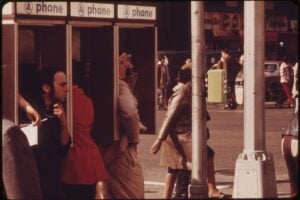
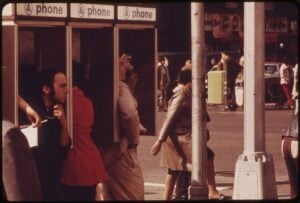
Decades before smartphones, New York street corners featured banks of brushed-metal payphones. You pushed coins into the slot, balanced a thick black plastic receiver on your shoulder, and listened to the dial tone while buses roared past on the avenue. They were shelters during sudden downpours, hubs for urgent late-night calls, and familiar neighborhood gathering points.
On May 23, 2022, workers removed the city’s last remaining free-standing public payphone installation near Seventh Avenue and West 50th Street in Midtown Manhattan, a symbolic end to the sidewalk payphone era. A handful of preserved or privately operated payphones remained, but the citywide replacement had already shifted toward New York City’s LinkNYC network, which provides free Wi-Fi, phone calls, and other digital services.
2. Old-School Sidewalk Newsstands
Peak Era: Early 1900s–2000s
What Replaced Them: Standardized street-furniture newsstands and digital media
Occupying prime real estate near subway stairs and busy intersections, old-school newsstands were run by neighborhood fixtures who knew their regular commuters. The stands were visual explosions of print: daily newspapers, magazines, foreign-language publications, candy bars, chewing gum, lottery tickets, and cheap umbrellas when rain clouds rolled in.
The newsstand itself did not vanish from New York, but the wildly individual sidewalk structures largely did. Beginning with the city’s coordinated street-furniture program in the 2000s, older stands were replaced with standardized stainless-steel-and-glass designs. At the same time, the long decline of print circulation transformed the business that had once made a street-corner newsstand feel indispensable. Our history of New York newspapers looks more closely at the print culture that once filled these stands.
3. Mechanical Pull-Down Fire Alarm Telegraph Systems
Peak Era: Late 1800s–20th century
What Replaced Their Former Role: 911, mobile phones, and modern emergency communications
Bolted to curbs throughout the five boroughs were cast-iron fire alarm boxes and pedestals painted bright red. Older pull-box systems used mechanical and electrical signaling equipment to transmit the alarm box location to the Fire Department. For generations, knowing the nearest street box could matter during an emergency.
This is one case where the old street fixture did not completely disappear. Red FDNY street alarm boxes still survive in New York, and the city still recognizes and maintains them as emergency-reporting equipment. What largely vanished was their former central role in everyday emergency reporting and the old telegraph-era technology associated with them. The telephone, 911, cellular service, and modern electronic systems changed how New Yorkers summon help.
4. Newspaper Vending Honor Boxes
Peak Era: 1970s–2000s
What Replaced Them: Digital subscriptions, news websites, and mobile apps
Clusters of spring-loaded steel newspaper boxes once crowded major intersections, often chained to poles and street signs. You dropped coins into the mechanical mechanism, pulled open the heavy spring-hinged door, and grabbed a copy of the Daily News, the New York Post, The Village Voice, or another local paper.
The honor system was part of the charm. Once the door opened, nothing physically stopped a customer from taking more than one copy. As digital news grew and print circulation fell, the boxes became less valuable, while street-management and maintenance concerns made large clusters of them less welcome on crowded sidewalks. One by one, they stopped being part of the normal New York corner.
5. Single-Space Mechanical Parking Meters
Peak Era: 1950s–2010s
What Replaced Them: Multi-space Muni-Meters, pay-by-plate meters, and mobile parking apps
Parallel parking along an avenue once meant pulling up beside a solitary gray cast-metal pole topped with a mechanical meter. Drivers kept rolls of quarters in their glove compartments or center consoles, fed coins into the meter, and turned the handle to register their minutes. If you overstayed your time, a bright mechanical flag reading “VIOLATION” or “EXPIRED” appeared behind the curved glass.
New York City gradually replaced those single-space meters with multi-space Muni-Meters. The modernization continued with mobile payment and, beginning in 2024, a citywide transition toward pay-by-plate meters. The old one-car, one-pole meter that once repeated itself block after block has disappeared from the modern streetscape.
6. Subway Token Booths and Token Turnstiles
Peak Era: 1953–2003
What Replaced Them: MetroCard, followed by OMNY contactless payment
At countless street-corner subway entrances, you descended into the station and headed for the booth to buy your fare. Bills went through the opening in the glass, and brass subway tokens came back. Then came the familiar clink of dropping a token into a mechanical turnstile before pushing through.
The subway token arrived in 1953 and remained one of New York’s most recognizable everyday objects for half a century. The MetroCard was introduced to replace it, and token acceptance in the subway ended in 2003. Today, OMNY contactless payment has pushed the system another generation forward. The change is especially striking at some of the oldest subway stations still operating in New York City, where century-old architecture now meets tap-and-go fare technology.
7. Street-Corner Horse Drinking Troughs
Peak Era: 1870s–1920s
What Replaced Them: Motor vehicles and a city built around automotive traffic
Before automobiles took over New York’s streets, horses provided an enormous share of the city’s transportation and hauling power. By 1910, New York City counted roughly 128,000 horses. Keeping that population watered was a practical necessity, especially during hot weather.
Public and privately funded drinking troughs appeared at busy streets and gathering points so draft horses, carriage horses, and other working animals could drink. Some were substantial stone or cast-iron fixtures built to withstand constant use. As trucks, automobiles, buses, and other motor vehicles displaced working horses, the troughs lost their purpose. Some survived as monuments or decorative planters, but they vanished as ordinary working infrastructure.
8. Wide-Opening Postal Collection and Package Boxes
Peak Era: Late 1800s–late 1900s
What Replaced Them: Modern high-security collection boxes and other postal drop-off options
Street corners once featured a wider variety of postal collection equipment than most New Yorkers see today. Early letter boxes were joined by larger ground-standing collection boxes and separate package boxes. Their colors changed repeatedly over the decades before the Postal Service standardized the familiar dark blue collection box in 1970.
The biggest change is not that street collection boxes disappeared entirely, but that many older, more open designs did. Mail theft helped force another round of redesign. Criminals learned to “fish” envelopes out of boxes using lines coated with sticky substances, leading the Postal Service to retrofit security devices and, in some locations, replace traditional collection boxes with higher-security models featuring much narrower slots.
9. Blue “Humpback” Street Signs
Peak Era: 1910s–1960s
What Replaced Them: Standardized reflective street-name signs
Before modern standardized street signs, New York corners had a much more varied visual identity. Among the most memorable were the dark blue “humpback” street signs used in Manhattan and the Bronx beginning in the early 20th century. Their white lettering identified the street, while the raised hump carried the name of the cross street.
The humpback signs remained in use for decades before newer generations of standardized street-name signs took over. Today’s familiar green-and-white signs, along with brown signs in many historic districts and other special designs, are easier to manufacture, maintain, and read consistently. An original humpback sign surviving in place is now a genuine piece of old New York street archaeology.
10. Curbside Coal-Ash Cans
Peak Era: 1880s–mid-20th century
What Replaced Them: Changing heating fuels and modern waste collection systems
For much of New York’s history, coal heat produced a waste stream that modern residents rarely think about: ash. Apartment houses, tenements, brownstones, businesses, and other buildings generated heavy quantities of coal ash that had to be hauled out and collected along with the city’s other refuse.
Building superintendents and janitors carried ash containers to the curb, and the old Department of Street Cleaning devoted enormous effort to collecting and disposing of ashes. The work belonged to the same evolving sanitation system that eventually produced the famous White Wings and Colonel George Waring’s sanitation reforms. As coal heating declined and the city’s heating and waste systems changed, dedicated curbside ash cans disappeared from everyday life. The clang of metal containers and the fine gray dust that came with them became another lost piece of the old New York streetscape.
Street Corner Summary
| Disappeared Object or System | Peak Era | Primary Function | Modern Replacement |
|---|---|---|---|
| Aluminum Payphone Banks | 1960s–1990s | Public voice calls | Mobile phones and LinkNYC |
| Old-School Newsstands | Early 1900s–2000s | Print sales and small goods | Standardized newsstands and digital media |
| Mechanical Fire Alarm Telegraph Systems | Late 1800s–20th century | Street-level emergency reporting | 911, cellular service, and modern systems |
| Newspaper Honor Boxes | 1970s–2000s | Coin-operated print distribution | Digital subscriptions and news apps |
| Single-Space Parking Meters | 1950s–2010s | Coin-operated curb parking | Multi-space and pay-by-plate meters, mobile apps |
| Subway Tokens and Token Turnstiles | 1953–2003 | Transit fare payment | MetroCard, then OMNY |
| Horse Drinking Troughs | 1870s–1920s | Water for working horses | Motorized transportation |
| Wide-Opening Postal Boxes | Late 1800s–late 1900s | Letter and package collection | Higher-security collection boxes |
| Blue Humpback Street Signs | 1910s–1960s | Street and cross-street identification | Standardized reflective street signs |
| Curbside Coal-Ash Cans | 1880s–mid-20th century | Coal-ash disposal | Modern heating and waste systems |
For more pieces of the New York that vanished from everyday life, read 10 Lost Sounds of Old New York You Rarely Hear Anymore, 10 New York Traditions That Vanished Almost Without a Trace, and 10 Old-Fashioned Street Jobs That Once Defined New York City.
Sources
- EquityNYC — LinkNYC Kiosks
- New York City Department of Transportation — Coordinated Street Furniture
- NYC311 — Fire Alarm Box Complaint
- FDNY — Certificate of Fitness Study Materials: Street Alarm Boxes
- New York City Department of Transportation — Parking Meters
- New York Transit Museum — Tokens and Turnstiles: Subway Fare Through Time
- NYC Municipal Archives — Horsepower: The City and the Horse
- United States Postal Service — Collection Box History
- United States Postal Service — Improving Collection Box Security
- Forgotten New York — Manhattan-Bronx Classic Humpback Street Signs
- NYC Municipal Archives — Street Cleaning and Ash Disposal
Published September 5, 2026.