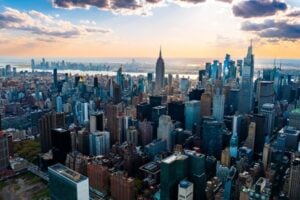
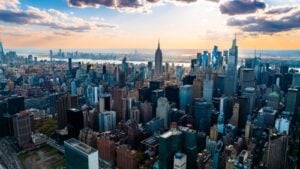
New York City skyline. Photo: Terelyuk / Shutterstock
Few cities on earth have collected as many aliases, historical names, personifications, and affectionate labels as New York. Some began as satire, some grew out of horse racing or literature, and others emerged from politics, popular culture, immigration, or the city’s sheer economic and cultural power.
Not every name on this list began as an official nickname. A few were once actual names of the city, while others became cultural shorthand for particular eras or ways of seeing New York. Together, they reveal how generations of New Yorkers and outsiders tried to describe a city that has never been easy to sum up in a single phrase.
Here are 20 of the most famous names and nicknames associated with New York City and the stories behind them.
1. The Big Apple
Key Date: 1921
Associated With: John J. Fitz Gerald of The Morning Telegraph
Few New York nicknames have generated more folklore than “The Big Apple.” Stories have linked the phrase to everything from apple sellers to brothels, but the strongest documentary trail leads to horse racing. Sportswriter John J. Fitz Gerald used “the big apple” in The Morning Telegraph in May 1921 while writing about New York racing.
Fitz Gerald later explained that he had heard African American stable hands in New Orleans use the expression for New York’s racetracks, where the biggest purses and prestige could be found. His better-known explanation appeared in 1924, several years after his earliest documented use. The term later circulated among jazz musicians and was revived dramatically in the 1970s by New York’s tourism campaign. Our article The Many Reasons Why New York City Is Called the Big Apple examines the nickname in greater depth.
2. Gotham
Key Date: 1807
Associated With: Washington Irving and Salmagundi
Long before Batman, “Gotham” belonged to New York. Washington Irving and his collaborators used the name in the satirical periodical Salmagundi in 1807. Irving drew on the English legend of the Wise Men of Gotham, villagers traditionally portrayed as fools, or as people pretending to be foolish in order to outwit authority.
Applied to New York, the name began as satire aimed at the city’s pretensions. Over time, however, the insult lost much of its sting. Gotham became one of New York’s most durable literary names and eventually acquired the darker, grander associations familiar from comic books and film. We explore that history in Why Is New York Called Gotham? History of the Iconic Nickname.
3. The City That Never Sleeps
Key Date: Early 1900s
Associated With: New York’s round-the-clock street life, transit, work, and entertainment
The idea of New York as a city that never sleeps was already circulating in print before 1912. Newspapers used versions of the phrase in the first decade of the 20th century, when electric lighting, late-night entertainment, all-night work, and rapid transit were transforming the rhythm of city life.
The nickname became even more deeply embedded in popular culture after the song “New York, New York,” written by John Kander and Fred Ebb for the 1977 Martin Scorsese film. Frank Sinatra recorded his famous version in 1979, helping make the image of a sleepless New York familiar around the world.
4. The Empire City
Key Date: 1830s
Associated With: New York’s rise as the nation’s commercial center
“The Empire City” emerged as a civic label during the 19th century as New York’s population, port, finance, and commerce expanded at extraordinary speed. A documented newspaper use appeared in 1836, when New York was described as the “Empire City of the New World.”
The phrase is often connected to George Washington’s earlier description of New York as a future “seat of empire,” but Washington did not simply coin “Empire City” as a New York City nickname. By the canal era, however, the title made perfect sense. The Erie Canal tied the Atlantic port to the interior, while Wall Street, shipping, trade, and immigration pushed New York beyond its regional rivals.
5. Fun City
Key Date: 1966
Associated With: Mayor John V. Lindsay
“Fun City” became one of New York’s most ironic nicknames almost overnight. John V. Lindsay took office as mayor on January 1, 1966, just as a transit strike shut down the city’s subway and bus system. Lindsay nevertheless insisted that New York was still a fun city.
The press seized on the phrase. What might have sounded optimistic quickly became a perfect vehicle for New York sarcasm as the city endured strikes, crime, blackouts, fiscal trouble, and political turmoil. “Fun City” became both a joke and a badge of resilience. For more on the mayor whose first day helped launch the nickname, see John Lindsay, History of New York City Mayors.
6. The Five Boroughs
Key Date: 1898
Associated With: The consolidation of Greater New York
“The Five Boroughs” is more a civic shorthand than a nickname in the traditional sense, but no phrase defines modern New York City’s geography more clearly. On January 1, 1898, the modern city was created by consolidating Manhattan, Brooklyn, Queens, the Bronx, and Richmond, later known as Staten Island, under one municipal government.
Brooklyn had been an independent city, while the areas brought into Greater New York retained strong local identities. The borough system gave the consolidated city a way to function as one enormous municipality without erasing those distinctions. More than a century later, New Yorkers still identify themselves as strongly by borough as they do by city.
7. The Melting Pot
Key Date: 1908–1909
Associated With: Israel Zangwill’s play The Melting Pot
The phrase “melting pot” existed before Israel Zangwill, but his play The Melting Pot gave the metaphor enormous cultural power. The play, set in New York and centered on immigrants building new lives in America, premiered in Washington, D.C., in 1908 and reached Broadway the following year.
The metaphor described America more broadly, not New York alone. Yet no American city embodied it more visibly than New York during the great immigration era. Ellis Island, the Lower East Side, Brooklyn, Harlem, and dozens of other neighborhoods became places where languages, religions, foods, occupations, and traditions collided and changed one another.
8. Metropolis
Key Era: 19th century onward
Associated With: New York’s scale and status as America’s leading city
“Metropolis” is not uniquely a New York nickname. The word has long been used for a large and important city. By the 19th century, however, newspapers, books, and guidebooks were regularly describing New York as the American metropolis or the nation’s great metropolis.
The word later gained a second layer of pop-culture meaning through Superman’s fictional city of Metropolis. That comic-book city is not simply another name for New York, but generations of readers and artists have inevitably associated its towering skyline and big-city energy with New York.
9. Knickerbocker and the Knickerbockers
Key Date: 1809
Associated With: Washington Irving’s fictional historian Diedrich Knickerbocker
Washington Irving gave New York one of its most enduring names when he published A History of New-York in 1809 under the persona of Diedrich Knickerbocker. Irving had even created a publicity hoax around the supposedly missing old historian before the book appeared.
The name became shorthand for New Yorkers, particularly families associated with the city’s Dutch heritage, and then spread into clubs, publications, hotels, clothing, and sports. The New York Knickerbockers basketball team eventually shortened the name to the Knicks, keeping a literary joke from 1809 alive in Madison Square Garden.
10. The Capital of the World
Key Era: 1940s
Associated With: E.B. White and New York’s postwar global role
Calling New York the “Capital of the World” may sound like hometown boasting, but the phrase captured a dramatic change in the city’s international position after World War II. In 1946, the United Nations chose New York for its permanent headquarters, placing global diplomacy on the East River.
Writer E.B. White reinforced the idea in his celebrated 1949 book Here Is New York, written as the city was becoming an unmatched meeting place for finance, publishing, art, entertainment, immigration, diplomacy, and international business. The history of the institution that helped make that claim plausible can be found in our History of the United Nations Headquarters in New York.
11. New Amsterdam
Key Era: Dutch colonial period, 1620s–1664
Associated With: The Dutch West India Company and New Netherland
New Amsterdam was not merely a nickname. It was the Dutch colonial settlement from which New York City developed. Dutch colonization of the area began in the 1620s, Fort Amsterdam was established at the southern tip of Manhattan, and in 1653 New Amsterdam received formal municipal government.
The English seized the settlement in 1664 and renamed it New York in honor of James, Duke of York. The Dutch name nevertheless remains one of the most recognizable reminders that New York’s European colonial history did not begin as an English story.
12. New Orange
Key Era: 1673–1674
Associated With: The brief Dutch recapture of New York
New York briefly stopped being New York in 1673. During the Third Anglo-Dutch War, Dutch forces retook the former New Amsterdam from the English and renamed it New Orange.
The change lasted only about a year. The Treaty of Westminster returned the colony to English control in 1674, and the name New York came back. New Orange survives as one of the strangest and shortest-lived names in the city’s history.
13. The Naked City
Key Date: 1945
Associated With: Weegee’s photography book Naked City
Photographer Arthur Fellig, better known as Weegee, made a career out of photographing New York after dark: crime scenes, fires, crowds, tenements, nightlife, and people caught in moments that were anything but polished. His 1945 book Naked City gave that raw vision a memorable name.
The title was later used for the 1948 film noir The Naked City and the television series that followed. Over time, “The Naked City” came to suggest an unvarnished New York stripped of glamour and exposed at street level.
14. Fear City
Key Date: 1975
Associated With: The Council for Public Safety
“Fear City” was born during one of New York’s worst fiscal crises. In 1975, threatened layoffs of thousands of municipal workers led a coalition representing police officers, firefighters, and other public-safety employees to produce a pamphlet called Welcome to Fear City.
The pamphlet warned visitors about crime, reduced services, and the consequences of budget cuts. Copies were distributed to tourists, including arrivals at JFK Airport. The campaign was political propaganda, but the name stuck because it matched the national image of a city struggling with crime, abandonment, and near-bankruptcy in the 1970s.
15. The Concrete Jungle
Key Era: Late 20th century into the 21st century
Associated With: Urban imagery and popular music
“Concrete jungle” was not invented as a nickname for New York. The phrase was already used more generally to describe dense, hard-edged urban environments, and Bob Marley and the Wailers used it as the title of a 1973 song without making New York its subject.
The expression became especially attached to New York in modern popular culture, most famously through Jay-Z and Alicia Keys’ 2009 hit “Empire State of Mind.” It works because the image is instantly recognizable: towers, pavement, crowds, ambition, pressure, and possibility packed into a narrow urban landscape.
16. The Center of the Universe
Key Date: 1957
Associated With: Mayor Robert F. Wagner Jr. and New York’s global ambitions
New Yorkers have rarely been accused of excessive modesty, and “The Center of the Universe” captures that confidence perfectly. In a 1957 profile, Mayor Robert F. Wagner Jr. described New York, with the United Nations now established there, as the center of the universe.
The phrase has also long been applied to Times Square, where Broadway, advertising, tourism, transportation, television, and enormous crowds converge in a few blocks of Midtown. That overlap makes the label feel less like an official nickname than a recurring New York boast that refuses to disappear. Our History of Times Square in New York City explores the place most often associated with that larger-than-life claim.
17. The Modern Gomorrah
Key Era: Mid-1870s
Associated With: Reverend Thomas De Witt Talmage
Not all New York nicknames were compliments. In the mid-1870s, the famous Brooklyn preacher Thomas De Witt Talmage denounced New York as a “modern Gomorrah,” drawing on the biblical city destroyed for wickedness.
The label reflected a long tradition of moral reformers portraying New York as a center of vice, drinking, prostitution, gambling, corruption, and dangerous entertainment. Later crusaders such as Anthony Comstock fit naturally into that movement, but the documented New York use of “Modern Gomorrah” is more securely associated with Talmage than with Comstock.
18. Baghdad-on-the-Subway
Key Era: Early 1900s
Associated With: O. Henry
O. Henry found his greatest subject in ordinary New Yorkers. After settling in the city, he filled his stories with clerks, shopgirls, policemen, dreamers, hustlers, lovers, and strivers, turning the streets into a stage for surprise and coincidence.
He famously referred to New York as “Baghdad-on-the-Subway,” a phrase that captured the city’s mixture of modern machinery and almost fairy-tale possibility. The subway supplied the modern part of the image; the Baghdad comparison suggested a place overflowing with stories, characters, mystery, and unexpected turns.
19. Father Knickerbocker
Key Date: 1877
Associated With: New York political cartoons and civic personification
Once “Knickerbocker” became a familiar New York identity, artists turned it into a person. In 1877, Puck published an early cartoon featuring “Father Knickerbocker” as a personification of New York City.
He developed into the city’s counterpart to Uncle Sam: an older Dutch-style gentleman who could represent New York in political cartoons, advertising, music, and civic imagery. By the early 20th century, audiences could recognize Father Knickerbocker without needing an explanation.
20. The City So Nice They Named It Twice
Key Date: 1959
Associated With: Jon Hendricks and George Russell’s New York, N.Y.
“New York, New York” is both the city and state written together in a postal address, but it also inspired one of the city’s most playful unofficial slogans. In 1959, vocalist and lyricist Jon Hendricks used the idea on George Russell’s jazz album New York, N.Y., describing New York as a city so nice that its name had to be said twice.
The line endured because it sounds exactly like New York advertising should sound: confident, funny, slightly excessive, and impossible to forget. It later circulated widely in tourism, comedy, popular speech, and souvenir culture.
The Complete Directory of New York City Nicknames
| Nickname or Name | Key Era | Source or Context | Underlying Meaning |
|---|---|---|---|
| The Big Apple | 1921 | John J. Fitz Gerald and horse racing | New York as the big-time destination |
| Gotham | 1807 | Washington Irving and Salmagundi | Satirical literary name that became civic shorthand |
| The City That Never Sleeps | Early 1900s | Press and popular culture | Round-the-clock urban life |
| The Empire City | 1830s | Commercial expansion | Economic and maritime power |
| Fun City | 1966 | Mayor John V. Lindsay | Optimism turned into New York sarcasm |
| The Five Boroughs | 1898 | Consolidation of Greater New York | The city’s five-part municipal identity |
| The Melting Pot | 1908–1909 | Israel Zangwill’s play | Immigration and cultural mixture |
| Metropolis | 19th century onward | New York’s national prominence | A dominant large city |
| Knickerbocker | 1809 | Washington Irving | Dutch New York identity |
| The Capital of the World | 1940s | E.B. White and the United Nations era | Global cultural and diplomatic importance |
| New Amsterdam | 1620s–1664 | Dutch colonial settlement | New York’s Dutch predecessor |
| New Orange | 1673–1674 | Brief Dutch recapture | Short-lived restoration of Dutch rule |
| The Naked City | 1945 | Weegee | Raw street-level New York |
| Fear City | 1975 | Public-safety unions | Fiscal crisis and urban fear |
| The Concrete Jungle | Late 20th century onward | Urban imagery and music | Density, pressure, ambition, and pavement |
| The Center of the Universe | 1957 | Mayor Robert F. Wagner Jr. and later Times Square usage | New York’s claim to global centrality |
| The Modern Gomorrah | Mid-1870s | Thomas De Witt Talmage | Moral condemnation of urban vice |
| Baghdad-on-the-Subway | Early 1900s | O. Henry | A modern city overflowing with stories |
| Father Knickerbocker | 1877 onward | Political cartoons | Personification of New York City |
| The City So Nice They Named It Twice | 1959 | Jon Hendricks and George Russell | Playful celebration of New York, New York |
For more on the names and identity of New York, read Naming Gotham, Who Does New York City Honor and Why?, How New York City Once Served as the Capital of the United States, History of the United Nations Headquarters in New York, and History of Times Square in New York City.
Sources
- New York Public Library — Why Is New York City Called the Big Apple?
- New York Public Library — So, Why Do We Call It Gotham, Anyway?
- The Big Apple — City That Never Sleeps
- Internet Broadway Database — The Melting Pot
- NYC Municipal Archives — A Charter for New Amsterdam
- United Nations — UN Headquarters: A Workshop for Peace
- International Center of Photography — Weegee’s Naked City
- NYC Municipal Archives — Welcome to Fear City
- NYC Municipal Archives — The Real Father Knickerbocker
- The New Yorker — When New York Was Really Wicked
- Smithsonian Magazine — O. Henry and New York
- The New Yorker — Mayor Robert F. Wagner Jr. and New York
- The Big Apple — New York, New York: So Nice They Named It Twice
Published September 5, 2026.