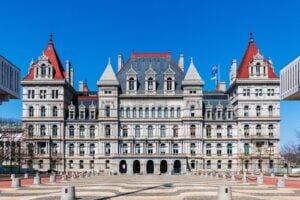
The New York State Capitol in Albany, which became the permanent seat of New York State government in 1797. Photo: E4 PLUS / Shutterstock.com
With New York City being the largest city in the United States, it might seem a little surprising that the capital of New York State is Albany. After all, New York City was once the capital of the entire country. Why, then, did the state government settle in a city roughly 150 miles to the north?
Albany became the permanent seat of New York State government in 1797 because of its favorable location along the Hudson River, its proximity to the Mohawk Valley, and the growing importance of communities beyond New York City. The decision also had roots in the American Revolution, when the British occupation of New York City forced the state’s founders to establish a government elsewhere.
Albany was not the first capital of New York State, however. That distinction belongs to Kingston. And in one of the more unusual twists in New York’s political history, the state did not explicitly designate Albany as its capital city in state law until 1971.
A State Born in Chaos
In September 1776, British forces took control of New York City, which had long been the administrative center of the colony. The occupation would last until November 1783. With the city unavailable to the revolutionaries, the men attempting to organize an independent New York government had to conduct their business elsewhere.
On April 20, 1777, New York adopted its first state constitution in Kingston. That summer, George Clinton became the state’s first governor, and in September, the newly elected legislature assembled in Kingston. The Senate met in a room rented from local merchant Abraham Van Gaasbeek. His house survives today as the Senate House State Historic Site.
Kingston’s time as the state’s first capital was remarkably short. On October 16, 1777, British troops commanded by Major General John Vaughan attacked the settlement as part of an expedition up the Hudson River. Hundreds of homes, barns, and other structures were destroyed. State representatives escaped to nearby Hurley, and the government subsequently conducted much of its business in Poughkeepsie.
New York continued to hold legislative sessions in different locations during the Revolution. The absence of a permanent meeting place was one of the practical difficulties of establishing a state government in the middle of a war. Even after independence, the legislature continued to meet in various communities rather than immediately settling on a single capital.
The Strategic Crossroads
Albany had already been an important center of trade for generations. The Dutch established Fort Orange in 1624, and the settlement that developed nearby became known as Beverwijck. After the English took control in 1664, it was renamed Albany. The city received its municipal charter in 1686, more than a century before it became the permanent state capital.
Albany’s great advantage was its position along the Hudson River, near the point where the Mohawk River joins it in the vicinity of Cohoes and Waterford. The Hudson provided a route south to New York City, while the Mohawk Valley offered access westward through the interior of the state. Routes north through the upper Hudson and Lake Champlain region connected Albany with the approaches to Canada.
These routes were of tremendous military importance during the Revolution. Albany was a supply center for American troops, but its location also made it a target. In 1777, British General John Burgoyne advanced from Canada with the intention of reaching Albany. Another British-led expedition moved east through the Mohawk Valley. Had the British gained control of this corridor, they could have severely disrupted communications between New England and the other states.
The American victory in the Battles of Saratoga prevented Burgoyne from reaching Albany. The British general surrendered on October 17, 1777, just one day after Kingston was burned. In a remarkable turn of events, Burgoyne subsequently stayed at the Albany home of American General Philip Schuyler as a prisoner of war.
Albany’s importance during the Revolution illustrates why the city was such a natural candidate to become the capital. Its location was not simply a matter of being farther inland. It connected several of the most important transportation and communication routes in New York.
Why Albany Was Chosen Over New York City
Once the Revolutionary War ended, New York City regained its place as a center of political activity. From 1785 to 1790, it served as the national seat of government, first under the Articles of Confederation and then under the United States Constitution. George Washington took the presidential oath of office at Federal Hall on Wall Street on April 30, 1789.
Yet the requirements of the federal government and those of New York State were not necessarily the same. The most practical location for a state capital had to take into consideration the needs of people living throughout New York, not just those in the state’s largest city.
New York City occupied the southeastern end of a state whose population was spreading north and west. Albany offered better access to many of those developing communities while maintaining its connection to the port of New York by way of the Hudson. It was not the geographical center of the state, but it was well situated within the transportation network of the late 18th century.
Albany was also an established city with merchants, lodging, public buildings, and experience accommodating the legislature. State lawmakers had first assembled there in 1780. By the 1790s, the political interests of the expanding western districts were becoming more significant, and the state was adjusting legislative representation to reflect those changes.
Historians Edwin G. Burrows and Mike Wallace, in their book Gotham: A History of New York City to 1898, identify several additional considerations surrounding the move, including the expense of living in New York City, epidemics, concerns about war, and the developing rivalry between upstate and downstate interests. The decision was more complicated than a contest between two cities. It reflected the changing geography and politics of an entire state.
Albany Becomes the Permanent Capital in 1797
In 1797, during the administration of Governor John Jay, Albany became the permanent home of the New York State Legislature. There was no magnificent Capitol building waiting for the lawmakers when they arrived. Instead, they assembled in Albany’s Stadt Huys, a municipal building that also housed local government and judicial functions.
Construction on the first dedicated state Capitol began in 1806. The building was completed in 1809, on a site now occupied by East Capitol Park. It served New York during a period of remarkable growth that transformed both Albany and the rest of the state.
The opening of the Erie Canal in 1825 further strengthened Albany’s position. Connecting the Hudson River with Lake Erie at Buffalo, the canal made it possible to move goods and passengers across the state far more efficiently. The canal did not exist when Albany was chosen as the capital, but its construction demonstrated the enduring importance of the transportation corridor that had helped make Albany an attractive location in the first place.
Building the New York State Capitol
By the middle of the 19th century, the original Capitol could no longer adequately accommodate the state’s expanding government. Construction of a replacement began in 1867. What followed was a lengthy and expensive architectural undertaking that involved several prominent architects, including Thomas Fuller, Leopold Eidlitz, Henry Hobson Richardson, and Isaac Perry.
In 1899, Governor Theodore Roosevelt declared the new Capitol complete. The building had taken 32 years to construct and cost approximately $25 million. Its elaborate stonework, monumental staircases, and distinctive mixture of architectural styles made it one of the most remarkable state government buildings in the country.
The New York State Capitol is still home to the Senate and Assembly. Along with the nearby Empire State Plaza, the State Education Building, and other government facilities, it reflects the enormous institutional growth that followed the decision to establish the capital in Albany.
Why 1971 Is Another Important Date in Albany’s History
Although Albany is universally recognized as having become New York’s capital in 1797, a curious legal detail remained unresolved for generations. As reported by Spectrum News in its Albany Archives series, an 1878 resolution had identified the Capitol building as the seat of government without explicitly designating the city itself as the state capital.
In June 1971, Governor Nelson Rockefeller signed legislation formally naming Albany the capital city. Assemblyman Charles Henderson of Hornell had advocated the measure during the period when the state was developing the massive Empire State Plaza complex.
Today, Section 1-a of the New York State Law expressly identifies Albany as the capital. The 1971 law did not move the government or establish a new capital. It simply put into statute a designation that had been understood in practice for 174 years.
New York City remains the state’s largest population center and its most internationally recognizable city. Albany, however, owes its position to a different set of circumstances. Its importance dates back to an era when rivers determined the movement of people, military supplies, and commerce. That geography, combined with the political needs of a growing state, helped establish Albany as the center of New York government more than two centuries ago.
For more on New York’s political and regional history, explore our complete list of New York State governors, the story of when New York City served as the capital of the United States, and our look at 25 famous people you didn’t know were from Albany.